Strict, Balanced or Flexible: How Much Freedom Should Your AI Reply Bot Have?
How much freedom should your AI reply bot have? The three answer modes explained, with the same question answered three ways and a safe path from Strict.
In this article
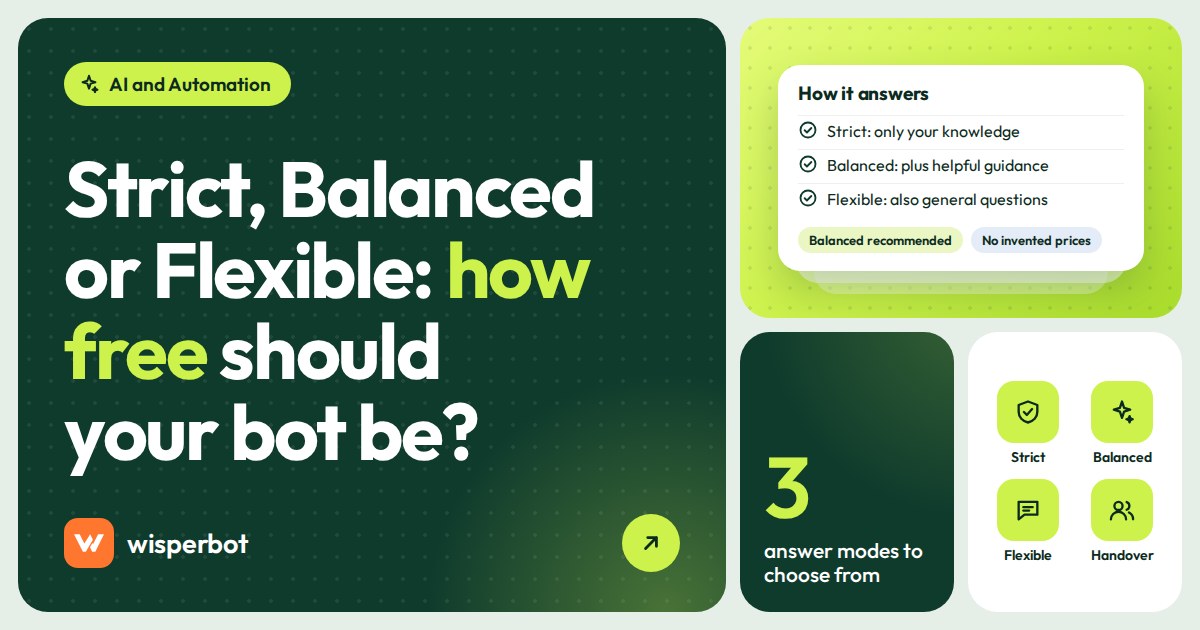
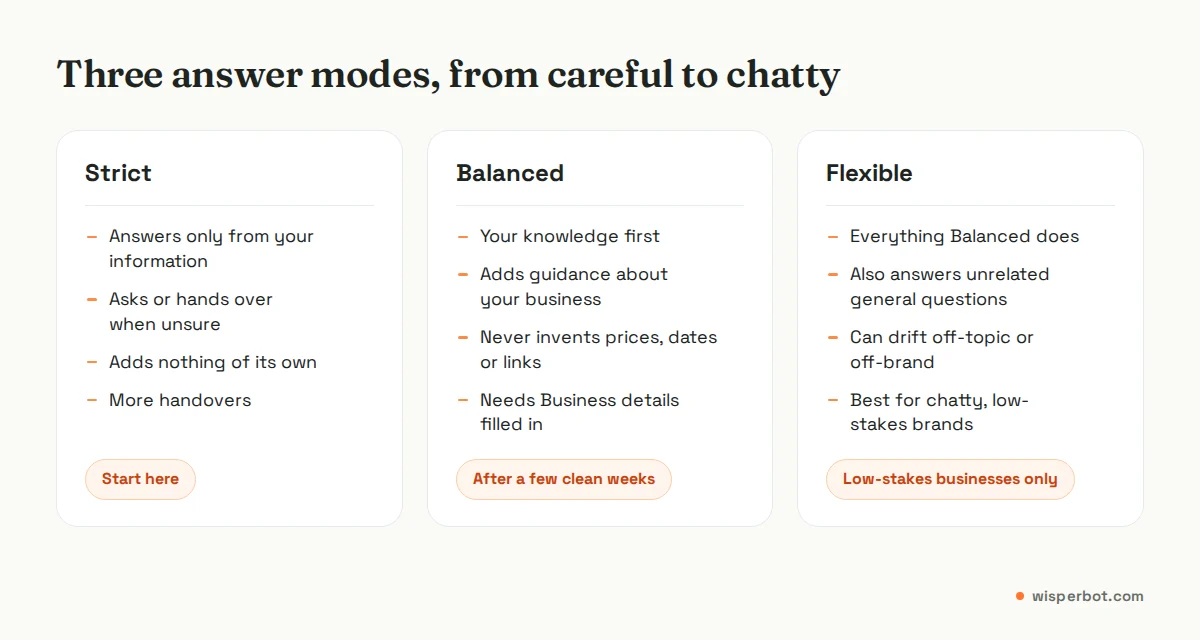
An AI chatbot's answer mode decides how far it may go beyond the information you gave it. In WisperBot, Strict answers only from your own knowledge and sends everything else to your team. Balanced uses your knowledge first, then adds helpful guidance about your business, and never invents prices, dates or links. Flexible does what Balanced does and also answers general questions unrelated to your business. The app marks Balanced as recommended, but most sellers should start on Strict, especially when prices, stock or policies are involved, and loosen the setting only after a few weeks of reviewing real answers.
Key takeaways
- The more freedom a bot has, the more questions it attempts and the more of each answer is worded by the bot rather than by you. No WisperBot mode invents prices, dates or links.
- Strict is the safest place to start for any business where a wrong price, date or policy costs money.
- Flexible also answers general questions unrelated to your business. That suits a chatty community brand, but it can drift off-topic and off-brand for a shop.
- A Canadian tribunal held Air Canada responsible for what its website chatbot told a customer (Moffatt v. Air Canada, 2024). Your bot's answers are your answers.
- When a bot hands over too often, fix the missing information first. Loosening the mode is the second step, not the first.
What do Strict, Balanced and Flexible mean?
They are three levels of freedom for an AI reply bot. In WisperBot's own words, Strict gives "only what your knowledge says. Anything else goes to your team." Balanced gives "your knowledge first, then helpful guidance about your business" and "never invents prices, dates or links". Flexible is "like Balanced, and also answers general questions unrelated to your business."
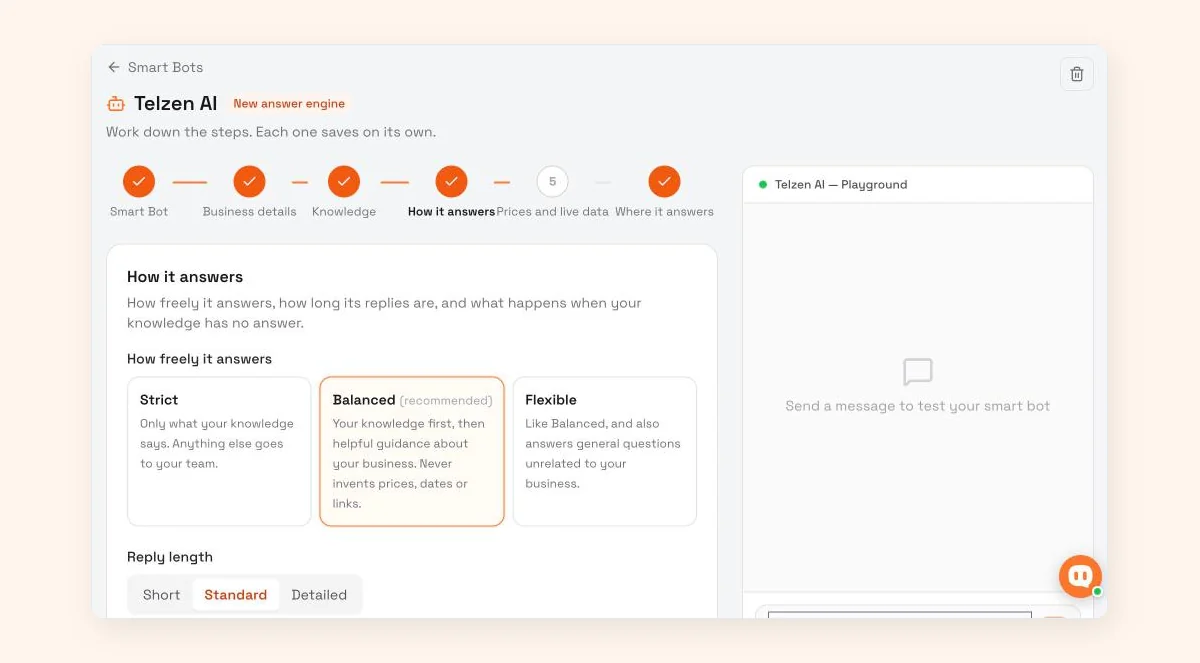
In WisperBot, a reply-first inbox for WhatsApp, Instagram, Messenger and website chat, this choice lives in step 4 of the Smart Bot setup, called "How it answers", under "How freely it answers", where the app marks Balanced as recommended. Below it, Reply length offers Short, Standard and Detailed. The six steps are: Smart Bot, Business details, Knowledge, How it answers, Prices and live data, and Where it answers. One catch: until your business name and description are filled in under Business details, Balanced answers like Strict, because it has nothing to base its guidance on.
A useful way to think about it: the mode controls how the bot behaves at the edges of your information. When the answer is clearly in your price list ("Black, size 38, 2,450 taka, in stock"), all three modes should say the same thing. The difference shows up when the customer asks something half-covered, or not covered at all.
Why does a bot's freedom matter so much?
Because customers treat a bot's answer as the business's answer, and so do courts. In February 2024 the British Columbia Civil Resolution Tribunal ordered Air Canada to pay a customer after its website chatbot described a bereavement fare refund that contradicted the airline's own policy page. A bot with room to improvise can create promises you never made.
The details are worth knowing. The chatbot told Mr Moffatt he could apply for a reduced bereavement fare within 90 days of his ticket being issued. Air Canada's bereavement travel page said the policy did not apply after travel was completed. The tribunal described Air Canada's position as suggesting the chatbot was a separate legal entity responsible for its own actions. The tribunal disagreed: "It should be obvious to Air Canada that it is responsible for all the information on its website." The award was C$812.02 including interest and fees.
That was an airline. For a Facebook seller in Dhaka the stakes look different but rhyme: a bot that says "Cash on delivery available everywhere" when you only offer COD inside Dhaka, or "Yes, free exchange within 15 days" when your policy is 7. The customer has the screenshot. In practice that kind of mistake usually comes from an old or missing line in your information rather than from the mode, which is why fixing the information comes first.
Same question, three modes
Here is one customer message and how each mode might answer it. The seller's information says: black and tan in stock, material is PU leather, delivery to Chattogram takes 3 to 5 days, and nothing about gift wrapping. The customer also tacks on a request that has nothing to do with the shop.
The message: "Ei bag ta black e ache? Real leather? Friday te Chittagong pabo? Gift wrap hobe? Ar amar boner birthday, ekta choto message likhe diben?"
| Part of the question | Strict | Balanced | Flexible |
|---|---|---|---|
| Black in stock? | "Yes, black is in stock." | "Yes, black is in stock. Shall I share the price?" | "Yes, black is in stock. Shall I share the price?" |
| Real leather? | "It's PU leather." | "It's PU leather, not genuine leather." | "It's PU leather, not genuine leather. PU is usually lighter and easy to wipe clean." |
| Friday delivery to Chattogram? | "Delivery to Chattogram takes 3 to 5 days. I'll ask the team about Friday." | "Delivery takes 3 to 5 days, so Friday depends on when you order. Our team can confirm the date." | "Delivery takes 3 to 5 days, so Friday depends on when you order. Our team can confirm the date." |
| Gift wrap? | "I'm not sure about gift wrapping. I'll pass this to our team." | "I don't have details on gift wrapping, so our team will confirm whether it's possible." | "I don't have details on gift wrapping, so our team will confirm whether it's possible." |
| Birthday message for her sister? | "I'll pass this to our team." | "That's outside what I can help with here, but I'm happy to help with the bag or your order." | "Of course: 'Happy birthday, apu! Wishing you a year as lovely as you are.'" |
Illustrative example of the kind of difference to expect, written by us. Actual wording varies and depends on your information.
Read across the rows. On the facts, all three columns agree: none of them promises a Friday date, because no mode invents prices, dates or links, and none offers a gift-wrap service the seller never mentioned. The differences are elsewhere. Balanced adds a helpful next step, such as offering the price or explaining what "3 to 5 days" means for Friday. Flexible adds general knowledge about PU leather and happily writes the birthday message.
That last row is Flexible's real risk. Here it is charming. For a clinic or a visa consultant, a bot that answers anything a customer asks, from cricket scores to homework, drifts off-brand fast, and each of those answers uses an AI reply from your plan.
The Strict column is plainer, and it hands over three times. That is the trade: more conversations for your team, and nothing said that you did not write.
Which mode suits which business?
Choose by asking how much you want the bot to say beyond your own words. If a price, date, dose or policy must be exact and approved, use Strict. If customers benefit from extra guidance around your information, Balanced fits. Flexible makes sense only when you are happy for the bot to chat about things unrelated to your business.
| Business | Typical questions | Starting mode | Why |
|---|---|---|---|
| Fashion or gadget page with price list | Price, size, stock, delivery charge | Strict | Prices and stock change weekly; a wrong number is a lost margin or an angry buyer |
| Clinic or diagnostic centre | Test prices, report times, fasting rules | Strict, permanently | Health questions need exact, approved wording (turn on "Use Knowledge Base wording exactly") and quick handover |
| Travel agency or visa consultant | Package prices, document lists, visa rules | Strict | Visa rules change and a wrong answer can cost a trip |
| Coaching centre | Fees, batch times, online or offline | Strict, then Balanced | Fees must be exact; general questions about teaching style can be looser |
| Software or app with long help docs | How do I do X | Balanced | Answers come from documentation and benefit from explanation |
| Café or community brand | Hours, location, menu, general chat | Balanced or Flexible | Low stakes; off-topic chat can be part of the brand |
Our guides for clinics and diagnostic centres and for after-hours replies both recommend Strict, for the same reason: when nobody is watching the inbox, you want the bot to say "I'll ask the team" rather than add guidance of its own. Coaching centres sit in between: fees must be exact, and our guide to answering admission questions for coaching centres and course sellers shows how to lay out batches, fees and instalments so the bot quotes only from that sheet.
How do you move from Strict to Balanced safely?
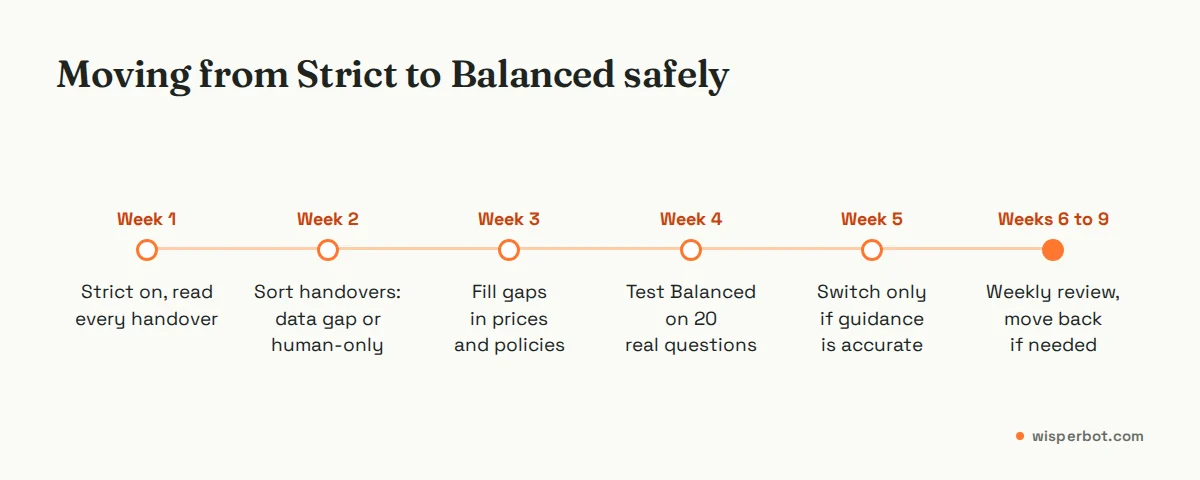
Treat it as a promotion the bot earns. Run Strict for at least two to three weeks, review handovers and answers every week, fill the gaps in your information, and only then switch to Balanced. Keep reviewing after the switch, and move back if new kinds of mistakes appear.
- Weeks 1 and 2, Strict. Read every handover. Each one is either a gap in your information (fix it) or a question that should always go to a person (leave it).
- Week 3, fill the gaps. Add missing products, synonyms and policies, and make sure your business name and description are filled in under Business details, or Balanced will simply answer like Strict. Our guide to writing a price list your chatbot can use covers the most common data gaps.
- Week 4, test Balanced privately. Send the bot 20 real questions from your inbox, including five it should not answer. Compare answers with what Strict gave.
- Switch only if the extra guidance is accurate. Friendlier wording is fine. Guidance that sounds like a policy you don't have is not.
- Review weekly for a month. Look for answers that sound confident but cite nothing you wrote.
You may never need to leave Strict. That is fine. A bot that answers 70% of questions correctly and hands over the rest is more useful than one that answers 90% and gets some of them wrong. (Those percentages are illustrative, not measured.)
A mode is not a fix for missing information
When a bot hands over too often, the instinct is to give it more freedom. Resist that. If customers keep asking about delivery to Sylhet and the bot keeps handing over, the fix is one sentence in your business details, not a looser mode. Balanced and Flexible won't invent a delivery time either; they will hand over or answer vaguely around the gap.
Check these first:
- Is the product in your price list under the name customers use? Add an other-names column.
- Are shop-wide policies (delivery areas and charges, payment methods, exchange rules) written in business details?
- Do customers write in Roman Bangla, Hinglish or Arabizi? The bot replies in the customer's language, but very short messages like "?" or "hm" can still fall back to a person whatever the mode.
- Is the question one a person should answer anyway, such as a complaint or refund?
Our guide on stopping an AI chatbot from making up prices and policies goes through these guardrails in more depth.
Where WisperBot fits
In WisperBot, you pick Strict, Balanced or Flexible in the "How it answers" step of the Smart Bot setup, and can change it later as the bot proves itself. Whatever the mode, your team can switch any conversation from AI to Human, and Reports show median first response time so you can see the effect. Two related settings help on Strict: "Use Knowledge Base wording exactly" keeps your approved wording for regulated or scripted answers, and marking one knowledge source as the "Official source" tells the bot which to follow when sources disagree. The app marks Balanced as recommended, and it is a sound default once your business details and knowledge are complete. For most sellers starting out, we'd still pick Strict.
Frequently asked questions
What is a chatbot answer mode?
It is a setting that controls how far an AI chatbot goes beyond the information you gave it. A strict mode answers only from your own data and hands over the rest. Looser modes add general guidance and, in WisperBot's Flexible mode, answers to unrelated questions. The mode does not add knowledge about your business.
Which AI answer mode is safest for prices?
Strict. In WisperBot no mode invents prices, dates or links, but Strict also adds nothing of its own: every answer comes from your price list and business details, and anything else goes to your team. It hands over more often, which is the right trade-off whenever a vague answer means a refund, a complaint or a lost margin.
Is it OK to use Flexible mode for customer service?
It can be, for brands where friendly chat about anything is part of the appeal, such as a café or community page. Flexible still won't invent your prices, dates or links, but it will answer general questions unrelated to your business, which can drift off-brand. Test it on 20 real questions before switching, and review answers weekly.
Is a business responsible for what its chatbot says?
In at least one published case, yes. In Moffatt v. Air Canada (2024), a British Columbia tribunal held the airline responsible for incorrect refund information its website chatbot gave a customer, and rejected the argument that the chatbot was responsible for itself. Treat your bot's answers as your own statements.
How long should I keep my bot on Strict mode?
At least two to three weeks, and longer if handovers still reveal gaps in your information. Move to Balanced only after a private test shows its extra guidance is accurate and on-brand. Staying on Strict permanently is a perfectly good outcome.
Sources
Last checked: 8 October 2026.