WhatsApp Auto-Replies for Clinics and Diagnostic Centres
Let a bot answer test prices, doctor schedules and report timings from your own information, and hand anything clinical or urgent to a person.
In this article
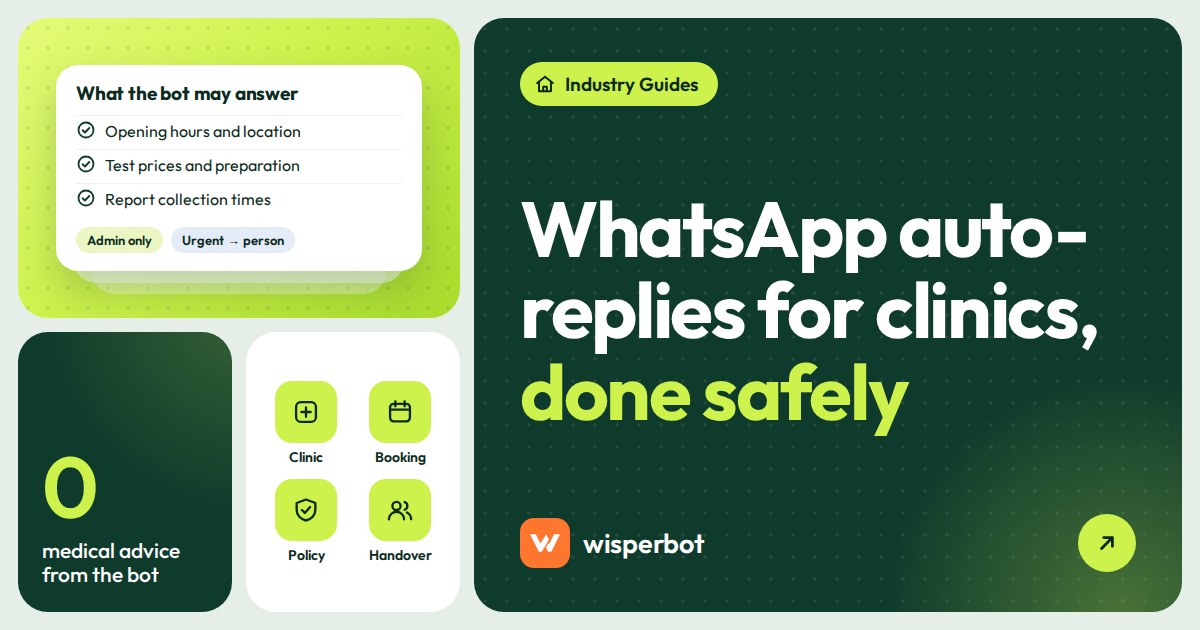
A WhatsApp chatbot for clinics and diagnostic centres should answer the admin questions that flood the front desk (test prices, opening hours, doctor schedules, report collection times, the preparation instructions your own doctors have written) and hand everything else to a person. It should never diagnose, interpret results or suggest medicines. Set it up that way and it takes the repetitive load off reception without going anywhere near medical advice.
Key takeaways
- Let the bot answer only administrative questions, from information your centre has written and approved.
- Symptoms, results, medicines and anything that sounds urgent go straight to a person, with your emergency instructions repeated word for word.
- WhatsApp's Business Messaging Policy says not to use WhatsApp for telemedicine, or to send or request health information where local rules require stronger safeguards.
- Meta's policy also requires automated chats to offer a "prompt, clear, and direct" route to a human.
- Strict answering mode and a price list from a sheet keep test prices from being guessed.
What do patients actually ask a clinic on WhatsApp?
Mostly logistics. Patients and their families ask what a test costs, whether a report is ready, when a particular doctor sits, whether they need to fast, and whether you collect samples at home. These questions repeat all day, have fixed answers your centre already knows, and rarely need a clinician to answer them.
Spend one morning reading through your WhatsApp and Messenger chats and you'll see the pattern. A typical run at a diagnostic centre in Dhanmondi might look like this:
- "CBC r lipid profile er dam koto?" at 7:15 am, before the counter opens.
- "Report kobe pabo? Sample dilam gotokal." from a son collecting for his father.
- "Dr. [name] ki shonibar boshen?" from someone trying to plan a day off work.
- "Fasting lagbe?" the night before a blood test.
- "Home collection Mirpur 10 e hoy?"
None of these needs a doctor. All of them need an accurate answer quickly, because a patient who can't get one by 8 am often books with the centre down the road. The trouble is that reception staff are also handling walk-ins, phones and payments, so WhatsApp gets answered in batches, often hours late.
What can a clinic chatbot safely answer, and what should it never touch?
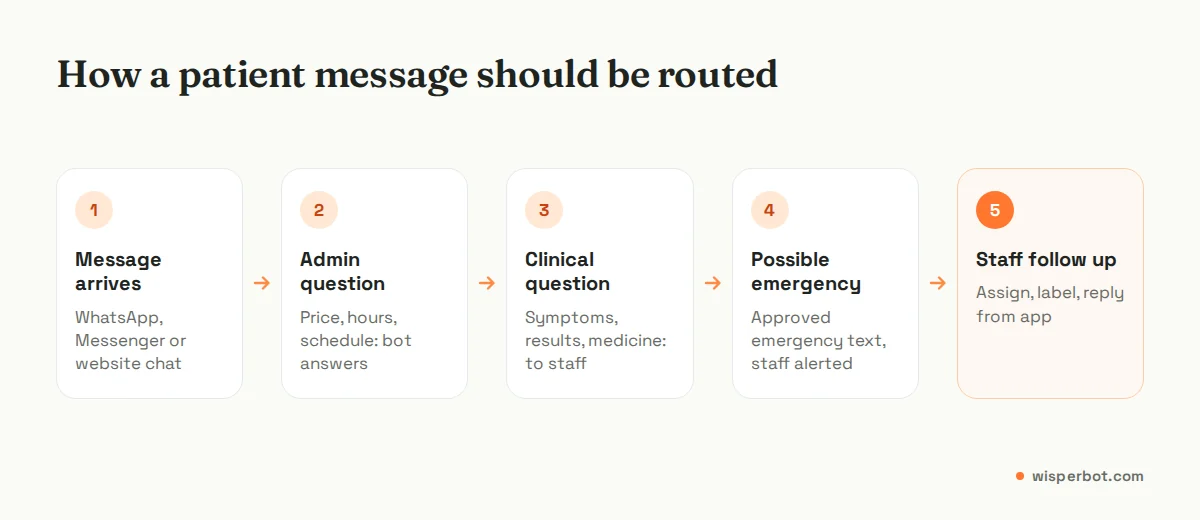
The line is simple: administrative facts your centre has published are fine, clinical judgement is not. The bot can quote a price, a timing or a written preparation sheet. It must not decide what a symptom means, whether a result is normal, which test someone needs or which medicine to take. Those go to staff.
| Question type | Example message | Bot answers? | What should happen |
|---|---|---|---|
| Test price | "Thyroid test er dam koto?" | Yes | Quote from your price list, including any home collection charge. |
| Opening hours and location | "Friday khola?" | Yes | Answer from business details, with branch address and map link. |
| Doctor schedule | "Dr. [name] kobe boshen?" | Yes, if kept current | Quote the published schedule; booking confirmation by staff. |
| Preparation instructions | "Fasting lagbe?" | Only word for word | Repeat your doctor-approved preparation sheet for that test, nothing more. |
| Report collection | "Report ready?" | General timing only | Give standard turnaround and how to collect; staff confirm a specific report. |
| Result meaning | "Amar sugar 9.2, eta ki beshi?" | Never | Hand to staff; patient is advised to discuss results with their doctor. |
| Which test or medicine | "Matha betha, ki test korbo?" | Never | Hand to staff; no suggestions from the bot. |
| Possible emergency | "Bukey betha korche" | Never | Reply with your emergency instructions and alert staff at once. |
Two rows deserve extra thought. Preparation instructions look harmless, but a fasting instruction from a bot that guessed is still a medical instruction, and a wrong one means a wasted sample or a patient who skipped a meal for nothing. Only let the bot repeat what your pathologist or doctors have written for each test, and if a test has no written sheet, the bot should hand over. Report status is the other one. "Reports are usually ready by 6 pm the next working day" is fine. Confirming that Mr Rahman's biopsy result is in, to whoever messages from a number, is not.
How should the bot handle urgent messages?
It shouldn't try to judge urgency at all. Your greeting and knowledge should say plainly that the chat is not for emergencies, give your emergency instructions (in Bangladesh, the national emergency number 999), and the conversation should be handed to a person immediately. Any doubt means a human looks at it now.
In practice that means three things:
- Say it up front. Put a line in your WhatsApp greeting and website chat: "This chat is for appointments, prices and reports. In an emergency, call 999 or go to the nearest emergency department."
- Give the bot the exact wording. Write your emergency message once, have a doctor approve it, and add it to the bot's knowledge so it repeats that text and nothing of its own.
- Make sure a human is watching. A handover at 2 am to an empty inbox is not a handover. If nobody monitors chats overnight, your night greeting has to say so clearly and point to the emergency number.
Know the limits here. A bot reading "bukey betha" (chest pain) in Roman Bangla, or a short "help pls", may not catch the meaning every time. That's exactly why the emergency line belongs in the greeting that every patient sees, not only in the bot's answers.
What does WhatsApp's own policy say about health information?
WhatsApp's Business Messaging Policy tells businesses not to use WhatsApp for telemedicine, or to send or request health-related information where applicable regulations prohibit sharing it on systems without heightened health-data protections. It also lists drugs and medical and healthcare products among goods that can't be sold through WhatsApp business messaging.
For a clinic, the practical reading is: use WhatsApp for appointments, prices, directions and "your report is ready for collection", not for consultations, prescriptions or sending results. Many centres already deliver reports through their own portal or at the counter. Keep doing that, and don't let the chatbot ask patients to type in symptoms, diagnoses or medical history.
The same policy requires that automated chats have "prompt, clear, and direct escalation paths" to a person, such as an in-chat transfer to an agent, a phone number or an email. A bot with no way out breaks Meta's rules, not only good practice.
What about patient privacy and data protection?
Health information is treated as sensitive in most data protection laws. Under UK GDPR, for example, "data concerning health" is special category data that needs extra protection and an additional legal condition. Collect as little as possible in chat, keep clinical details out of it, and get local legal advice on your obligations.
We're not lawyers and this isn't legal advice, but some habits make sense almost anywhere:
- Ask only for what the admin task needs: a name, a phone number, a preferred time. Not symptoms.
- Keep internal notes factual and short ("wants Saturday slot with Dr. [name]"). Notes are not a medical record.
- Decide who on your team can see the shared inbox, and remove access when people leave.
- Ask any messaging vendor, including us, where conversation data is stored and who can access it, before you connect a patient-facing number.
In Bangladesh, the interim government approved a Personal Data Protection Ordinance in October 2025, built around consent and limits on processing sensitive data. Check its current status and what it requires of you with a qualified adviser. In India, the UAE or Saudi Arabia, the rules differ again.
How to set up the bot for a diagnostic centre
This follows the same steps whichever tool you use. The names below are WisperBot's, because that's what we know best.
- Start with your test price list. Export it as a CSV or Google Sheet with test name, common short names (CBC, TSH, "sugar test"), price and home-collection charge. One row per test. A centre with 800 tests is well inside a 5,000-row sheet.
- Write the business details. Branches, hours per branch, Friday and holiday timings, parking, map links.
- Add knowledge carefully. Doctor schedules (with a "last updated" date), report turnaround times, how to collect reports, home collection areas, and the doctor-approved preparation sheets. Nothing you wouldn't print on a notice board. If an old schedule and a new one both end up in there, mark the current one as the Official source so the bot follows it when they disagree.
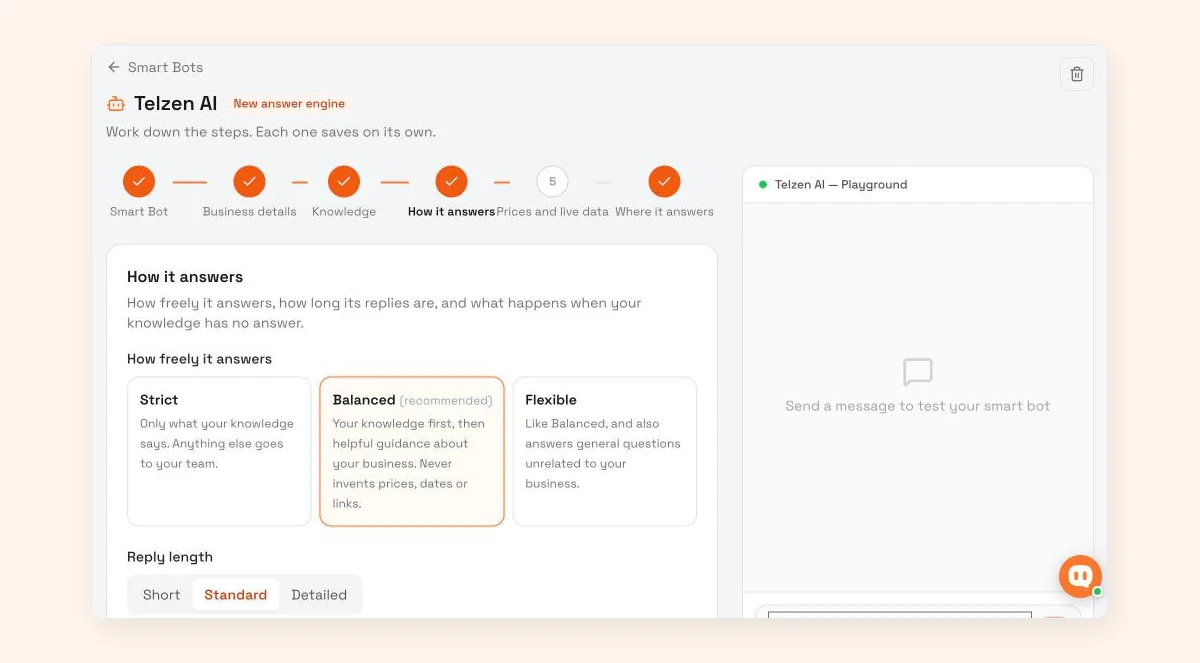
- Choose Strict mode. The bot answers only from your information and sends anything else to your team. Balanced, which the app marks as recommended, adds general guidance about your business, and Flexible also answers general questions unrelated to it, which for a clinic means health questions you don't want a bot touching.
- Add your emergency and "we can't advise on this" wording exactly as approved, and switch on "Use Knowledge Base wording exactly" so the bot keeps your approved text for these and the preparation instructions rather than rephrasing them.
- Run it on nights first. Use Scheduled answering for, say, 9 pm to 8 am, when nobody is at the desk anyway. Read every night conversation for two weeks before widening the hours.
Where WisperBot fits
WisperBot, a reply-first inbox for WhatsApp, Instagram, Messenger and website chat, works for the admin side of a clinic: a Smart Bot in Strict mode answers prices and timings from your sheet in seconds, and the AI/Human switch, assignment and labels let reception pick up anything clinical. Staff can do that from the agent app between walk-ins.
It is not a medical system. It doesn't diagnose, triage, store medical records or deliver lab reports, and you shouldn't use it to. If you need a patient portal or e-prescriptions, that's a different product. Skin and aesthetic clinics that take most bookings through Instagram should also read our guide to handling salon and spa bookings in Instagram DMs, which covers slot questions and booking links. For the wider picture of keeping answers grounded, read how to stop an AI chatbot making up prices and policies and our comparison of Strict, Balanced and Flexible bot modes.
Frequently asked questions
Is it OK for a clinic to use a WhatsApp chatbot?
Yes, for administrative questions like prices, timings, directions and report collection, as long as there's a clear route to a human. WhatsApp's policy says not to use it for telemedicine or to exchange health information where local rules demand stronger safeguards, so keep consultations, results and prescriptions out of the chat.
Can a chatbot tell patients whether they need to fast before a test?
Only by repeating preparation instructions your own doctors or pathologist have written and approved for that specific test. It should never work out fasting times by itself. If a test has no approved instructions in its knowledge, the bot should hand the question to staff rather than guess.
Should a diagnostic centre send test reports on WhatsApp?
We'd advise against using WhatsApp chat for the reports themselves. Use it to say a report is ready and how to collect or view it, then deliver results through your own secure channel or at the counter. Check what your local regulations require before sending any health information electronically.
What happens if a patient sends an emergency message at night?
Your greeting should already tell every patient the chat isn't for emergencies and give the emergency number, such as 999 in Bangladesh. The bot should repeat your approved emergency wording and hand over. If nobody monitors the inbox overnight, say that clearly in the night greeting.
How much does a WhatsApp chatbot for a clinic cost?
WisperBot's paid plans start at $15 a month for 750 AI replies, and Growth is $39 a month for 3,000, as of 8 October 2026. There's also a free plan with 100 AI replies. Meta's WhatsApp fees, where they apply, are separate. See the pricing page for current details.
Sources
- WhatsApp Business Messaging Policy (health information, escalation paths, prohibited goods)
- Information Commissioner's Office: Special category data (UK GDPR)
- Dhaka Tribune: Government approves Personal Data Protection Ordinance, 2025 (9 October 2025)
- Prothom Alo: 999 launched in Bangladesh (December 2017)
Last checked: 8 October 2026.