A White Label AI Chatbot Buying Checklist
Test branding scope, answer quality, human help, privacy, mobile use, and cost with a practical checklist before choosing a white-label chatbot.
In this article
Two chatbot products can both promise white labeling and deliver different things. One lets you change a footer name. Another includes a custom launcher image. A third sells a reseller platform with a branded domain.
Before comparing prices, decide which of those things you actually need. Then test the customer experience rather than relying on a feature tick.
WisperBot offers an editable footer company name on every tier, including Free. You can show “Powered by Your Brand” in the website chatbot. The checklist below helps you assess that specific benefit alongside the answer quality and operations a business still needs.
Write the requirement as a visible result
“We need white label” is not precise enough for a buying decision. “Our trading name must appear after ‘Powered by’ in the website widget” is something you can inspect.
Do the same for other requirements. If you want a custom launcher image, write that separately. If staff need a branded login domain, make it its own item.
Separate essentials from preferences. A small shop testing website chat may not need the same commercial arrangement as an agency serving several clients.
This makes comparisons fairer. You are asking each product to satisfy the same job rather than comparing broad labels that mean different things.
Use a scorecard that records evidence
A simple three-state score is enough for a first review: not demonstrated, partly demonstrated, or demonstrated. Add a note describing what you actually observed.
Do not total the scores blindly. A failure on an essential privacy or answer-quality requirement can outweigh several convenient features. Mark those essentials before the demonstration begins.
The table is a worksheet, not a published ranking of products. Fill it from your own tests and current commercial terms.
| Requirement | Evidence to request | Your result |
|---|---|---|
| Footer brand name | Your name shown in the public widget | Not tested / partial / demonstrated |
| Knowledge quality | Answers to your approved question set | Not tested / partial / demonstrated |
| Missing information | A useful response without invented facts | Not tested / partial / demonstrated |
| Human help | A request reaches the responsible teammate | Not tested / partial / demonstrated |
| Visitor privacy | Separate visitors cannot see each other's chats | Not tested / partial / demonstrated |
| Mobile usability | Real conversation on a narrow screen | Not tested / partial / demonstrated |
| Cost visibility | Plan limits and external charges explained | Not tested / partial / demonstrated |
| Maintenance | A source can be updated and retested | Not tested / partial / demonstrated |
Bring your own questions to the demonstration
A polished vendor example can show how a product is intended to work. It cannot prove that the bot will answer your business's questions accurately.
Prepare a small set from real enquiries, with personal details removed. Include a question whose answer is in your source, one that needs clarification, and one that should go to a person.
Add a misleading question. Ask about an offer you do not run or a service you do not provide. The bot should not invent an agreeable answer just because the request sounds plausible.
Score usefulness as well as correctness. An answer can contain the right facts and still leave the customer unsure what to do next. Read it as a visitor, not as someone who already knows the policy.
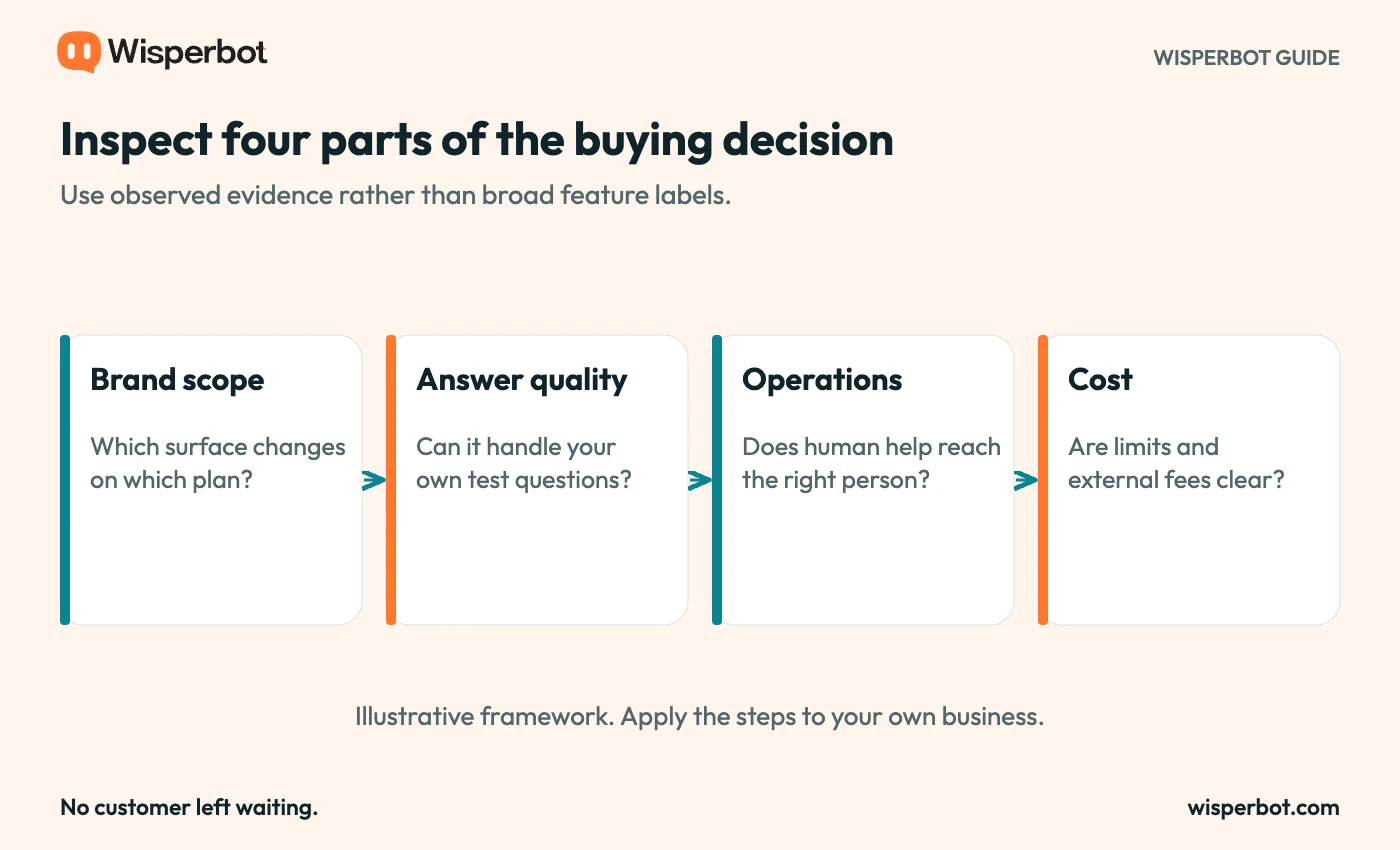
Evaluation framework only. No vendor scores or market rankings are implied.
Test the small branding detail directly
Create or open a widget and enter the intended company name. Save it, then inspect the actual website chat in a fresh session.
In WisperBot, the relevant field is Footer company name under Widget Setup, Appearance. The value appears after the standard “Powered by” prefix across all tiers.
Check the boundary as well as the benefit. The field does not remove the whole footer. A blank value falls back to WisperBot, and a custom launcher image has a separate paid entitlement.
These details matter more than a broad white-label badge in a comparison table. They tell you what the customer will actually see on the plan you intend to use.
Inspect handoff and privacy before the purchase
Ask for a person and follow the request into the team workflow. Who owns it? What does the visitor see while waiting? Can the teammate read the conversation before replying?
Repeat when the team is unavailable. The waiting message should reflect the real service hours rather than an optimistic default.
For visitor privacy, test separate browser sessions. A public website chatbot should not reveal one visitor's transcript to another. If the site identifies logged-in users, have the implementation team verify that identity and history behave correctly for that integration.
A good-looking widget does not establish any of these properties. They need their own checks.
Compare the whole operating arrangement
Ask how usage is counted, what happens at the allowance, and which services can bill separately. Keep the answers with the date of the review.
Then ask who maintains the knowledge after launch. A chatbot can become less useful if the website changes while its sources remain stale. The maintenance process belongs in the buying decision.
If an agency is involved, clarify account ownership and access. If several businesses will use the service, confirm the required workspace and commercial arrangement rather than assuming one free account covers everything.
Use the total-cost guide for the budget review and the agency guide when clients are part of the setup.
Decide with a short written reason
After testing, write one paragraph explaining the choice. Name the job, the essential requirements the product demonstrated, and any limitation the team accepts.
For a small pilot, the reason might be that the bot answers a defined set of policy questions, gives access to a person, and lets the business use its own footer name without an upgrade. That is more useful than declaring a product “best” for everyone.
Keep the test notes. When the business grows, they provide a baseline for deciding whether to change plans, expand the scope, or improve the knowledge.
Questions about choosing a white-label chatbot
Is white label a standard feature definition?
No. Ask which surfaces change, on which plan, and for which audience. Footer text, launcher images, domains, and reseller platforms are separate requirements.
Can I test my own brand tag on WisperBot Free?
Yes. The footer company name is editable on every tier. The standard “Powered by” line uses the name you enter.
Does a high score guarantee results?
No. The scorecard helps organise evidence for a specific job. Real outcomes still depend on the business information, traffic, configuration, and human service.
Start the evaluation with the WisperBot website chatbot and the setup walkthrough. Bring your own questions and make the product demonstrate the answer.