How to Measure Whether Your Branded Chatbot Helps
Measure chatbot answer quality, handoff completion, and useful outcomes. Use a clearly hypothetical sample to build a review without inflated success claims.
In this article
Your chatbot has the right name, a clear welcome, and a place on the website. Now comes the useful question: is it helping customers do anything they could not do as easily before?
The answer needs more than a count of messages. A busy conversation can still be confusing. A short conversation can end because the customer found the answer or because they gave up.
WisperBot lets you change the footer company name on every tier, including Free. That makes it possible to test a chatbot under your own brand tag from the beginning. Measure the service behind that tag with a few outcomes you can actually verify.
Choose the job before choosing the metric
Start with what the bot is meant to do. A delivery-policy assistant and an enquiry qualifier have different success conditions.
For policy questions, a useful outcome might be an accurate answer that explains the relevant next step. For service enquiries, it might be a relevant request passed to a person with enough context to respond.
Write the definition before reviewing results. Otherwise, it is easy to call whichever number increased a success.
Keep the scope narrow for the first review. If the bot handles delivery and returns, do not judge it against a goal of replacing the entire support team. The small-business pilot guide explains how to choose a manageable starting point.
Keep a small set of measures
Use separate measures for answer quality, human follow-up, and customer activity. They describe different parts of the service.
For accuracy, review a defined sample against the business sources. For handoff, count requests and completed follow-ups within a stated period. For activity, track the number of relevant conversations rather than celebrating every bot message.
If you measure response time, define the start and end events. An automated greeting and a substantive answer are not necessarily the same thing.
| Measure | Working definition | Interpretation limit |
|---|---|---|
| Reviewed useful answers | Sampled replies that meet your answer criteria | Requires consistent human review |
| Incorrect answers | Sampled replies that contradict approved facts | Keep severity visible, not only a percentage |
| Handoff completion | Requests receiving the agreed human follow-up | Routing alone is not completion |
| First substantive response | Time until a relevant answer is provided | A greeting may not answer the question |
| Relevant enquiries | Conversations matching your stated business need | Volume does not prove commercial value |
| Attributed outcomes | Events linked using a defined method | Association does not establish causation |
Use an illustrative review before building a dashboard
Suppose a hypothetical team reviews 100 chatbot conversations. It classifies 50 as useful answers, 25 as appropriate handoffs, 15 as unclear outcomes, and 10 as incorrect answers.
These numbers are invented to show the method. They are not WisperBot performance data, customer results, or an expected benchmark.
The categories add to 100 because each conversation receives one outcome in this example. Real reviews need a written rule for mixed cases, such as a useful opening answer followed by an incorrect claim.
The review immediately suggests different work. Incorrect answers need investigation. Unclear outcomes need a better definition or follow-up. Handoffs need a check that staff actually responded. Combining all three into “75% successful” would hide too much.
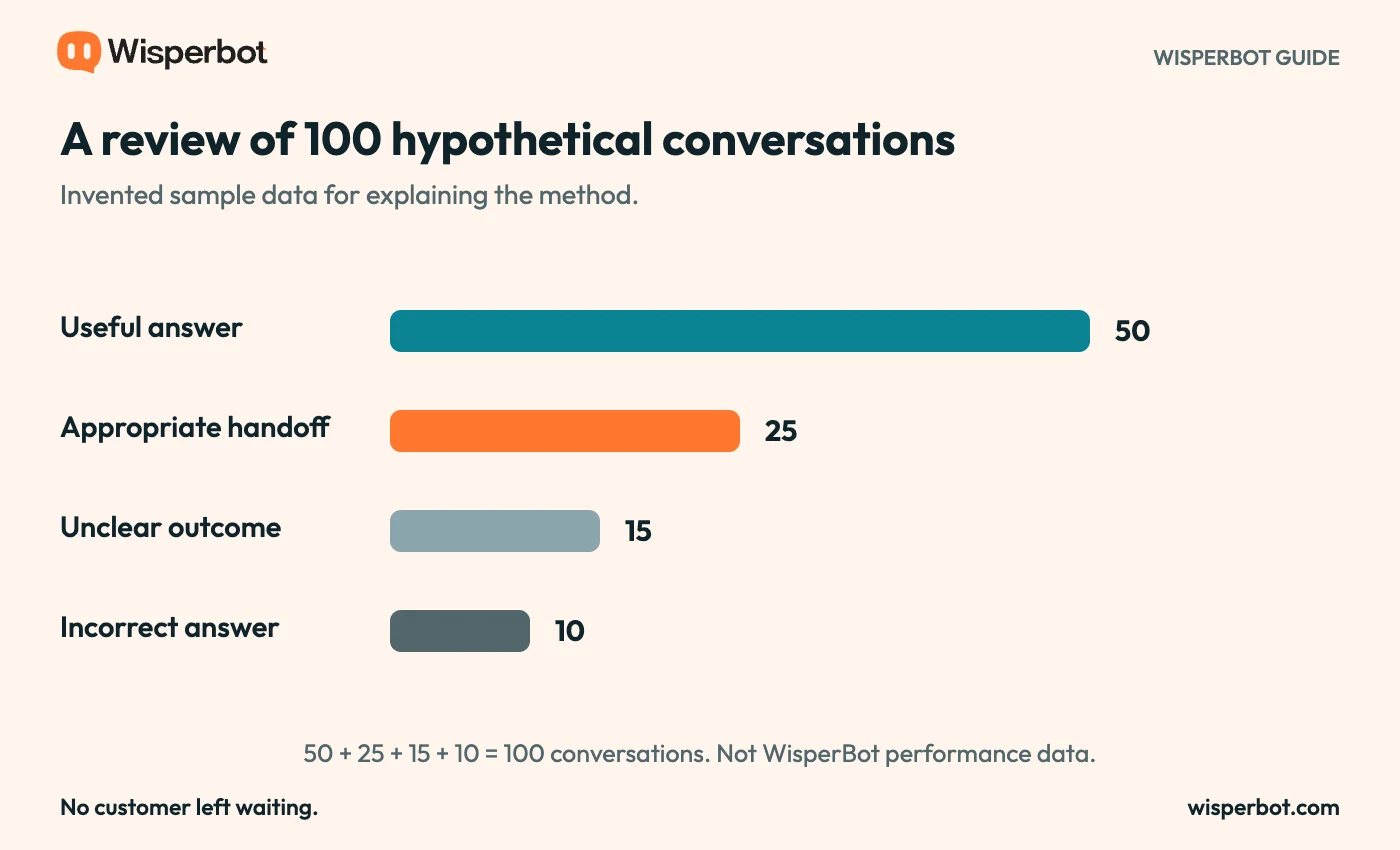
Illustrative data only. Categories total 100 conversations. These figures are not product results or a target.
Do not call silence a resolution
A customer who stops typing may have received the right answer. They may also have become distracted, switched channels, or abandoned the attempt.
If your reporting treats inactivity as resolution, state that definition clearly. Do not present it as verified customer success without further evidence.
Review a sample of ended conversations. Look for an explicit acknowledgement, a completed next step, or a follow-up outcome where one is available. Keep unknown cases unknown.
This discipline makes the results less dramatic and more useful. It helps the business decide whether to improve the source, the conversation design, or the human service.
Test branding separately from answer changes
If you want to learn whether the branded tag affects the experience, avoid changing the knowledge, welcome message, placement, and traffic campaign at the same time.
Keep the comparison as consistent as practical and record what changed. A small pilot may not have enough activity to support a confident conversion claim. You can still collect useful qualitative feedback.
Ask whether visitors understood whose service they had reached and whether they found the answer useful. Do not turn a handful of positive comments into a market-wide conclusion.
WisperBot's footer control lets you use your own company name on Free. The benefit is verifiable in the interface. Any effect on trust, enquiries, or sales needs its own evidence.
Connect outcomes carefully
If a conversation leads to a form submission or purchase, document how the link is made. Define the time window and whether the same visitor can be recognised appropriately across the journey.
Do not add personal information to public tracking URLs. Use campaign labels that describe the content or channel, and keep customer data inside the authorised systems that need it.
Compare similar periods and note promotions, traffic changes, and staffing differences. A busy sale week can change both the number and type of enquiries.
Describe the result at the strength the evidence supports. “These conversations were associated with later enquiries” is different from “the chatbot caused those enquiries”.
Turn the review into a short action list
At the end of each review, choose the most important fix. It might be an incomplete source, an unclear fallback, or a handoff without an owner.
Make the change and repeat the relevant test questions. Keep the earlier result so you can see whether the fix worked under the same conditions.
Use the buying checklist when the issue is a missing capability and the total-cost guide when capacity or operating effort is the constraint.
Questions about chatbot measurement
What should a small team measure first?
Start with answer quality and whether human handoffs receive follow-up. Those checks reveal service problems before a larger dashboard is useful.
Does my own brand tag prove the chatbot converts better?
No. It proves that the tag displays your chosen name. Commercial impact requires a separate measurement method and enough evidence to support the claim.
Are the chart numbers WisperBot results?
No. The sample is explicitly hypothetical and exists only to explain the review process. Replace it with your own reviewed data before presenting business performance.
Set up a WisperBot website chatbot, put your name in the footer tag, and define one useful customer outcome. That gives the pilot a clear purpose and the next review something meaningful to judge.