What a Free Branded Chatbot Actually Costs to Run
Compare chatbot subscription, AI usage, provider fees, and team time. See why an editable brand tag is separate from capacity and other paid features.
In this article
A chatbot can have a zero subscription price and still create work or usage costs. Someone prepares the knowledge, checks the answers, and handles the conversations that need a person. Connected services may charge separately.
That does not make a free plan misleading. It means the useful comparison is the cost of running the service you need, rather than the largest “Free” label on a page.
WisperBot makes one part straightforward: you can change the company name in the chatbot's brand tag on every tier, including Free. You do not need an upgrade just to show “Powered by Your Brand” in that footer text.
Separate four kinds of cost
Start with the platform subscription. This covers the plan you choose and its included capacity. Then identify usage costs, external provider charges, and the time your team spends operating the chatbot.
These categories behave differently. A fixed subscription is predictable. AI usage can vary with the actions performed. Staff review depends partly on source quality and the complexity of the requests.
Avoid collapsing them into one vague monthly number. If the pilot becomes expensive, you need to know whether the cause is conversation demand, a costly integration, or repeated manual correction of poor information.
The same logic applies to branding. An editable footer company name is a specific benefit. It should not be mistaken for free custom domains, unlimited AI, or every design feature.
| Cost category | What to record | What not to assume |
|---|---|---|
| Subscription | Actual plan and billing period | Free means every feature is included |
| AI usage | Credits used and the applicable rate | One credit always equals one conversation |
| Connected providers | Messaging, API, or gateway charges | The chatbot plan pays external bills |
| Team time | Setup, review, maintenance, handoff | Every automated answer saves equal time |
| Additional branding | Features beyond the editable tag | A footer name includes a custom domain |
Do the small recurring-cost calculation
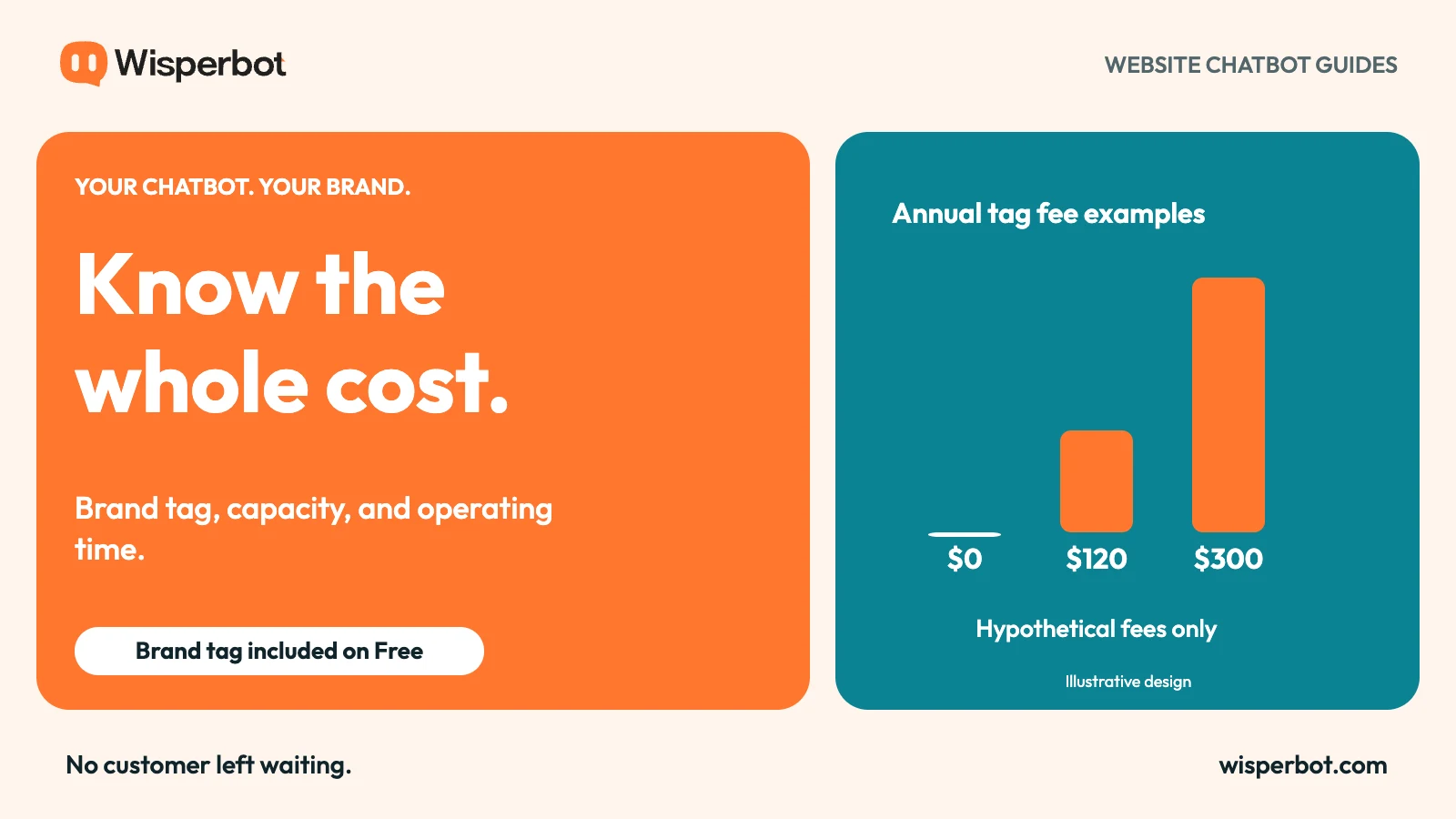
A monthly branding fee, where one applies, becomes a recurring annual expense. Multiplying by twelve is simple, but it helps reveal what a seemingly small line item means over time.
For illustration only, a hypothetical fee of $10 a month becomes $120 a year. A hypothetical $25 monthly fee becomes $300 a year. These are invented examples, not WisperBot prices or competitor quotes.
The editable WisperBot footer company name does not require that separate upgrade. The point is narrow: your business name in the tag can be part of the free pilot.
Do not turn the illustration into a claim that every customer saves $120 or $300. A saving depends on a real alternative, its actual terms, and what the business would otherwise have purchased.
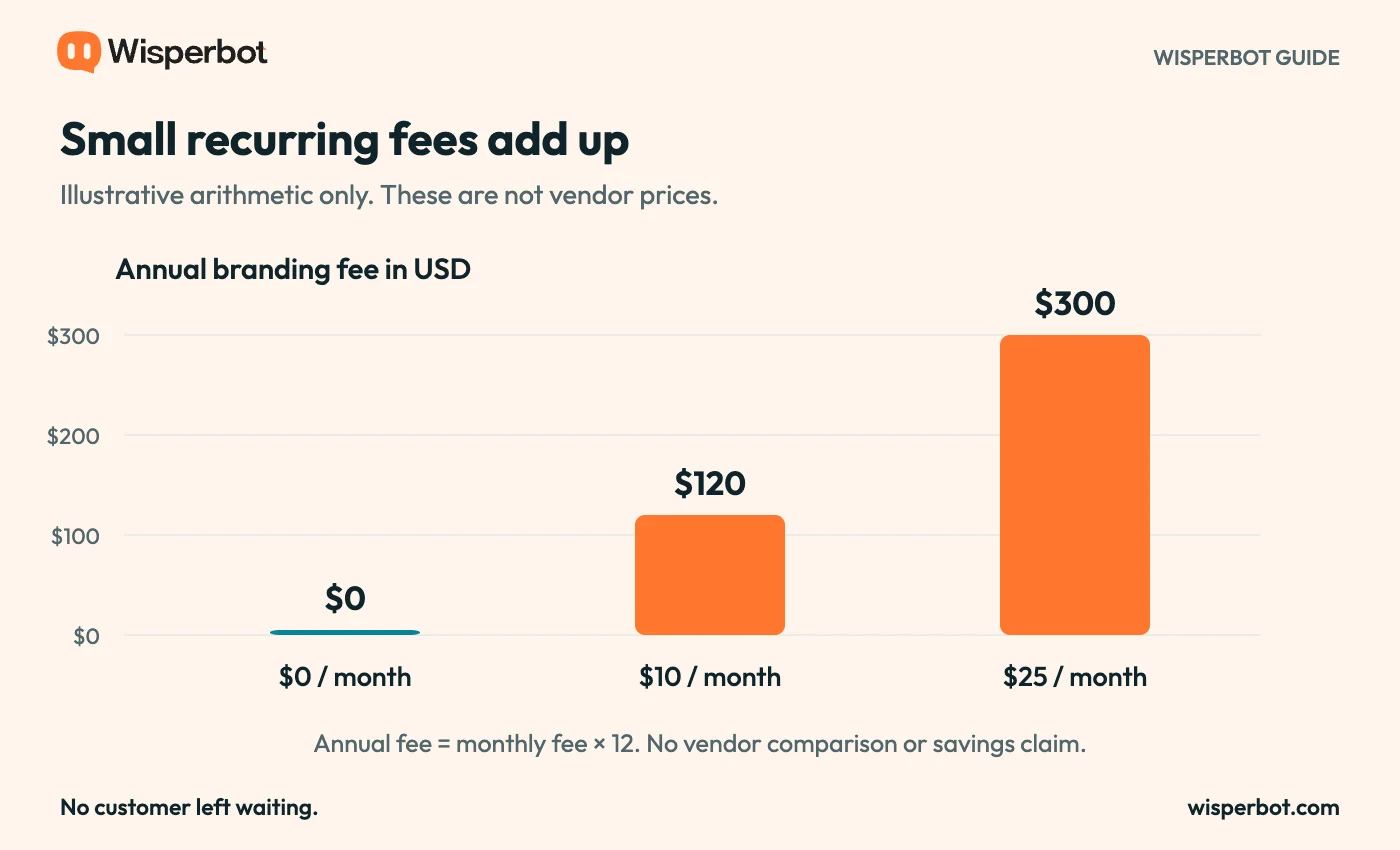
Illustrative arithmetic only: annual fee equals monthly fee multiplied by 12. The values are not vendor pricing or customer savings.
Count credits using the product's definition
An AI credit is a unit defined by the service. It is not automatically the same as a visitor, a message, or a resolved conversation.
Check the current rate for the actions you intend to use. Record actual usage during the pilot, including any work that consumes credits outside the simple chat pattern you expected.
For WisperBot, use the workspace's usage information and the current pricing page when making a purchase decision. Published allowances and commercial terms can change, and a historical screenshot is a poor budgeting source.
If the current allowance is too small, first check what is driving the demand. A popular useful bot and a misconfigured workflow may both consume capacity, but they call for different decisions.
Put a value on maintenance without exaggerating it
Record the time spent preparing the first knowledge source. Then record ongoing updates and review. Use your own working cost if you want to estimate the labour component.
For a hypothetical internal calculation, two hours of review at an assumed $20 per hour would be $40. Both the hours and rate are examples, not a recommended staffing budget or a claim about WisperBot setup time.
The value of the exercise is the structure. It makes hidden work visible and helps compare different operating approaches.
Do the same for human handoff. A bot that routes difficult questions correctly may still leave substantial staff work. That can be the right result. The goal is a useful service, not a report that makes every conversation look automated.
Choose an upgrade by the constraint you reached
A pilot can show that the free plan is sufficient for the current job. It can also show that the team needs more capacity, more access, or another feature.
Name the constraint before changing plans. “We need another person to answer chats” is a clearer reason than “paid must be more professional”.
Compare the actual plan terms for that requirement. If your goal is a custom launcher image, assess that entitlement. If you need a custom domain, assess it separately. Neither should be confused with the footer company-name control that is already available across tiers.
This approach keeps the buying decision tied to work the business is doing today. It also leaves room to stay on Free when the pilot has not yet produced a reason to expand.
Keep cost and usefulness in the same review
The lowest bill is not necessarily the best service. A bot that gives inaccurate answers cheaply can create more work than it removes. A more capable setup can also be wasteful if nobody uses it.
Review cost alongside answer quality, handoff completion, and the volume of relevant questions. Look for a meaningful result that the business can verify.
The evaluation checklist helps compare requirements, and the measurement guide helps define outcomes. Together they make a stronger purchase case than a claimed saving with no baseline.
Questions about free chatbot costs
Is the WisperBot brand tag free to change?
Yes. Every tier can edit the footer company name. The standard tag displays “Powered by” followed by that name.
Does that mean the entire chatbot has no running cost?
No. Plan capacity, external services, and your own operating time still matter. The editable tag is one specific part of the offer.
When should a business pay for a higher plan?
When a verified need justifies it, such as capacity, access, or a separate feature. Measure the constraint first, then compare the current terms.