What Is a Reply-First Inbox? (And How It Differs From a Helpdesk)
A reply-first inbox answers every DM in seconds from your own information, then hands over to a person. Here is how it differs from a helpdesk, shared inbox or chatbot.
In this article
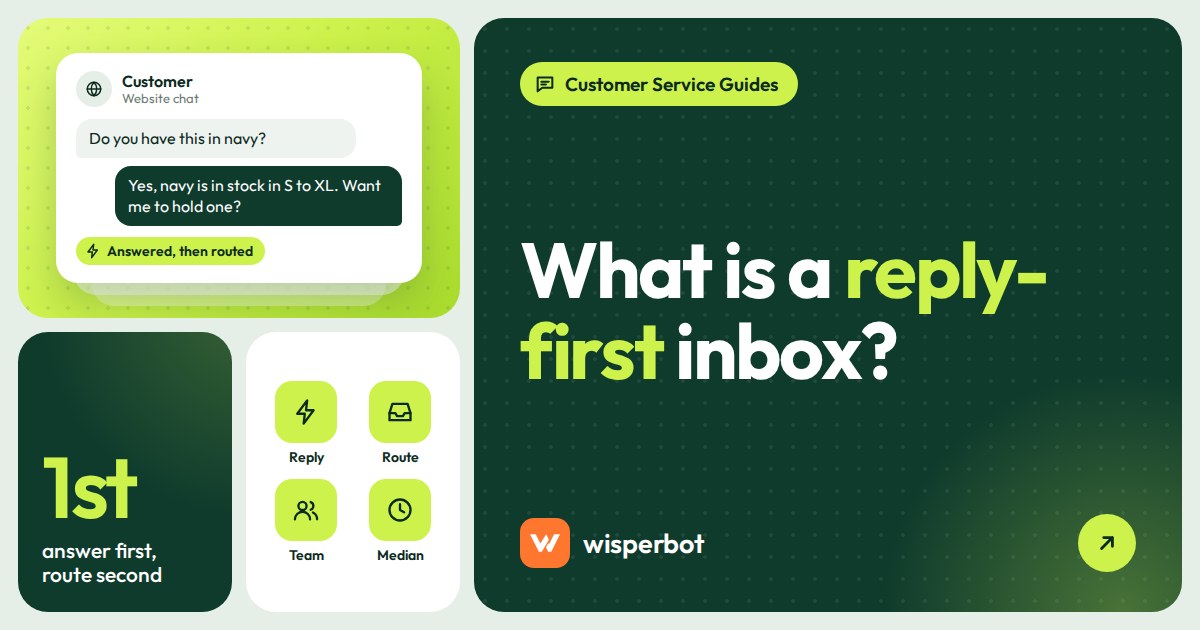
A reply-first inbox is a customer-messaging inbox built around one job: giving every incoming message a useful first reply within seconds, at any hour, and then handing the conversation to a person when it needs one. A helpdesk is built to track and close problems; a reply-first inbox is built so that no customer is left waiting. The number it is judged on is time to first reply, not how many cases the team closed.
Key takeaways
- A reply-first inbox answers first and routes second. A helpdesk logs first and answers when an agent is free.
- It suits businesses whose customers arrive in DMs and website chat and expect a reply while they are still holding the phone.
- Its core metric is median time to first reply, measured on real answers, not "we got your message" auto-replies.
- The first reply comes from an AI that answers only from the business's own information, with a clear handover to a person.
- It is not the right fit for B2B teams with long email cases, formal escalations or strict audit trails. They still need a helpdesk.
Where the idea comes from
It is 11:40 pm in Mirpur. Someone has been scrolling a clothing page for twenty minutes, sends "dam koto apu?" and puts the phone down to wait. At 11:52 they send a single "?". By morning they have bought the same kurti from a page that answered.
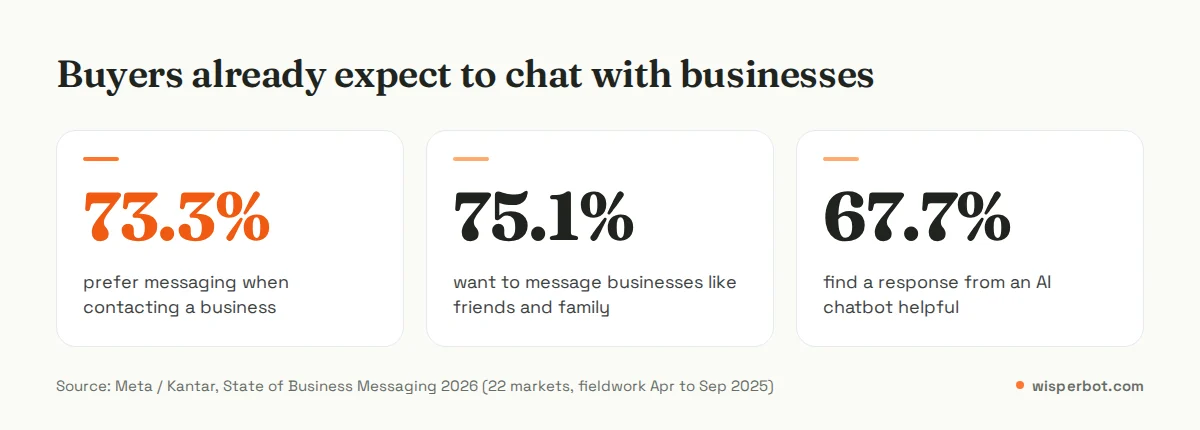
That scene is why the category exists. In chat, patience is measured in minutes because the channel feels live. In Meta's State of Business Messaging report (Kantar fieldwork across 22 markets, April to September 2025, published as the 2026 edition), 73.3% of consumers said they prefer messaging when contacting a business, and 75.1% said they want to message businesses the way they message friends and family.
Nobody waits twelve hours for a friend to reply about dinner. They don't wait that long for a shop either.
Most customer-service software was designed in the email era, when a reply by tomorrow was fine. Those tools start from the question "how do we track this?" A reply-first inbox starts from "how fast does this person hear back with something useful?"
How is a reply-first inbox different from a helpdesk?
A helpdesk turns each message into a numbered case with a queue, a priority and an owner, then waits for an agent to pick it up. A reply-first inbox sends a real answer straight away from your own price list and policies, and only then decides whether a person needs to step in.
The difference shows most at night. A helpdesk with no one logged in at 2 am usually sends an acknowledgement ("Thanks, we'll get back to you within 24 hours"), which tells the customer exactly how long they will wait. A reply-first inbox answers the price question at 2 am and leaves a note for whoever opens the inbox at 9.
To be fair, helpdesks now sell AI too. Zendesk includes a small allowance of AI "automated resolutions" per agent and charges for extra ones; Help Scout sells AI Answers at $0.75 per resolution. The difference is the default. There, AI is an add-on to a case system. Here, it is the front door.
The table compares the four kinds of tool small businesses usually weigh up, with entry prices from each vendor's pricing page on 8 October 2026.
| Type of tool | Built around | What happens to a 2 am message | Main number it tracks | Typical pricing basis (checked 8 Oct 2026) | Best for |
|---|---|---|---|---|---|
| Helpdesk (e.g. Zendesk, Freshdesk) | Cases, queues, priorities, escalation | Logged, maybe acknowledged, answered when an agent is online | Resolution time, cases closed, satisfaction | Per agent: Zendesk Support Team from $19/agent/month billed yearly; Freshdesk Growth $19/agent/month billed yearly | Email-heavy support teams, B2B, formal escalations |
| Shared inbox (e.g. Front, Help Scout) | Many people working one set of conversations | Waits in the shared queue until someone picks it up | Assignment, workload, reply time | Per seat: Front Starter $25/seat/month; Help Scout Standard $25/user/month | Teams that mainly need to stop stepping on each other's replies |
| Chatbot or flow builder (e.g. ManyChat) | Pre-built flows, keywords, buttons, campaigns | Answered if it matches a flow or keyword; otherwise a fallback | Subscribers, flow completion, campaign clicks | Per contact: ManyChat Free for 25 active contacts, Essential from $14/month | Marketing campaigns, giveaways, comment-to-DM funnels |
| Reply-first inbox (e.g. WisperBot) | The first reply, then handover to a person | Answered in seconds from your own data, flagged for a person if needed | Median time to first reply, unanswered count | Per plan and AI replies: WisperBot Free $0 (100 AI replies/month), Starter $15 | DM sellers and lead-driven service businesses with 1 to 10 people on the inbox |
None of these is "better" in the abstract. If your customers email you about invoices and wait patiently for a reference number, a helpdesk is the better choice. We compare the trade-offs in more detail in helpdesk vs shared inbox vs chatbot for a small business.
What does a reply-first inbox actually do?
It pulls every chat channel into one list, answers each new message straight away from the business's own information, asks a short question when it is unsure, and hands the conversation to a named person with the history attached. A human can take over any conversation with one switch, and the bot steps back.
In practice the flow for a single message looks like this:
- Message arrives on WhatsApp, Instagram, Messenger or website chat, and lands in the same inbox as everything else.
- The AI reads it in the customer's language, including mixed scripts like Roman Bangla.
- It answers from your data: your price sheet, delivery charges, return policy, opening hours. Not from the open internet.
- If it isn't sure, it asks or hands over rather than guessing. "Which size, M or L?" is a better reply than an invented price.
- A person takes over where judgement is needed (a refund, a complaint, a custom order), seeing everything the bot already said.
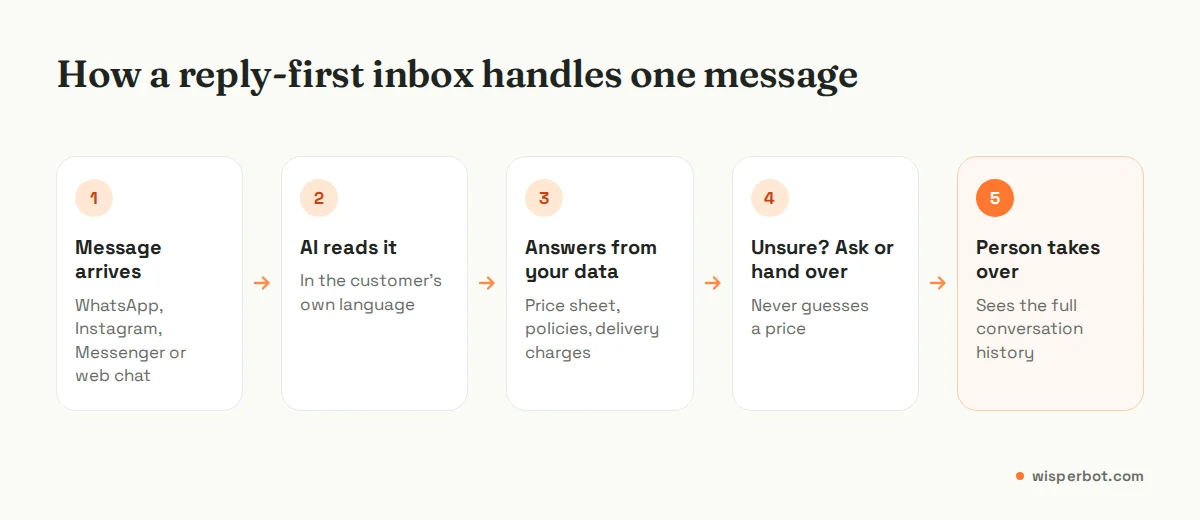
Step 4 matters most. A general-purpose AI that is allowed to improvise will sooner or later quote a price you never set. The grounded approach, answering only from information you have given it, is covered in our guide to knowledge-base chatbots and grounded answers.
The number it is built to move: time to first reply
First response time is the time between a customer's first message and your first real reply. "Real" is the important word. An auto-acknowledgement such as "Thanks for your message!" does not count, because it doesn't answer anything. A bot reply that gives the correct price and delivery charge does count, because the customer now has what they asked for.
Track the median (the middle value when you line up all reply times), not the average. One customer who waited nine hours overnight can make an average look awful, or a handful of instant replies can make a bad week look fine. Our guide to measuring first response time walks through the formula with a worked example.
The second number is simpler: how many conversations are still unanswered when you close the inbox for the day. In a reply-first setup that number should be zero, every day, because the bot has at least given each person a first answer.
Writing in Harvard Business Review in March 2011, after auditing how companies answered web leads, Oldroyd, McElheran and Elkington concluded that "most companies are not responding nearly fast enough". Chat has only shortened the fuse.
Who needs a reply-first inbox, and who doesn't?
You need one if most sales or bookings start in DMs, if many messages arrive after your team goes home, and if a handful of questions (price, size, delivery, opening hours) make up most of the volume. You probably don't need one if you get a few messages a day and answer them within minutes.
Good fits
- Facebook and Instagram sellers in Dhaka, Lahore or Delhi whose busiest DM hours are 9 pm to 1 am.
- Clinics, coaching centres, travel agents and property agents who lose leads to whoever calls back first.
- D2C brands running click-to-WhatsApp ads, where every slow reply wastes money already spent on the click.
- Small teams (one to ten people) who can't afford a night shift but can afford a morning review.
Poor fits
- A shop with eight messages a day. The free WhatsApp Business app, saved replies and a bit of discipline will do. Come back when the evenings get busy.
- Software companies handling technical bugs by email, with engineering escalations and service contracts. A helpdesk does this better.
- Businesses where every answer is bespoke (custom furniture, legal advice). An AI has little to answer from, so the gain is small.
What a reply-first inbox is not
It is not an away message. "We're closed, we'll reply tomorrow" is a polite way of making someone wait. The point is to answer the question.
It is not a flow builder. Flow tools make you predict every question and draw a branch for it. That works for a giveaway campaign. It struggles when a customer types "L size ache? Uttara te delivery koto?" in one message.
It is not a promise to remove people. The bot handles the repetitive first answer. Refunds, angry customers and anything involving judgement still go to a person, and the handover should be obvious to the customer. We set out how in our AI-to-human handoff playbook.
It is not a channel count. Plenty of tools connect ten channels and still leave a message unanswered for six hours. Joining channels into one view helps (see what omnichannel customer service means), but this category is judged on the first minute.
Rules a reply-first inbox has to live by
Meta's platform rules shape how this works on its channels. On WhatsApp, a 24-hour customer service window opens when the customer messages you, and you can send normal, non-template messages inside it. Those were free until 30 September 2026; since 1 October Meta charges for each one at the market's utility rate, after 1,000 free service messages per business number each month. On Messenger, Meta's policy says businesses "will have up to 24 hours to respond to a user", with a Human Agent tag that allows a person to reply manually within 7 days.
A reply-first inbox fits those rules. The instant AI reply lands well inside the window, and the slower, judgement-heavy follow-up still has time. The thing to avoid is a team that opens a WhatsApp message 26 hours later and finds it can no longer send a free-form reply at all.
One more rule, our own: start small. Switch AI answering on for nights first, review the answers every morning for a week, and only then widen the hours. We explain why in setting up after-hours AI replies.
Where WisperBot fits
"Reply-first inbox" is the phrase we use for what we build, so read this section with that in mind. WisperBot, a reply-first inbox for WhatsApp, Instagram, Messenger and website chat, answers from your own price list and policies (CSV or Google Sheet, up to 5,000 rows), lets you choose how strictly the bot sticks to them, and hands over with a per-conversation AI/Human switch on the web and in the agent app. Reports show median first response time, and a weekly digest arrives every Monday. There is a free plan with 100 AI replies a month, enough to test it on your night hours. If you mainly run long email cases, a helpdesk will suit you better. See the inbox and the Smart Bot.
Frequently asked questions
What is a reply-first inbox in simple words?
It is a shared inbox for chat messages that answers every customer straight away, usually with an AI that uses only your own information, and then passes the conversation to a person when needed. The goal is that nobody waits hours for a first useful reply, including at night and on weekends.
Is a reply-first inbox the same as a chatbot?
No. A chatbot is one part of it. A reply-first inbox also gives your team one place to see every conversation, take over from the bot, assign chats and track reply times. A chatbot on its own often has no proper way for a person to step in mid-conversation.
Do I still need staff if I use a reply-first inbox?
Yes, but fewer hours go on repeat questions. The bot covers the first answer, especially at night. People handle refunds, complaints, custom orders and anything the bot isn't sure about. Most small shops find one person can cover more conversations, not that the person disappears.
What is a good first reply time for DMs?
For chat channels, aim for an AI first reply within seconds and a person picking up within a few minutes during working hours. More complex cases can take longer, as long as the customer has already had a useful first answer and knows a person is on it.
Does an auto-acknowledgement count as a first reply?
Not if you want numbers you can trust. "We've received your message" tells the customer nothing they didn't already know. Count the first reply that actually moves the conversation on, such as the price, the stock answer or a relevant question back to the customer.
Sources
- Meta / Kantar: State of Business Messaging (2026 edition, fieldwork April to September 2025)
- Meta for Developers: Pricing on the WhatsApp Business Platform (customer service window)
- Meta for Developers: WhatsApp non-template (service) message pricing
- Meta for Developers: Messenger Platform policy overview (24-hour window, Human Agent tag)
- Harvard Business Review: The Short Life of Online Sales Leads (Oldroyd, McElheran, Elkington, March 2011)
- Zendesk pricing
- Freshdesk pricing
- Front pricing
- Help Scout pricing
- ManyChat pricing
Last checked: 8 October 2026.