A Simple Customer Service SLA Template for Small Teams
A one-page SLA template for small teams, with first reply and resolution targets by issue type, an escalation ladder, holiday exceptions and how to track it.
In this article
A customer service SLA template for a small team fits on one page: which channels you cover, your working hours, a first reply target, resolution targets by type of issue, who handles escalations, what the exceptions are (holidays, sale days) and how you will measure it. A service level agreement (SLA) is simply a written promise about how fast you reply and fix things. For a team of two to ten people, the point is not legal cover. It is making sure everyone means the same thing by "we reply quickly".
Key takeaways
- Write two versions: an internal target your team works to, and a looser public promise customers see.
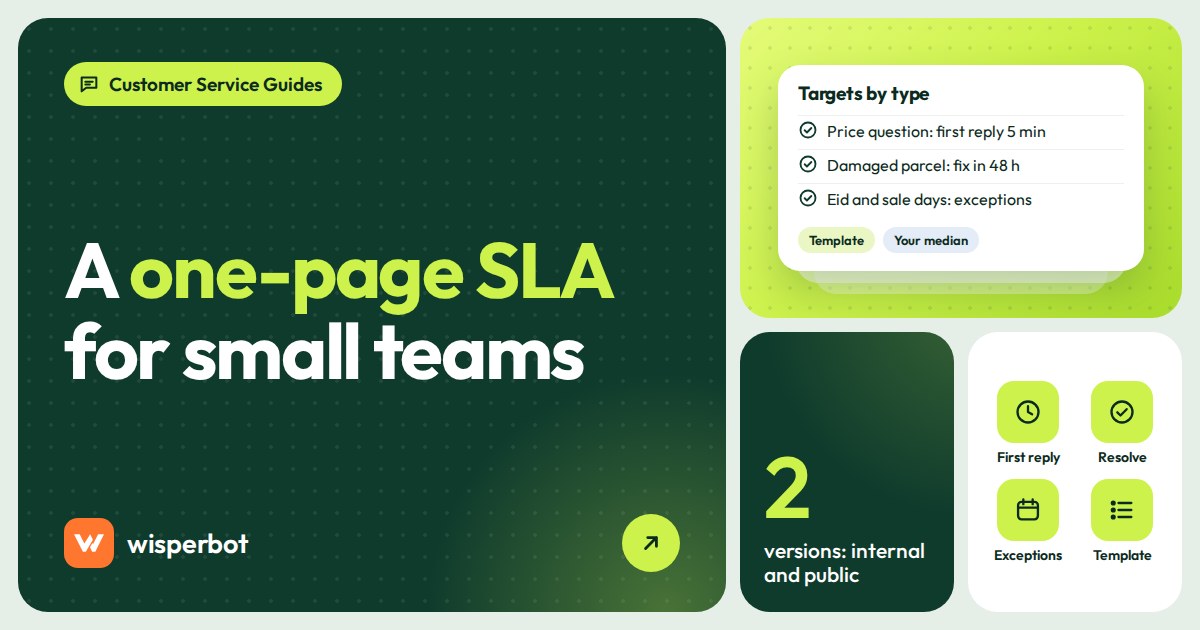
- Set separate first reply and resolution targets. A price question and a damaged parcel shouldn't share one number.
- Base targets on your measured median from the last two weeks, then tighten a little. Don't copy someone else's numbers.
- Plan exceptions in advance: Eid, sale days and courier disruptions will break an SLA that pretends they don't exist.
- Review it monthly with the same three numbers: median first reply, median resolution time and the share of days you hit target.
What is a customer service SLA for a small business?
It is a short written agreement, usually internal, that says how quickly your team will send a first reply and resolve each type of customer issue, during which hours and on which channels. Large companies sign SLAs with clients. Small businesses use them to make "fast" measurable, so everyone on the team knows what good looks like.
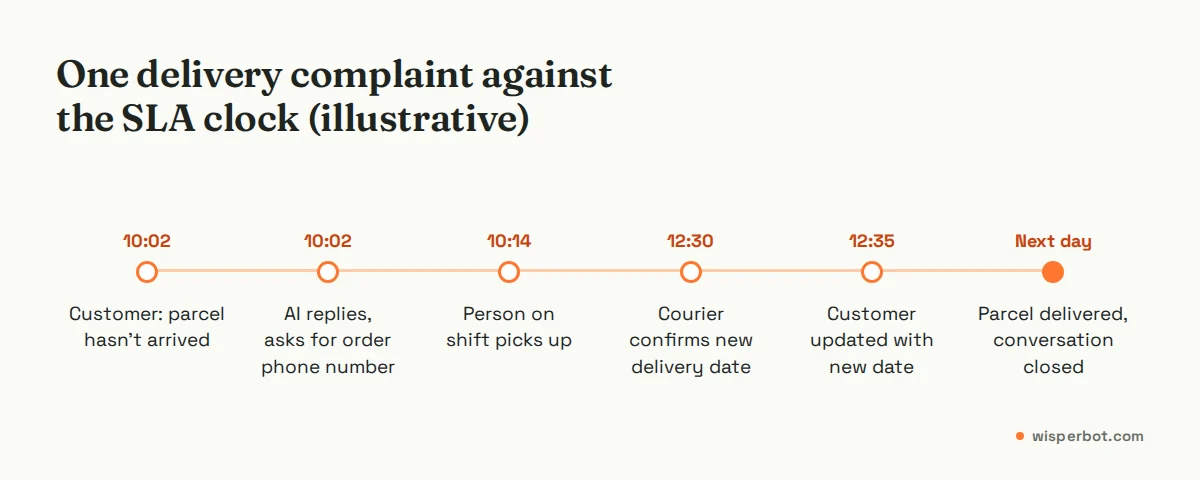
You may never show it to a customer. That's fine. A two-person Instagram shop in Banani doesn't need a contract; it needs Sadia and the owner to agree that a delivery complaint gets a reply within 15 minutes during working hours and a fix within a day, and that both know who calls the courier.
Helpdesk software often builds SLA policies in. Help Scout, for example, lists one basic SLA policy on its Standard plan and two advanced ones on Plus (checked 8 October 2026). You don't need that software to start. A one-page document and a weekly look at your numbers will do.
The one-page SLA template
Copy the left two columns into a document and fill in the third with your own details. The example column is written for an illustrative three-person online clothing shop. Every number in it is an example, not a benchmark.
| Section | What to write | Example (illustrative three-person shop) |
|---|---|---|
| 1. Scope | Channels covered and what is out of scope | WhatsApp, Instagram DMs, Messenger and website chat. Phone calls and Facebook comments not covered. |
| 2. Hours | Staffed hours and timezone, plus what happens outside them | 10 am to 10 pm Dhaka time, Saturday to Thursday. AI answers outside these hours; a person follows up next morning. |
| 3. First reply target (AI) | How fast the bot or auto-answer replies, and what counts as a reply | Within seconds, 24/7. Counts only if it answers the question or asks a relevant one. "We got your message" does not count. |
| 4. First reply target (person) | How fast a person picks up a conversation that needs one | Within 15 minutes during staffed hours; by 11 am for anything handed over overnight. |
| 5. Resolution targets | Target time to resolve, by issue type (see next table) | Price and stock questions: same conversation. Delivery problems: 24 hours. Refunds: 3 working days. |
| 6. Escalation | Who handles what when the first person can't | Complaints, refunds and anything over 5,000 taka go to the owner. |
| 7. Exceptions | Holidays, sale days, outages, and how you'll tell customers | Eid: AI only for 3 days, notice posted a week before. 11.11: human reply target relaxed to 30 minutes. |
| 8. Measurement | Which numbers, where from, how often | Median first response and resolution time, checked every Monday from the inbox reports. |
| 9. Review | When you revisit the targets | First Monday of each month, or after any week where we miss target on more than one day in three. |
Keep the internal version and the public one separate. Internally you might aim for a 15-minute pickup. Publicly, say something you will beat on your worst day, such as "Instant answers to common questions, any time. A person replies within working hours." The public line is the floor; the internal target is what you actually work to.
Resolution targets by issue type
First reply time is the time between a customer's first message and your first real reply. Resolution time is how long until the issue is actually sorted. They need separate targets, and resolution targets need to vary by issue, because a size question and a missing parcel are different jobs. We explain how to measure the first one properly in our first response time guide.
| Issue type | First reply | Resolution target | Owner | Escalate if |
|---|---|---|---|---|
| Price, size, stock | AI in seconds | Same conversation | Bot, then whoever is on shift | Bot unsure or customer asks for a person |
| Order confirmation | AI in seconds; person within 15 min | Within 1 hour in staffed hours | Order handler | Address or payment unclear |
| Delivery delay | Person within 15 min | Update within 24 hours | Order handler | No courier update after 24 hours |
| Wrong or damaged item | Person within 15 min | Replacement or refund agreed within 48 hours | Owner or senior | Customer mentions a review or post |
| Refund | Person within 15 min | Paid within 3 working days | Owner | Payment provider delay |
| Wholesale enquiry | AI in seconds; person within 1 hour | Quote sent within 1 working day | Owner | Order above your usual stock |
All of these are examples. Your own numbers should come from your own history, which is the next step.
How should a small team set first reply targets?
Measure first. Take the last two weeks of conversations, find your median first reply time (the middle value when all reply times are lined up) for staffed hours and for nights separately, then set a target slightly better than today. Pick a number you can hit on nine days out of ten, not your best day.
Splitting staffed hours and nights matters more than people expect. A shop whose staffed-hours median is 6 minutes and whose overnight median is 9 hours has two problems, and only one of them is about effort. The night problem is a coverage problem. That's where an AI first reply belongs, and it is the reason we suggest switching AI answering on for nights before anything else.
Use the median, not the average. One customer left waiting overnight can distort an average for the whole week. But the median has a blind spot too: half your customers waited longer than it. Once a week, open the five slowest conversations and read them. Our post on median vs p90 reply time shows how to work out the 90th percentile by hand from a sample of reply times, if you want a number for the slow tail.
The escalation ladder
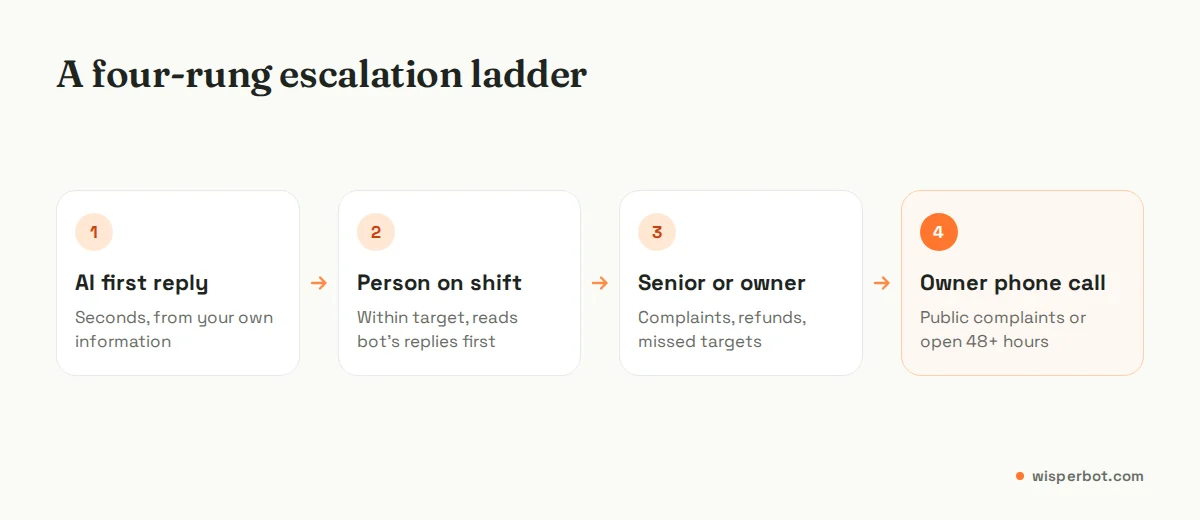
An SLA without escalation rules is just a hope. Write down, for each rung, who takes over and what triggers the move up. For a three-person team it rarely needs more than four rungs:
- AI first reply. Answers from your own price list and policies. Hands over when unsure, when the customer asks for a person, or when the topic is a complaint or refund.
- Person on shift. Picks up within the human first reply target, reads what the bot already said, and owns the conversation from then on.
- Senior or owner. Takes complaints, refunds, anything above a set value, and anything unresolved past its target.
- Owner calls the customer. For public complaints, threats of a bad review, or anything open longer than 48 hours. A phone call often settles in two minutes what ten messages couldn't.
Platform rules affect escalation timing. On WhatsApp, a 24-hour customer service window opens when the customer messages you; once it closes, you can only send approved template messages until they write again. On Messenger, Meta's policy lets a person reply manually within 7 days using the Human Agent tag. So a WhatsApp conversation stuck at rung 3 needs a reply before the 24 hours run out, even if it's only "We're still chasing the courier, update by 6 pm."
Exceptions: holidays, sale days and things outside your control
Every SLA needs an exceptions section, written before you need it.
Religious and public holidays. Eid dates depend on moon sighting, so you won't know the exact day weeks ahead. Write the rule instead: "AI answers only from Chand Raat to the third day of Eid; human replies resume on day four; notice posted a week before." Our Ramadan and Eid inbox readiness checklist covers the details.
Sale days. On 11.11 or Black Friday, volume can multiply. Relax the human target in advance and say so internally, rather than missing it silently. The sale-day inbox plan has a staffing table.
Courier and payment disruptions. When a courier stops pickups or a payment provider has an outage, resolution targets for those issues pause. First reply targets don't. Customers still deserve to hear what's happening.
Platform outages. If WhatsApp or Instagram is down, note the time window and exclude it from that week's numbers.
How do you track an SLA without a helpdesk?
Pick three numbers and check them every Monday: median first reply time, median resolution time and the share of days you hit target. Many shared inboxes report the first two. Record them in a simple sheet, one row per week, and look at the trend over a month rather than reacting to a single bad day.
Add a fourth check that no report gives you: the number of conversations still open and unassigned when you close each night. If that isn't zero, the SLA is fiction. Clear statuses and one owner per conversation make all of this measurable, as we set out in organising a three-person inbox.
Where WisperBot fits
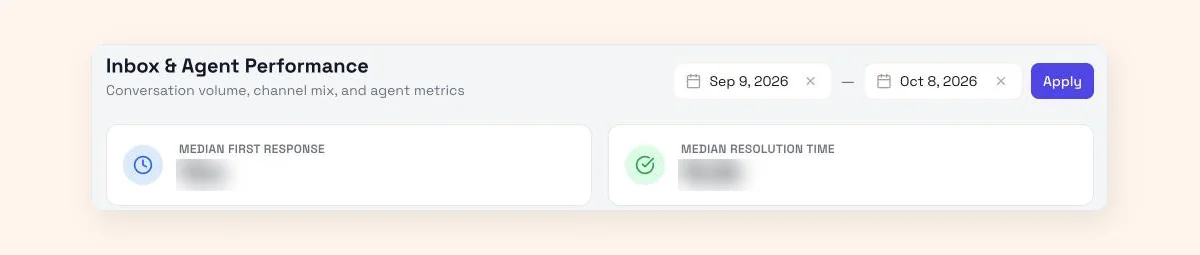
WisperBot, a reply-first inbox for WhatsApp, Instagram, Messenger and website chat, covers the measurement side: Reports show median first response time, median resolution time, an SLA trend and an agent leaderboard, and a performance digest email arrives every Monday. AI answering can be set to Scheduled: you pick a timezone and give each day you tick one or more time windows when the AI may answer, such as midnight to 10 am and 10 pm to midnight. Set those windows to the gaps around your staffed hours, and tick your day off (Friday in the example) with All day, because the AI only answers on the days you tick. That gives you "AI answers outside staffed hours" in practice. It shows medians, not p90, and it doesn't export conversations or reply-time data, so read your slowest conversations by hand. See the inbox and reports.
Frequently asked questions
What should a customer service SLA include?
At minimum: the channels covered, staffed hours and timezone, a first reply target, resolution targets by issue type, who handles escalations, exceptions such as holidays and sale days, and how and when you will measure performance. For a small team, all of that fits on one page.
What is a good first response time SLA for chat?
For chat and DMs, a sensible starting point is an AI answer within seconds and a person within about 15 minutes during staffed hours. That is our suggestion, not an industry standard. Measure your own median for two weeks and set a target you can hit on nine days out of ten.
Is an SLA the same as a response time guarantee?
No. An SLA is a target you work to and measure. A guarantee promises customers something, often with a remedy if you miss it. Small teams should keep SLAs internal, or publish a looser version, until they have months of data showing they reliably meet the target.
Should small businesses publish their SLA?
Publish a simple, conservative version, such as staffed hours and "a person replies within working hours", and keep tighter internal targets. That way customers know what to expect and you build trust by beating it, rather than losing trust by missing an ambitious public number.
How often should you review a customer service SLA?
Monthly is enough for most small teams. Check median first reply, median resolution and the share of days on target. Review sooner after a big change, such as adding a channel, hiring someone or switching on AI answering, because each one shifts what is realistic.
Sources
- Meta for Developers: Pricing on the WhatsApp Business Platform (customer service window)
- Meta for Developers: Messenger Platform policy overview (24-hour window, Human Agent tag)
- Help Scout pricing (SLA policies by plan)
Last checked: 8 October 2026.