AI-to-Human Handoff: The Complete Customer Support Playbook
A complete playbook for deciding when to escalate, packaging conversation context, routing to the right teammate and measuring handoff quality.
In this article
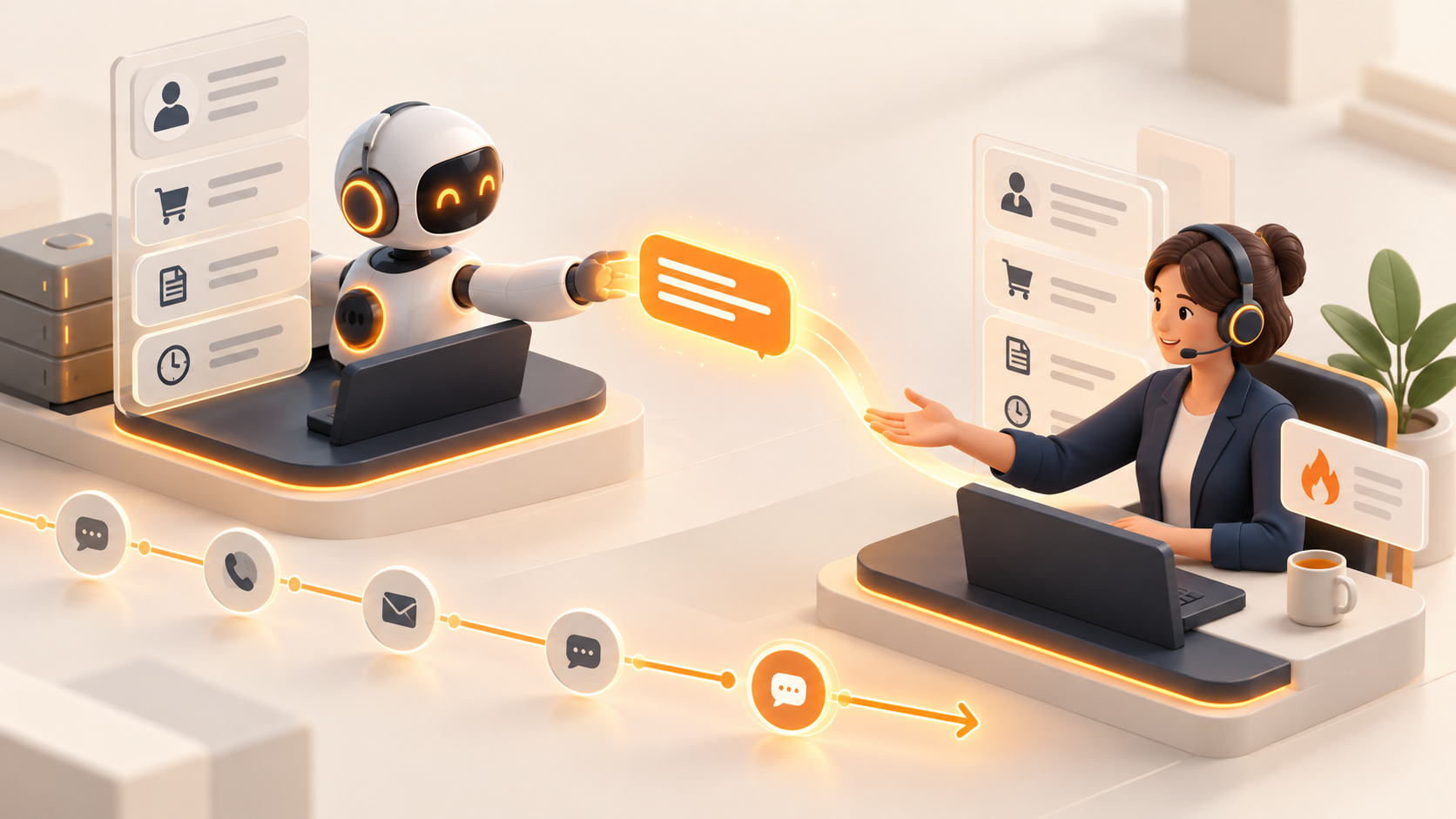
An effective AI-to-human handoff transfers responsibility, not just a chat transcript. The human teammate should receive the customer’s goal, verified identity state, relevant history, steps already attempted, source information, urgency and a clear reason for escalation—then become visibly accountable for the next response.
The five parts of a reliable handoff
| Part | Required information | Failure to avoid |
|---|---|---|
| Trigger | Why automation stopped | Silent or random transfer |
| Context | Goal, history, attempts and sources | Customer repeats everything |
| Destination | Correct queue and skill | Ping-pong reassignment |
| Expectation | What happens next and when | Unclear waiting |
| Ownership | Named person or team | Unassigned backlog |
Trigger rules to define before launch
- The customer requests a human.
- The system lacks a trusted source or has conflicting sources.
- Confidence falls below the threshold for that intent.
- Authentication, payment, safety, legal or policy-exception handling is required.
- The same answer or action fails twice.
- Sentiment, urgency or account value calls for human judgment.
- A required tool is unavailable or returns an unexpected result.
Thresholds should vary by risk. A store-hours answer can tolerate a different confidence threshold from an account-access decision.
The handoff packet
Pass a compact structured summary: customer objective; channel and identity state; products, order or workspace involved; actions already attempted; relevant knowledge links; detected urgency; and the exact unresolved question. Never place credentials, payment details or unnecessary personal data in the summary.
What the customer should experience
- Acknowledge that a handoff is happening.
- Explain why in plain language without blaming the system.
- Set an honest response expectation.
- Let the customer add one final detail while waiting.
- Have the human continue from the summary, not restart discovery.
Use a shared inbox so the handoff has a destination, owner and visible timeline.
Handoff patterns compared
| Pattern | Best for | Main risk |
|---|---|---|
| Immediate live transfer | Urgent issues during staffed hours | No specialist available |
| Queued asynchronous handoff | Messaging and email support | Weak response expectation |
| Scheduled callback | Complex investigation | Missed appointment |
| Human approval, then automation continues | Bounded high-impact actions | Unclear audit trail |
Metrics that reveal handoff quality
Track handoff rate by intent, time to human ownership, time to first human response, reassignment rate, customer repetition, resolution after transfer and reopen rate. Review transcripts where customers ask for a person more than once.
Best fit—and common misuse
Best fit: any automated service flow where a human can genuinely resolve exceptions.
Common misuse: treating “handoff” as a generic email form with no owner, context or response commitment.
Frequently asked questions
Should a customer always be able to request a human?
In most service contexts, provide a clear route to human help, with truthful availability and expected timing.
How long should a handoff summary be?
Long enough to preserve decisions and attempts, but short enough for an agent to understand in seconds.
Should the AI keep replying after transfer?
Usually it should stop substantive replies unless the workflow clearly marks supportive updates and prevents conflicting answers.
Who owns failed handoffs?
A named operations owner should review routing failures, stale queues and repeated transfers.
Can handoffs happen across channels?
Yes, but only with customer consent, identity controls and a clear explanation of where the conversation will continue.
How often should triggers be reviewed?
Review monthly at first, and immediately after policy changes, serious failures or new automation capabilities.
Source
Intercom: workflow automation and human handoff
Last verified: 18 September 2026.