WhatsApp Business API Pricing in 2026, Explained for Small Businesses
Meta charges per delivered message, and since 1 October 2026 service replies are no longer automatically free. Here is what a small seller actually pays.
In this article
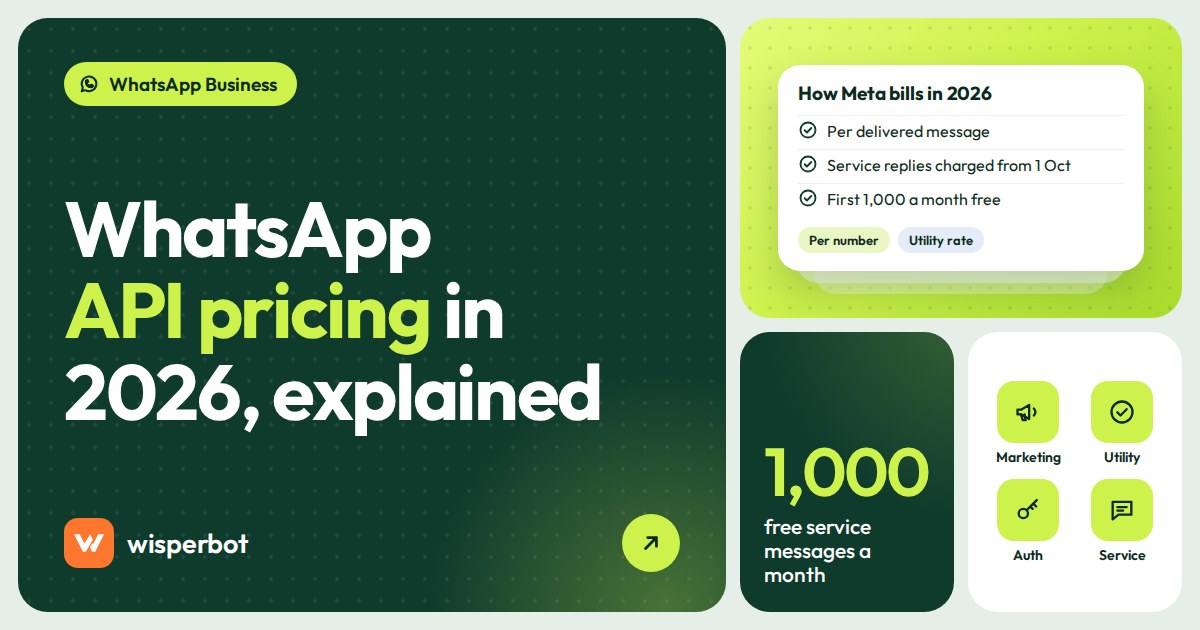
WhatsApp Business API pricing in 2026 works per message: Meta charges for each delivered template message, at a rate set by the template's category (marketing, utility or authentication) and the country code of the person receiving it. Since 1 October 2026, Meta also charges for ordinary service replies inside the 24-hour customer service window, at the same rate as utility messages, once a number has used its 1,000 free service messages for the month. For a shop messaging customers in Bangladesh, that means about $0.0732 per marketing message and $0.0037 per utility or service message on the 1 October 2026 rate card, plus whatever your provider adds.
Key takeaways
- Meta has billed per delivered message, not per conversation, since 1 July 2025.
- From 1 October 2026, service replies and utility templates sent inside the 24-hour window are no longer automatically free. Meta gives each business phone number 1,000 free service messages a month, then charges from the 1,001st.
- Bangladesh moved to its own rate card on 1 October 2026, with lower utility, authentication and service rates.
- Marketing messages are the expensive category almost everywhere: in Bangladesh they cost roughly 20 times a utility message.
- Provider fees sit on top of Meta's rates, so always ask for the Meta rate and the provider fee separately.
How does WhatsApp Business API pricing work in 2026?
Meta charges per delivered message. Template messages are billed by category (marketing, utility or authentication) and by the recipient's country calling code, so a message to a +880 number costs a different amount from one to a +91 number. Messages customers send you are never charged. Rates can only change on 1 January, 1 April, 1 July or 1 October.
Four things decide what a single message costs you:
- Category. A template (a pre-approved message format you need to start or restart a chat) is marketing, utility or authentication. Meta assigns or confirms the category, and you pay for whatever category the template carries when you send it.
- The recipient's country. Meta prices by the customer's phone country code, not by where your business is registered. A Dhaka shop messaging a customer in Dubai pays the UAE rate.
- The window. The customer service window is the 24 hours after a customer's last message to you. Inside it you can send free-form replies; outside it you can only send templates. Our guide to the 24-hour messaging window covers the rules in detail.
- Where the chat started. Chats that begin from a Click to WhatsApp ad get a free entry point window of up to 7 days, explained below.
What changed on 1 October 2026?
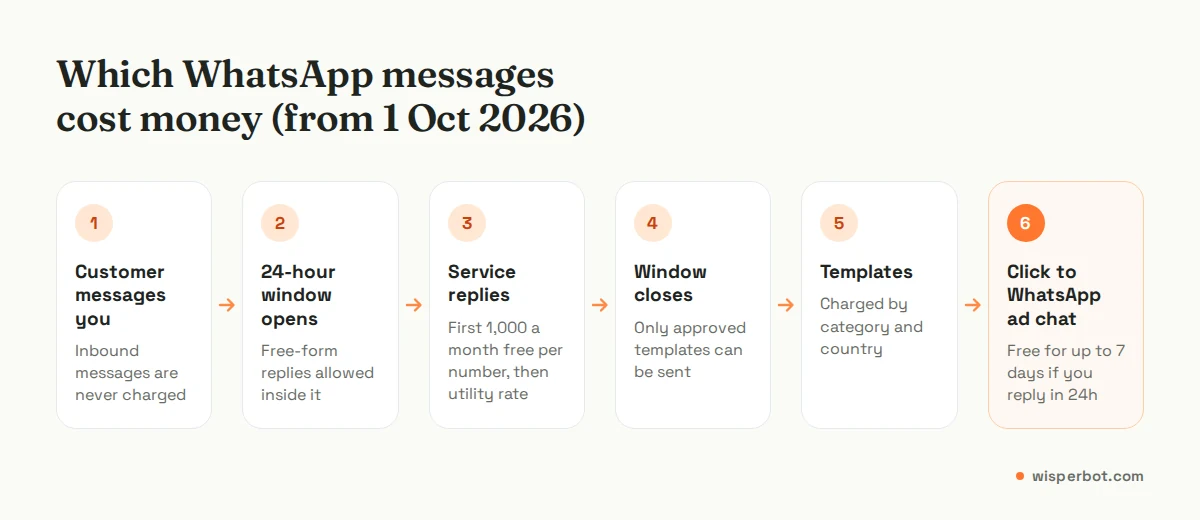
Two things. Service messages (free-form replies, written by a person or by a third-party AI tool, inside the 24-hour window) became chargeable at each market's utility rate. Utility templates sent in reply to a customer inside that window also became chargeable. Meta's non-template messages documentation states both changes and says service messages get no volume discounts.
Until 30 September 2026, replying inside the window cost nothing. That was the main reason to let customers message first. It is still cheaper, because service rates are low, but "free" is no longer the right word. Each message is charged once, so a promotional free-form reply does not also pick up a marketing charge.
There is one softener, and it is Meta's own rule, not a partner perk. Meta's pricing page says that for each business phone number it provides 1,000 free service messages per month, which do not roll over, and that it only charges from the 1,001st. A shop that sends fewer than 1,000 replies a month from one number pays nothing for them. Check that the allowance shows up on your provider's invoice, because providers bill you, not Meta.
The same date brought rate card changes. Bangladesh, Nepal, Sri Lanka and Iraq got lower utility and authentication rates plus a new, higher authentication-international rate (charged when a business registered in another country sends a one-time passcode). Kazakhstan, Kuwait, Morocco, Oman and Ukraine went up.
WhatsApp rates by country (1 October 2026)
Meta publishes the actual numbers as downloadable rate cards rather than on the docs page itself. The figures below are USD list rates per delivered message for the 1 October 2026 card, as reproduced by three Meta partners (YCloud, SleekFlow and Zernio) whose numbers agree with each other. They do not include provider fees or tax.
| Recipient market | Marketing | Utility, authentication and service | What to notice |
|---|---|---|---|
| Bangladesh | $0.0732 | $0.0037 | Own rate card from 1 Oct 2026; utility was $0.0113 before |
| India | $0.0118 | $0.0014 | Cheapest marketing rate in this list; INR billing for eligible Indian businesses |
| Pakistan | $0.0473 | $0.0150 | Utility and authentication went up on 1 April 2026 |
| United Arab Emirates | $0.0576 | $0.0157 | Marketing reported up from $0.0499 |
| Saudi Arabia | $0.0576 | $0.0107 | Marketing reported up from $0.0501 |
| Indonesia | $0.0411 | $0.0250 | High utility rate relative to marketing |
| Malaysia | $0.0860 | $0.0140 | One of the higher marketing rates in Asia |
| Rest of Asia Pacific | $0.0842 | $0.0113 | Regional bucket for markets without their own card |
| United Kingdom | $0.0635 | $0.0220 | Marketing went up on 1 July 2026 |
Two patterns matter more than any single number. First, the gap between marketing and everything else. In Bangladesh, one promotional template costs about the same as 20 service replies. Second, the country mix. If a third of your customers are expats with UAE or Saudi numbers, your bill follows their country codes, not yours.
India is a special case. Since 1 January 2026, eligible Indian businesses are billed in rupees, and Meta says non-INR accounts in that group must migrate by 31 December 2026. Check the INR card in your WhatsApp Manager rather than converting the dollar figures yourself.
| Category | Typical use | When you pay | When it is free |
|---|---|---|---|
| Marketing template | Offers, new arrivals, cart reminders, "we miss you" | Every delivered message | Only inside a free entry point window |
| Utility template | Order confirmed, shipped, appointment reminder | Every delivered message from 1 Oct 2026 | Only inside a free entry point window |
| Authentication template | One-time passcodes | Every delivered message | Only inside a free entry point window |
| Service message | Normal replies to a customer, by a person or an AI tool | Every delivered message from 1 Oct 2026, no volume tiers | The first 1,000 per business number per month (Meta's rule, no rollover), and inside a free entry point window |
What is the WhatsApp free entry point window?
When a customer messages you from a Click to WhatsApp ad on the Android or iOS app and you reply within 24 hours, Meta opens a free entry point window that may stay open for up to 7 days, counted from your reply (Meta's developer pricing page, updated 30 September 2026; some older Meta pages still say 72 hours). Messages you send inside it, templates included, are not charged. It does not apply to chats started on WhatsApp Web or desktop, and Meta Business Agent messages are still charged inside it.
For sellers running ads, this is the cheapest stretch of the whole relationship. A customer who taps your ad at 9:15 pm on Friday and gets an answer by Saturday evening gives you up to a week of free follow-up. That is where your order confirmation and "your parcel left Mirpur this morning" message should land. More on making those ad chats convert in our post on Click-to-WhatsApp ads and the inbox.
How much will a small shop actually pay each month?
For most small sellers who reply to customers and send occasional order updates, Meta's fees are small. The bill grows mainly with marketing broadcasts. A clothing page in Dhaka sending one 2,000-person promotion a month would spend more on that single broadcast than on a whole month of customer replies.
Example (illustrative, using the Bangladesh rates above): a page gets 1,200 WhatsApp chats a month. Each chat averages six replies from the shop, so 7,200 service messages. The first 1,000 are free under Meta's monthly allowance, so 6,200 are charged.
| Line | Volume | Rate | Monthly cost |
|---|---|---|---|
| Service replies inside the window (7,200 sent, first 1,000 free) | 6,200 | $0.0037 | $22.94 |
| Shipping updates sent outside the window | 800 | $0.0037 | $2.96 |
| One promotional broadcast | 2,000 | $0.0732 | $146.40 |
| Total Meta fees | $172.30 (about Tk 21,200) |
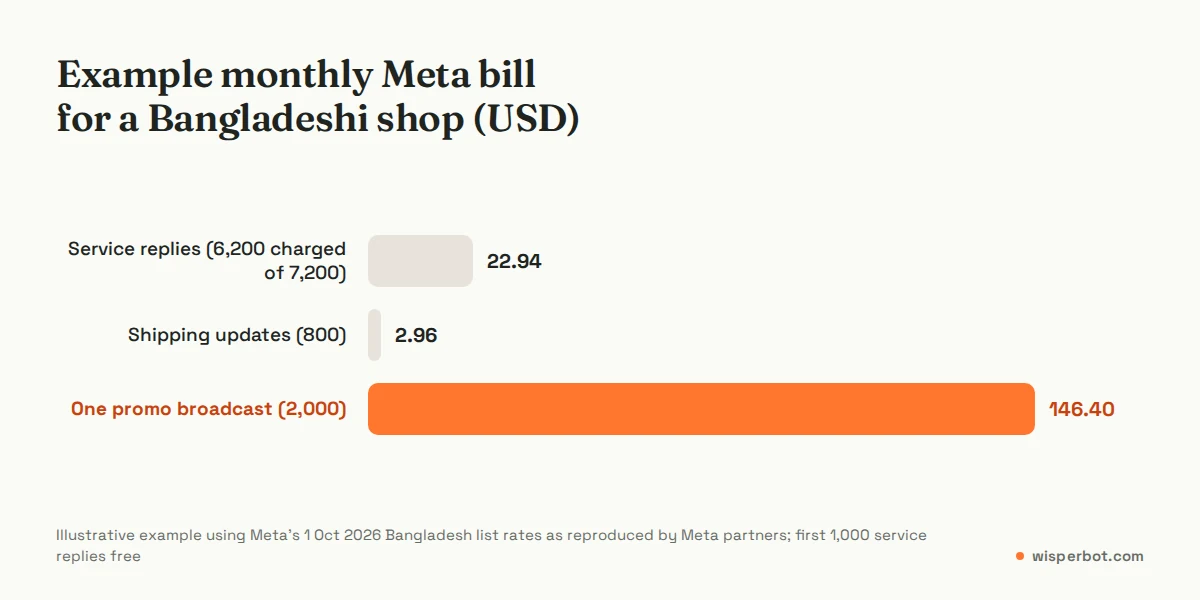
The same broadcast to 2,000 Indian numbers would cost about $23.60. To Malaysian numbers, $172. Before you copy a promotion plan from a seller in another country, run their volumes through your own country's rates.
One detail people miss: Meta charges per message, not per answer. If your team (or your bot) splits one answer into three bubbles, "Hi apu", "Price 1,450 tk", "Delivery 2 days", that is three service messages. Write one complete reply instead.
What do WhatsApp providers charge on top of Meta?
Most businesses reach the WhatsApp Business Platform through a provider, so the real cost is Meta's rate plus the provider's fee. Providers charge in three common ways: a flat fee per message, a percentage markup on Meta's rate, or a monthly subscription with Meta's fees passed through at cost.
Some published examples. Twilio's WhatsApp pricing page (current as of September 2026) lists its own fee as $0.005 per message, inbound or outbound, on top of Meta's charges. That is more than Meta's Bangladesh service rate, so on a busy inbox the provider fee can be the bigger line. SleekFlow's help centre lists Bangladesh marketing at $0.08418, which works out about 15% above Meta's $0.0732. Neither approach is wrong; you just need to see both numbers.
Ask any provider three questions: what is Meta's rate for my top three countries, what is your fee per message or per month, and are inbound messages charged. Then check whether utility and authentication volume tiers (Meta's automatic discounts as monthly volume grows, counted across all accounts in your business portfolio) are passed on to you. Service messages do not get tiers.
How can you keep WhatsApp costs down?
Most savings come from sending fewer marketing templates and fewer, fuller replies. Segment broadcasts, answer in one complete message, keep utility templates strictly transactional so Meta does not reclassify them as marketing, and send follow-ups while a free entry point window is still open.
- Cut the broadcast list before you cut anything else. Send offers to people who bought or asked in the last 90 days, not your whole contact export.
- Keep utility templates clean. An order update with "use code EID10 for 10% off" in it is marketing in Meta's eyes, and gets billed that way. Our template approval guide shows where the line sits.
- Answer in one message. Combine price, delivery charge and stock into a single reply.
- Use ad windows. Send confirmations and delivery updates while a free entry point window (up to 7 days after your reply to an ad chat) is still open.
- Compare with SMS for big promotions. In Bangladesh, a local SMS still costs a fraction of a WhatsApp marketing message. We compare the two in WhatsApp broadcast vs SMS.
- Read your country mix monthly. If Gulf numbers creep up, so does your average cost.
Where WisperBot fits
WisperBot, a reply-first inbox for WhatsApp, Instagram, Messenger and website chat, answers customers in seconds with a Smart Bot and hands over to a person when needed. Our plans run from Free to Agency and are priced per month in USD. Meta's WhatsApp fees, where they apply, are separate from WisperBot plans.
Since 1 October 2026, a Smart Bot reply on WhatsApp counts as a service message like any other reply. That is one more reason to give your Smart Bot clear prices and delivery details in its knowledge, so it can answer fully the first time instead of going back and forth. If you are still deciding how to connect your number, start with our comparison of the WhatsApp Business app, Cloud API and coexistence.
Frequently asked questions
Is the WhatsApp Business API free to use?
No. Connecting is free if you go direct to Meta's Cloud API, but Meta charges per delivered template message and, since 1 October 2026, for service replies inside the 24-hour window at the utility rate. Meta gives each business phone number 1,000 free service messages a month and charges from the 1,001st. Providers usually add their own fee on top.
How much does a WhatsApp marketing message cost in Bangladesh?
On the rate card effective 1 October 2026, Meta's list rate for a marketing template delivered to a Bangladeshi number is $0.0732, about Tk 9 at October 2026 exchange rates. Utility, authentication and service messages cost $0.0037. Provider fees and VAT are extra, so check your own invoice.
Are replies inside the 24-hour window still free?
Mostly no. From 1 October 2026, Meta charges for each delivered service message at that country's utility rate, with no volume tiers, after the first 1,000 per business phone number each month (Meta's own allowance, which does not roll over). Replies inside a free entry point window of up to 7 days, opened by a Click to WhatsApp ad, also remain free.
Who pays the WhatsApp fee, the business or the customer?
The business pays. Customers never pay to message a business or to receive its messages beyond their own mobile data. Meta bills either you directly, through a payment method in Meta Business Suite, or your provider, who then passes the charge on to you.
How often do WhatsApp API prices change?
Meta only changes rates on the first day of a quarter: 1 January, 1 April, 1 July or 1 October. It gives at least one month's notice for rate card updates and six months for changes to the pricing model itself. Recheck your top countries every quarter.
Sources
- Meta: Pricing on the WhatsApp Business Platform
- Meta: Pricing for non-template messages (service messages from 1 October 2026)
- WhatsApp Business: Platform pricing and rate calculator
- 360dialog: Service message charging starts October 1, 2026
- YCloud: WhatsApp API message pricing update effective October 1, 2026
- SleekFlow Help Center: WhatsApp Business API pricing
- Zernio: WhatsApp API pricing calculator (October 2026 rates)
- Twilio: WhatsApp pricing
Last checked: 8 October 2026.