Click-to-WhatsApp and Messenger Ads: Where Your Ad Money Dies
Messaging ads pay for the conversation to start. If nobody replies within a minute, the money is gone. The one-minute rule and a setup checklist.
In this article
Click-to-WhatsApp ads and click-to-Messenger ads send people who tap your ad straight into a chat with your business, and you pay for that chat to start. If nobody replies for two hours, you have bought a conversation and let it go cold. Our rule is simple: if your inbox cannot send a useful first reply within about a minute while the ads are running, pause the ads or put a bot on the inbox before you spend another taka, rupee or dirham.
Key takeaways
- Messaging ads charge you to start conversations. Your cost per order depends on what happens in the inbox afterwards.
- Buyers who tap an ad are holding their phone right now. A reply in seconds meets them there; a reply after lunch meets an empty chat.
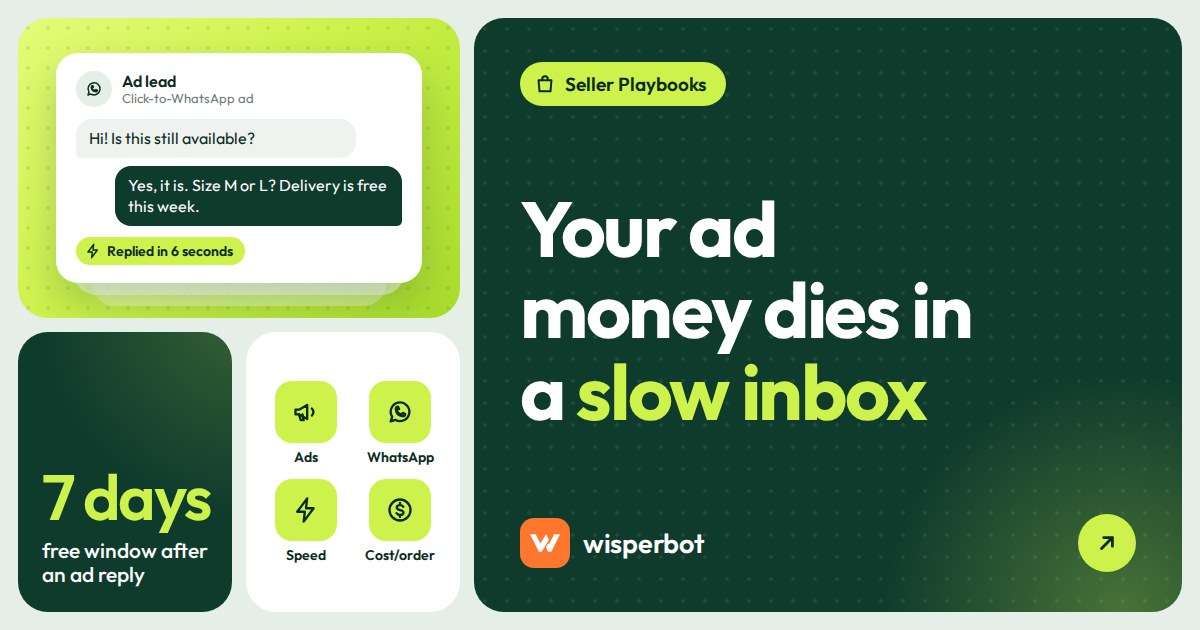
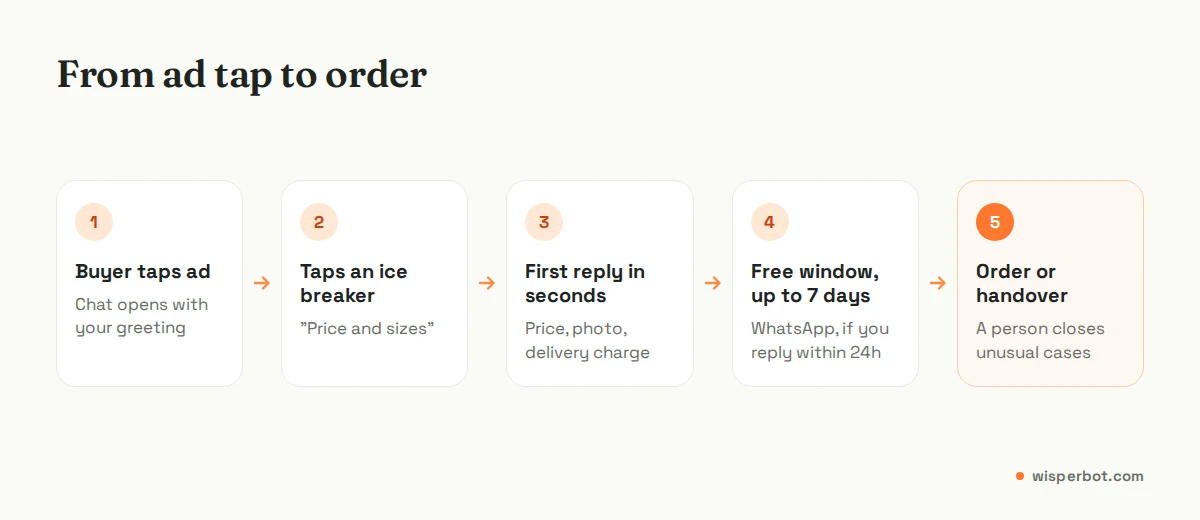
- On WhatsApp, if you reply within 24 hours to someone who came from a click-to-WhatsApp ad, Meta opens a free entry point window of up to 7 days in which your messages are free.
- Set the greeting and ice breakers before launch, and make sure whoever answers (person or bot) knows the advertised product's price.
- Run ads only in hours when someone or something answers properly.
What are click-to-WhatsApp and click-to-Messenger ads?
They are Meta ads on Facebook and Instagram whose button opens a chat instead of a website. Meta's documentation describes them as ads that "send people who click on your ads directly into conversations with your business" in WhatsApp or Messenger. Click-to-WhatsApp ads need a WhatsApp number linked to your Facebook Page.
When someone taps, the chat opens with a pre-filled message. Meta's default is "Hello! Can I get more info on this?", which you can replace with your own greeting. You can also add ice breakers: short, tappable questions such as "Price and sizes" or "Delivery charge to my area".
For DM-first sellers in Bangladesh, Pakistan and much of India, these are often the main paid channel. There is no website checkout to send people to. The chat is the shop.
What are you actually paying for?
You are paying for a conversation to start, not for a sale. Ads Manager reports a cost per messaging conversation started. That number can look healthy while your cost per order is terrible, because everything between "conversation started" and "order placed" happens in your inbox, where Ads Manager can't see if you replied.
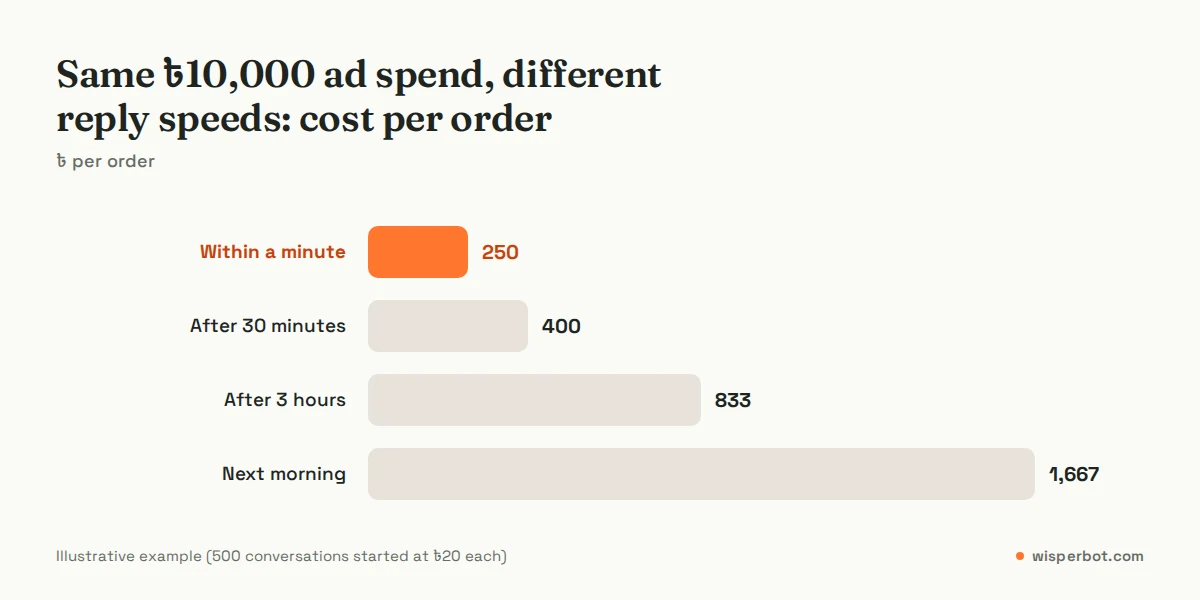
Here is an illustrative example. The numbers are invented to show the shape of the problem, not taken from any study. A Dhaka shop spends ৳10,000 and pays ৳20 per conversation started, so 500 people open a chat. What happens next depends on the first reply.
| First reply arrives | Conversations started | Orders (illustrative) | Cost per order |
|---|---|---|---|
| Within a minute | 500 | 40 | ৳250 |
| After 30 minutes | 500 | 25 | ৳400 |
| After 3 hours | 500 | 12 | ৳833 |
| Next morning | 500 | 6 | ৳1,667 |
Same ad, same audience, same spend. In this example the slow inbox pays more than six times as much per order. Your own numbers will differ, so measure them: count orders from ad conversations for one week with your current reply speed, then for a week with faster replies.
Our post on what a slow reply really costs has a calculator you can fill in with your own figures.
Why do ad conversations go cold so quickly?
Because the buyer tapped your ad mid-scroll, not after deciding to shop with you. They are curious for a few minutes. Many tap two or three similar ads in one session, and the first page to reply with a real price and a photo usually wins. After that, your reply lands in a chat they have forgotten.
The timing makes it worse. Ads for clothing, gadgets and home goods in South Asia tend to get their cheapest attention late in the evening, when people are home and on their phones. That is often exactly when the shop owner has stopped replying. An ad that runs until 1 am with an inbox that closes at 10 pm is spending three hours of budget on conversations nobody answers.
The first reply also has to be useful. "Hi, thanks for your message, we'll get back to you soon" is an acknowledgement, not an answer. To someone who asked "dam koto?", it reads like nobody is there.
The one-minute rule
If your inbox can't send a useful first reply within about a minute while ads are running, do one of three things before spending more:
- Pause the ads in hours nobody covers. Use ad scheduling where your campaign settings allow it, or turn the campaign off at night by hand. Crude, but it stops the waste.
- Put a person on the inbox during ad hours. Someone whose only job between 8 pm and midnight is replying to ad conversations. This works for a team, and gets expensive for a single owner.
- Let an AI reply bot send the first answer. It answers price, stock, sizes and delivery questions from your own information in seconds, and hands anything unusual to a person.
We would not run messaging ads on an inbox that relies on "I'll check my phone when I can". It is the most common way we see small sellers conclude that "Facebook ads don't work", when the ad did its job and the inbox didn't.
Agencies running these campaigns for clients hit the same wall from the other side: the client blames the ads for a cost per order that the client's own inbox caused. Some agencies now sell reply cover alongside the ad budget, and our guide to white-label AI chat for agencies shows how to price and run it.
How does the free entry point window work on WhatsApp?
When someone messages you from a click-to-WhatsApp ad, using the WhatsApp Android or iOS app, and you reply within 24 hours, Meta opens a free entry point window. It may stay open for up to 7 days from your reply (Meta's developer pricing page, updated 30 September 2026; some older Meta pages still say 72 hours), and every message you send them inside it is free, including templates. Desktop and web WhatsApp don't qualify, and Meta Business Agent messages are still charged.
This matters because it removes one excuse for slow replies. You are not saving money by waiting. The quicker you reply, the sooner the free window starts and the longer you have to follow up on a buyer who said "let me ask my husband" or "I'll order after salary day".
A few cautions. The free entry point window is separate from the 24-hour customer service window, so once the service window closes, you can only send template messages, even if they are free. Once the free window ends, ordinary replies cost money too: since 1 October 2026 Meta charges per message for service replies inside the 24-hour window, at the utility rate for that market, after the first 1,000 service messages per business number each month. And Messenger works differently: it has its own 24-hour standard messaging window and no WhatsApp-style per-message fees. Our explainer on the 24-hour messaging window on each channel sets out the rules side by side.
How should you set up the greeting and ice breakers?
Write a greeting that names the product in the ad and add three or four ice breakers that match the questions buyers actually ask: price and sizes, delivery charge and time, how to order, and talk to a person. The greeting sets the topic; the ice breakers give the buyer a one-tap first question your inbox can answer instantly.
Use this checklist before each campaign goes live:
| Item | What to set | Why it matters |
|---|---|---|
| Greeting | Names the product: "Hi, I'm asking about the cotton three-piece in the ad" | Whoever replies knows which product without asking |
| Ice breakers | 3 to 4 short questions (Meta caps Messenger ice breaker titles at 80 characters) | One tap is easier than typing |
| Price list | The advertised product, every size and colour, current price | The first reply can include the price |
| Delivery charges | Inside and outside your city, and typical days | The second question is almost always delivery |
| Ad hours | Only hours with a person or AI answering | No paid conversations into an empty inbox |
| Handover | Who takes over, and by when | The bot can answer, a person closes the unusual cases |
One mistake we see often: the ad promotes a new arrival that isn't in the price list or the bot's knowledge yet. The first 50 buyers ask the price of exactly the product nobody has written down. Update your price list before you press publish, not after. Our guide on writing a price list your chatbot can use shows the columns to include.
Where WisperBot fits
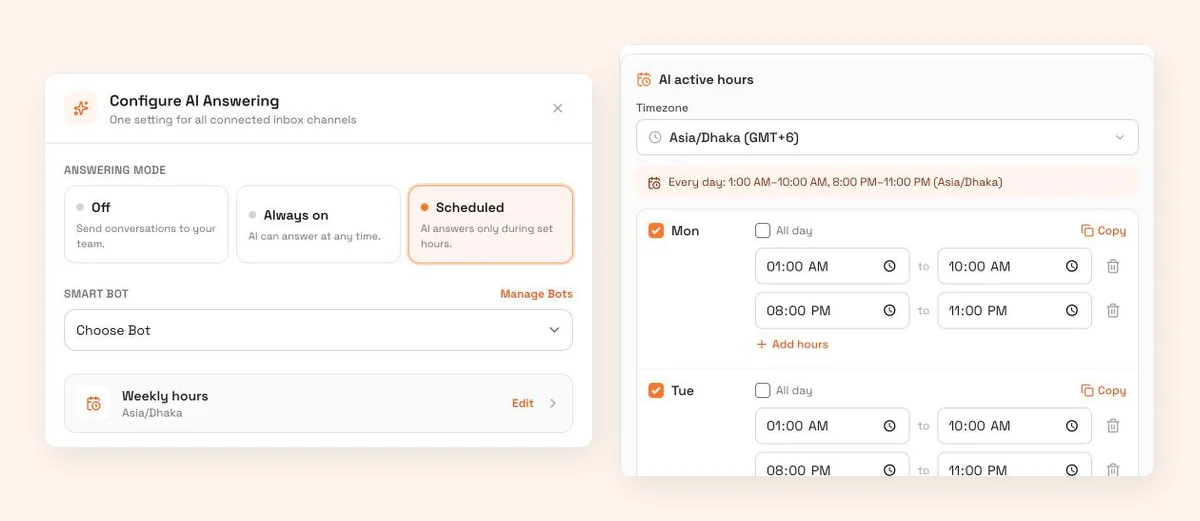
WisperBot, a reply-first inbox for WhatsApp, Instagram, Messenger and website chat, is built for exactly the ad-hour problem. Set AI answering to Always on while campaigns run, or Scheduled for the evening hours you can't cover, and the Smart Bot replies in seconds from your own price list and information, then hands over to a person. Strict mode keeps it to your data. Reports show your median first response time, so you can check whether the one-minute rule held. WisperBot doesn't create or manage Meta ads; you still run those in Ads Manager. Plans are on the pricing page.
Frequently asked questions
Are click-to-WhatsApp ads worth it for a small shop?
They can be, if your inbox replies quickly and knows your prices. The ad only starts the conversation. Test with a small budget for one week, count orders from ad chats, and work out cost per order, not cost per message. If replies are slow, fix that first or the test tells you nothing.
How fast should I reply to someone who clicked my ad?
Within about a minute for the first useful reply, meaning one that answers their question rather than "we'll get back to you". After that, a person can take over for anything complex. Ad clicks are impulse moments, and buyers often message several sellers in the same few minutes.
Is replying to a click-to-WhatsApp ad conversation free?
Mostly, yes. If the person came from a click-to-WhatsApp ad on the Android or iOS app and you reply within 24 hours, Meta opens a free entry point window of up to 7 days. Outside it, Meta has charged per message since 1 October 2026, even for normal replies inside the 24-hour customer service window, at the utility rate for that country, once a number has used its 1,000 free service messages for the month.
Should I run messaging ads at night?
Only if something answers at night. Evening and late-night attention is often cheap and active, but an unanswered chat at 11:40 pm is wasted spend. Either schedule AI replies for those hours, put a person on the inbox, or stop the ads when you stop replying.
What is a good cost per messaging conversation started?
There is no universal benchmark: it varies by country, category, season and audience. A more useful number is cost per order from ad conversations. Track it weekly. If cost per conversation falls but cost per order rises, the problem is usually in the inbox, not the ad.
Sources
- Meta for Developers: Ads that click to WhatsApp (checked October 2026)
- Meta for Developers: Ads that click to Messenger (checked October 2026)
- Meta for Developers: Welcome message sequences for click-to-WhatsApp ads (checked October 2026)
- Meta for Developers: WhatsApp Business Platform pricing, free entry point window (checked October 2026)
- Meta for Developers: Messenger Platform policy, 24-hour standard messaging window (checked October 2026)
- Meta for Developers: Non-template (service) message pricing, charged per message from 1 October 2026
Last checked: 8 October 2026.