How to Make an AI Chatbot Understand Roman Bangla (Banglish) Messages
Roman Bangla has no standard spelling, so keyword bots break. How AI bots handle Banglish, a 20-message test set you can copy, and when to hand over to a person.
In this article
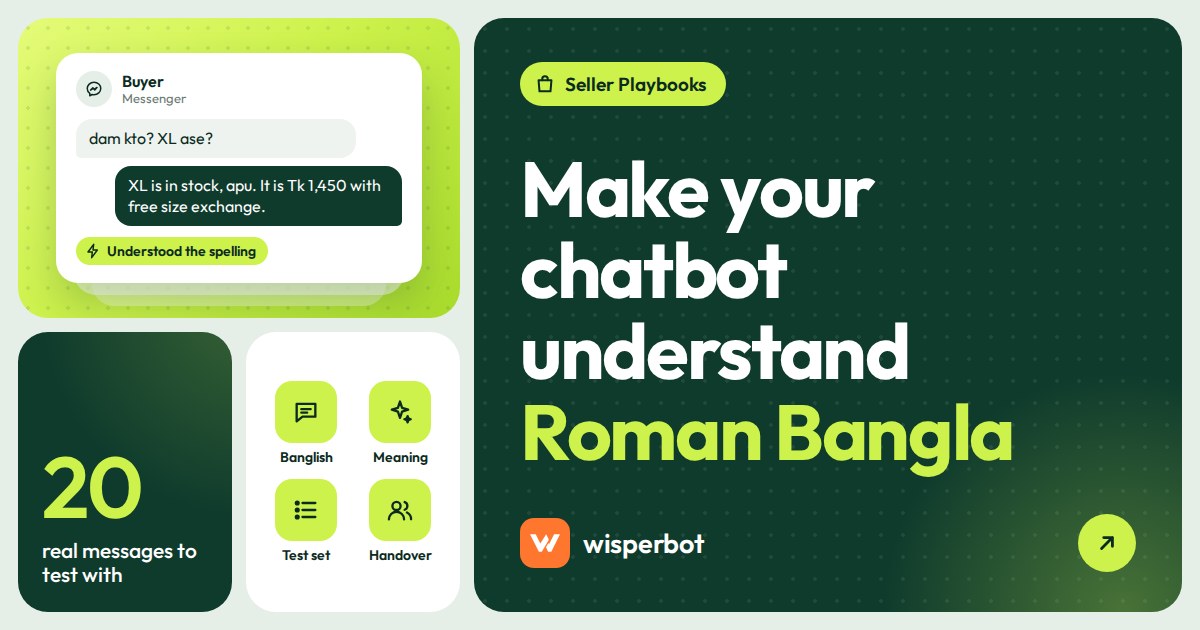
A buyer types "XL ase?" at 1 am, another writes "XL ache?", a third sends "xl acha apu??". All three mean the same thing, and a keyword bot built on the word "ache" will answer only one of them. A Banglish chatbot (one that understands Bangla typed in English letters, also called Roman Bangla) needs to read meaning, not match spellings. Modern AI bots built on large language models usually manage this well. You still need to test with real messages from your inbox and send very short or unclear ones to a person.
Key takeaways
- Roman Bangla has no standard spelling. Google researchers describing South Asian languages written in Latin script found no commonly used standard and spellings that vary from person to person.
- Keyword and button bots break on that variety. AI bots that work out meaning from the whole message handle it far better.
- Test any bot with at least 20 real messages from your own inbox before switching it on.
- Very short messages ("kto", "?", "hmm") can still fail. Plan a clarifying question, then a handover.
- Understanding the language is half the job. The bot also needs your prices and policies to answer correctly.
What does Roman Bangla look like in real DMs?
Roman Bangla is Bangla written with English letters, usually mixed with English words and sometimes Bangla script in the same message. In seller inboxes it looks like "dam koto", "eta koto taka", "delivery charge koto?" or "red ta ase?". The same word can be spelled four ways by four buyers, and nobody considers any of them wrong.
A few patterns show up again and again in Bangladeshi Facebook and WhatsApp inboxes:
- One word, many spellings. "koto", "kto", "kot"; "ache", "ase", "asey", "acha"; "lagbe", "lgbe", "lagbay".
- English inside Bangla. "size chart ta den", "cash on delivery hobe?", "order confirm korsi".
- Numbers as words. "2ta", "duita", "2 piece" all meaning two.
- Dropped vowels and shortcuts. "plz", "vai", "apu", "pls dm".
- Dialect. A buyer from Sylhet or Chattogram may write words a Dhaka-trained ear wouldn't expect.
This isn't sloppiness. Google researchers who built the Dakshina dataset (Roark and colleagues, 2020) note that South Asian languages, Bengali among them, are often written in Latin script for informal messaging, WhatsApp and social media, that there is "no commonly used standard Latin script orthography", and that spellings vary from one person to the next.
Why do keyword chatbots fail with Banglish messages?
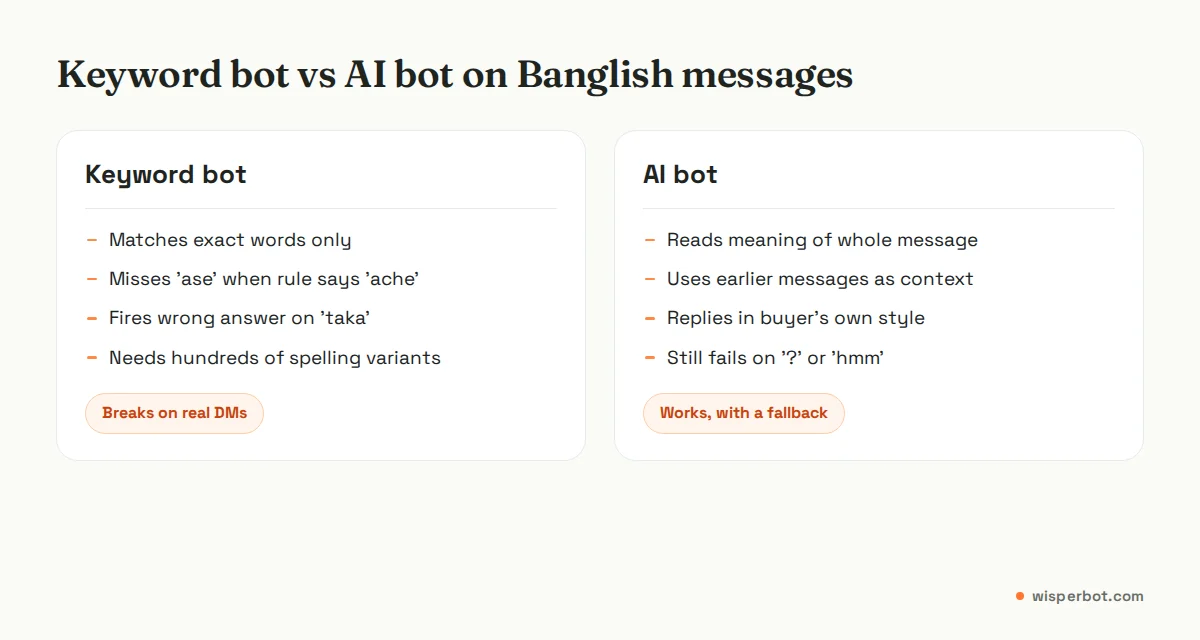
Keyword chatbots fail with Banglish because they match exact words or short lists of words. A rule that answers "price" and "koto" misses "dam kto", "prize?" and "koto porbe". A rule for "ache" misses "ase". With no standard spelling, you would need hundreds of variants per question, and buyers keep inventing new ones.
The failures also look bad. A keyword bot that sees "taka" may fire a payment message at someone asking about delivery cost. A button menu ("Press 1 for price") gets ignored by buyers who just want to type. It's a common reason sellers give up on bots after a week and go back to answering everything by hand at midnight.
How do AI chatbots understand Roman Bangla?
AI chatbots built on large language models learn from huge amounts of text, which includes plenty of informal, romanised South Asian writing. Instead of matching a word, they read the whole message and its context, so "XL ase?" and "xl acha apu" both come out as a question about size availability. They can also reply in the buyer's own style.
Context is what makes this work. "koto?" on its own is vague. "koto?" sent right after a buyer shares a post about a K-214 three piece is clearly a price question about that item. A good AI bot uses the previous messages in the conversation, so it often gets the right answer even when the latest message is two letters long.
Two limits. First, understanding the question doesn't mean knowing the answer. The bot still needs your price list, delivery charges and policies, or it will either hand over or, worse, guess. Our guide to stopping an AI chatbot making up prices covers that side. Second, the shortest messages with no context, like "?" or "hmm", don't contain enough meaning for any bot, AI or not.
How to test a Banglish chatbot with 20 real messages
Don't trust a demo. Test the bot with messages your buyers actually sent. This is the set we'd start with for a clothing Page in Dhaka; swap in your own products and areas.
| # | Message | What the buyer means | Expected bot action |
|---|---|---|---|
| 1 | dam koto? | Price (product unclear) | Ask which product, or use the shared post |
| 2 | eta koto taka (with post link) | Price of this item | Give exact price and delivery charge |
| 3 | price koto apu | Price | Give price if product known, else ask |
| 4 | kto | Price, very short | One clarifying question |
| 5 | XL ase? | Is size XL in stock? | Check list, answer yes or no |
| 6 | red colour ta available ache? | Is red in stock? | Check list, answer |
| 7 | Dhakar baire delivery charge koto? | Delivery charge outside Dhaka | Give the charge |
| 8 | ajke order dile kalke pabo? | Next-day delivery? | Give delivery time by area |
| 9 | cash on delivery hobe? | Do you take cash on delivery? | Answer from payment policy |
| 10 | bKash e payment kora jabe? | Can I pay by bKash? | Answer from payment policy |
| 11 | size chart ta den | Send the size chart | Share size chart text or link |
| 12 | ami 5'4, kon size nibo? | Which size fits me? | Answer from size chart or hand over |
| 13 | exchange kora jay? | Exchange policy | Give policy |
| 14 | 2ta nile koto porbe? | Price for two | Calculate from list plus delivery |
| 15 | apnader showroom ache? kothay? | Do you have a shop? Where? | Give address or say online only |
| 16 | discount den na vai | Asking for a discount | Hand over to a person |
| 17 | parcel e vul product asche | Wrong item delivered | Apologise, hand over |
| 18 | order ta cancel korte chai | Cancel my order | Hand over |
| 19 | hmm | Unclear | Wait or ask gently, no sales push |
| 20 | ? | Unclear, probably waiting | Ask what they need, then hand over |
Run it like this:
- Copy 20 real messages from last month's inbox, covering your common questions plus three or four awkward ones. Remove names and numbers.
- Send each one to the bot from a test account, in a fresh conversation, so earlier messages don't help it.
- Then send the price questions again after sharing a product post, to check it uses context.
- Mark each reply: right answer, right handover, or wrong. A wrong price or policy is a fail, however polite it sounds.
- Fix your information first (missing delivery area, unclear size chart), then retest only the failures.
- Repeat monthly with new messages. Buyers' spellings and your products both change.
Our rule of thumb: if the bot gets fewer than 17 of 20 right, including every price, don't switch it on yet. Fix the data and retest.
When should a Banglish chatbot hand over to a person?
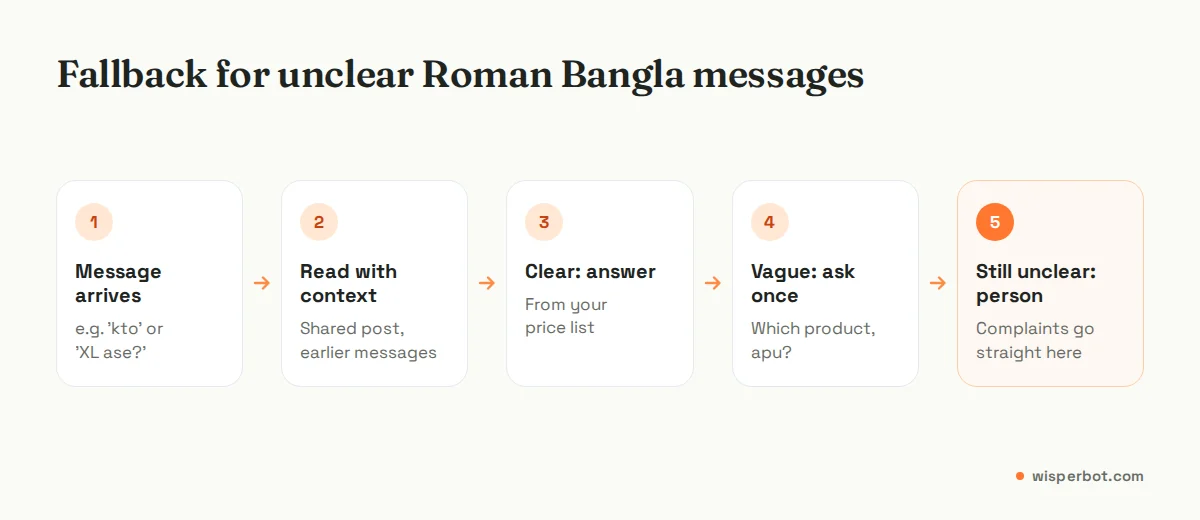
A Banglish chatbot should hand over when the message is a complaint, a cancellation, a discount request or a custom order, and when it still doesn't understand after one clarifying question. Two failed attempts in a row is a reasonable trigger. Buyers forgive "amader team ekhuni reply dibe" far more easily than a confident wrong answer.
The clarifying question matters. For a bare "kto", a reply like "Kon product ta, apu? Post er code ta dile dam bole dichhi" fixes most cases in one step. If the buyer answers with a screenshot and nothing else, the bot may still not know which product it is, so hand over. For handover design in general, see our AI-to-human handoff playbook.
Which answer mode works best for Roman Bangla?
The answer mode controls how freely the bot answers, not how well it understands Banglish. For shops where most questions are prices and stock, a strict mode that answers only from your information is safest. If the bot keeps handing over friendly small talk like "thank you apu", a balanced mode gives it a little more room.
WisperBot's app marks Balanced as recommended, but we'd start strict for the first two weeks, read the handovers, and only loosen it if most of them were harmless chat rather than real questions. The guide to Strict, Balanced and Flexible modes compares the same question answered in each.
Where WisperBot fits
WisperBot, a reply-first inbox for WhatsApp, Instagram, Messenger and website chat, has a Smart Bot that replies in the customer's language, including mixed scripts like Roman Bangla. It answers from your own business details, knowledge and price list (CSV or Google Sheet), in Strict, Balanced or Flexible mode. Very short, low-keyword messages can still fall back to a human, and each conversation has an AI/Human switch in the inbox and the mobile app. There's no Bangla interface language yet. More on the Smart Bot page, and for price questions specifically, see answering "price koto?" automatically.
Frequently asked questions
What is a Banglish chatbot?
A Banglish chatbot is a chatbot that understands Bangla written in English letters, often mixed with English words, such as "dam koto" or "XL ase?". Most good ones today are AI bots built on large language models, because keyword rules can't keep up with how many ways people spell the same Banglish word.
Can ChatGPT-style AI understand Roman Bangla?
Large language models generally understand common Roman Bangla well, especially everyday shopping phrases, because they have seen a lot of informal romanised text. Accuracy drops with very short messages, heavy dialect and slang. That's why you should test a bot on your own customers' messages instead of relying on a demo.
Should my bot reply in Bangla script or Roman Bangla?
Reply in the style the buyer used. If they write Roman Bangla, answer in Roman Bangla; if they write Bangla script, answer in Bangla script. Matching their style reads as friendly, and it avoids answering in a script they didn't choose to use.
How many test messages do I need before going live?
Twenty real messages is a sensible minimum for a small shop, covering prices, stock, delivery, payment, exchange and a few complaints and unclear ones. If your catalogue is large or you sell in several cities, use 40. Retest every month with fresh messages from your inbox.
Will a chatbot understand Sylheti or Chattogram dialect?
Sometimes. AI bots handle common regional words better than keyword bots, but strong dialect written in English letters is harder and results vary. Include a few dialect messages in your test set if many buyers come from those areas, and make sure unclear replies go to a person.
Sources
- Roark et al. (2020), Processing South Asian Languages Written in the Latin Script: the Dakshina Dataset (arXiv)
- Google Research: publication page for the Dakshina dataset
Last checked: 8 October 2026.