How Fast Should You Reply to Customer Messages? 2026 Benchmarks for WhatsApp, Instagram and Messenger
Chat buyers expect minutes, not hours. Here are reply targets for WhatsApp, Instagram and Messenger, the research behind them, and how to measure yours.
In this article
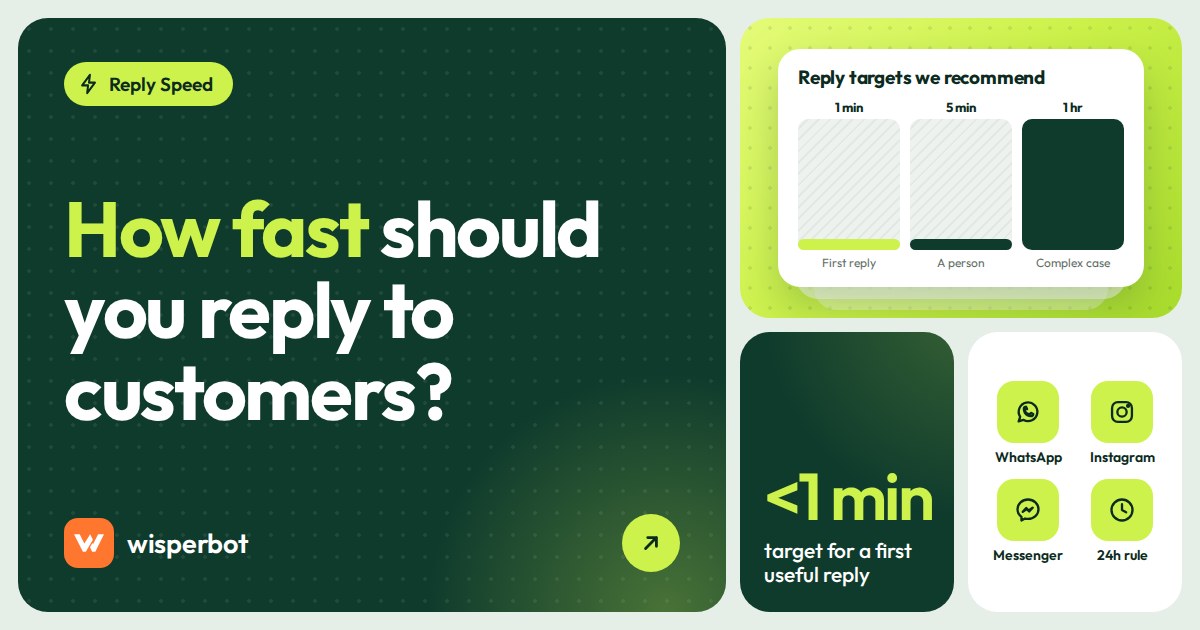
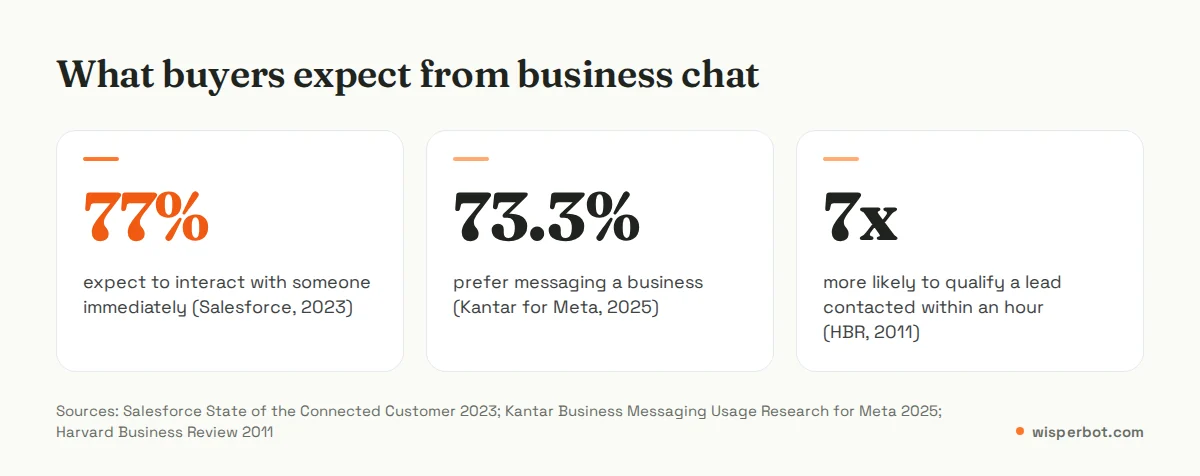
How fast should you reply to customer messages? On WhatsApp, Instagram and Messenger the answer is minutes, not hours. A practical target for 2026 is a first useful reply in under a minute, a person picking up within five minutes during business hours, and a full answer to complicated questions within an hour. Buyers treat chat as a live conversation: in Salesforce's 2023 State of the Connected Customer survey, 77% of customers said they expect to interact with someone immediately when they contact a company.
Key takeaways
- 77% of customers expect to interact with someone immediately when they contact a company (Salesforce, 2023).
- Our recommended ladder: first useful reply under 1 minute, a person under 5 minutes in business hours, complex cases under 1 hour.
- Meta's 24-hour messaging window is a ceiling, not a target. Once it closes on WhatsApp you can only restart with an approved template.
- An away message is not a reply. Count the first message that actually answers the question.
- Track your median first reply every week and look at night-time messages separately.
Why do chat customers expect replies in minutes?
Because your shop sits in the same app as their friends and family, and nothing on the screen says you are closed. In Kantar's 2025 research for Meta, 75.1% of consumers said they want to message businesses the way they message friends and family. Friends answer in minutes, so that becomes the yardstick.
Think about the moment the message is sent. It's 11:40 pm in Mirpur. Someone has just seen your black kurti in a reel and types "Apu, M size ache? dam koto?" They send something similar to two other pages that sell almost the same thing. There is no queue number and no hold music, so silence doesn't feel like waiting. It feels like nobody is there.
From what we see in sellers' inboxes, the page that answers first with the price and the size usually gets the conversation, and often the order. The other two pages reply at 9 am to someone who has already paid.
Email is different. Nobody expects an email back in sixty seconds. But WhatsApp, Instagram DMs, Messenger and website chat all look and feel like a live conversation, and customers judge you by live-conversation standards.
What does the research say about reply speed?
The strongest public evidence is about expectations, not exact minutes. Surveys by Salesforce (2023) and Kantar for Meta (2025) show most customers expect an immediate answer and prefer messaging, and a 2011 Harvard Business Review audit found leads contacted within an hour were far more likely to turn into real conversations.
| Source | Year | Finding | What it means for a DM seller |
|---|---|---|---|
| Salesforce, State of the Connected Customer | 2023 | 77% of customers expect to interact with someone immediately when they contact a company | "Immediately" is the bar, and the customer sets it |
| Kantar for Meta, Business Messaging Usage Research (11,056 adults, 22 markets incl. India, UAE, Saudi Arabia) | 2025 | 73.3% prefer messaging when communicating with a business; 67.7% say a response from an AI chatbot is helpful | Buyers accept a bot answering first, as long as it answers |
| Harvard Business Review, "The Short Life of Online Sales Leads" (2,241 US companies) | 2011 | Firms that contacted a lead within an hour were nearly 7 times as likely to qualify it as firms that waited even an hour longer | Buying interest fades in hours, not days |
| Zendesk CX Trends 2025 (about 5,100 consumers) | Published Nov 2024 | 63% of consumers would switch to a competitor after one bad experience | One ignored DM can be the whole relationship |
Two cautions. First, you will find plenty of blog posts claiming "the average WhatsApp response time is X minutes" with no traceable study behind them. We don't repeat those. Second, the Kantar study was commissioned by Meta, which sells business messaging, and none of these surveys looks specifically at small sellers in Dhaka, Lahore or Deira. Read them as direction, not as a stopwatch.
Reply time targets for WhatsApp, Instagram and Messenger
Each channel has a hard rule set by the platform and a softer expectation set by buyers. The rule tells you when you lose the ability to reply freely. The expectation tells you when you lose the sale. The second one always comes first.
| Channel | Platform rule | How buyers use it | Our first-reply target |
|---|---|---|---|
| 24-hour customer service window from the customer's last message; after that, only approved templates. Since 1 October 2026 Meta charges per message for replies inside the window too, after 1,000 free a month per business number | Feels like a friend's chat; used for price, stock and order checks | Under 1 minute; a person within 5 minutes in business hours | |
| Messenger | 24-hour standard messaging window; the Human Agent tag lets a person reply manually within 7 days | Often starts from a Facebook post or ad while the buyer compares pages | Under 1 minute |
| Instagram DMs | 24-hour window; a human agent tag allows a manual reply outside it | Impulse questions straight from a reel or story | Under 1 minute |
| Website chat | No Meta window, but the visitor leaves when they close the tab | The person is on your page right now | Under 1 minute, while they are still on the page |
| None | Longer questions, invoices, complaints | Same business day |
One detail matters if you run ads. When someone messages you from a Click-to-WhatsApp ad on the Android or iOS app and you reply within 24 hours, Meta opens a free entry point window of up to 7 days in which all messages, including templates, are free. You have paid for that conversation to start. Letting it sit unanswered for eight hours is the most expensive kind of slow. Our guide to the 24-hour messaging window on each channel covers the rules in detail.
The target ladder: one minute, five minutes, one hour
A single number like "reply within 10 minutes" is too blunt. Different messages need different speeds. This is the ladder we suggest to sellers, and it's the one we use ourselves.
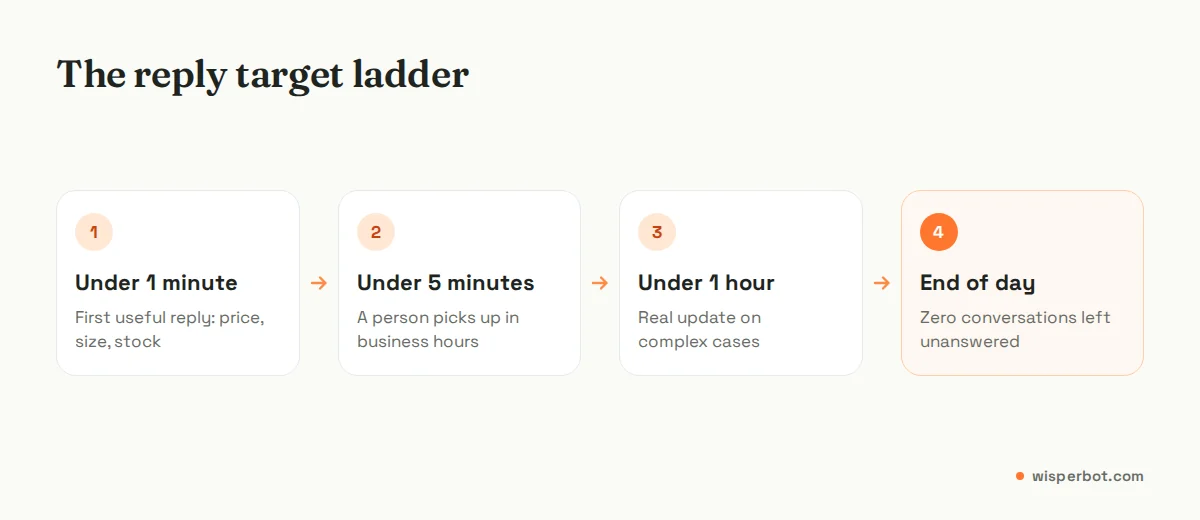
Under 1 minute: the first useful reply
Most first messages are the same five questions: price, size, colour, stock and delivery charge. These can be answered from your own price list in seconds, day or night. "Useful" is the key word. "Thanks for your message!" is not useful. "The black kurti is Tk 1,450, M and L in stock, delivery inside Dhaka Tk 80" is useful (example prices).
Under 5 minutes: a person picks up, during business hours
Bargaining, custom sizes, "can you deliver to Sylhet by Friday?" and anything emotional need a human. During the hours you say you are open, a person should be in the conversation within five minutes of being needed.
Under 1 hour: complex cases
Wrong item delivered, refunds, bulk quotes. You may not solve these in an hour, but you should give a real update within one. "I'm checking with the warehouse, I'll message you by 4 pm" is fine. Then message at 4 pm.
Same day: nothing left unanswered
The number we care about most is boring: how many conversations are still waiting when you close up for the night. Aim for zero.
Does an automatic reply count as a reply?
An away message that only says "we'll get back to you soon" should not count, because it answers nothing. A reply that answers the question does count, whether a person or an AI bot sent it. Zendesk's own first reply metric, for example, ignores most automated actions and stops at the first public agent reply.
This matters because it's easy to fool yourself. Turn on an instant greeting and your dashboard shows a first reply time of zero seconds, while the buyer still waits until morning for the price. Measure the reply that moves the conversation forward. Our guide to measuring first response time properly goes through the edge cases.
How do you find out your real reply speed?
Measure your median first response time each week: the middle value of the time between a customer's first message and your first real reply. Split it by channel and by hour of day, then send a few test messages yourself at 11 pm and 7 am. Most sellers find nights are much slower than days.
Use the median rather than the average. One customer who waited fourteen hours drags the average up, while a week of quick daytime replies drags it down, and the number you end up with describes nobody. Even the median has a blind spot: it can look healthy while a handful of people waited for hours. We explain that in median vs p90 reply time.
If you've never checked, start with a simple test. Message your own page from a friend's phone at three different times and write down how long each reply took. Our reply speed test method turns that into a ten-message scoring sheet.
What if your team can't hit these numbers?
Most small shops can't, at least not around the clock, and that's normal. Cover the hours where you lose the most buyers first, usually late at night, with accurate automated answers, and keep people for the conversations that need judgement. Then work through these four changes in order.
- Fix the nights first. Late evening is when many buyers browse and when owners are asleep. Covering 10 pm to 9 am with automated answers gives the biggest gain for the least risk.
- Don't promise a time you can't keep. If your greeting says "we reply within 5 minutes" and you don't, you've made the wait worse.
- Accuracy beats speed. A correct price in two minutes is better than a wrong one in two seconds. If a bot answers, it should answer only from your own information and pass anything uncertain to a person.
- Pause ads when nobody answers. If your inbox is empty of humans at 2 am, either have something that replies or stop paying for conversations to start then.
Where WisperBot fits
WisperBot, a reply-first inbox for WhatsApp, Instagram, Messenger and website chat, puts all of those messages in one place and lets a Smart Bot give the first reply in seconds, 24/7, using your own price list and business details. You can run it Always on or Scheduled, for example nights only in your timezone. In Strict mode it answers only from your information and hands over when unsure. Reports show median first response time, median resolution time and an SLA trend, with a performance digest by email every Monday. If you get five DMs a day and always answer from your phone, you probably don't need it yet. If nights are where you lose buyers, see how the Smart Bot works; the Free plan includes 100 AI replies a month to test it.
Frequently asked questions
Is it OK to reply to customer messages the next morning?
For email, often yes. For WhatsApp, Instagram or Messenger, a next-morning reply usually means the buyer has already bought elsewhere or lost interest. If you can't have a person online at night, give an immediate answer to the common questions and let a person follow up in the morning for anything that needs judgement.
What is a good response time on WhatsApp Business?
Aim for a first useful reply within a minute and a person within five minutes during the hours you say you're open. The hard limit is Meta's 24-hour customer service window. After it closes you can only restart the chat with an approved template, which can carry a Meta fee.
How fast should I reply to Instagram DMs?
Treat Instagram DMs like WhatsApp: under a minute for the first useful answer. Most Instagram questions arrive straight after someone sees a reel or story, so the buying impulse is short. A price and size answer while they are still in the app is worth far more than a detailed reply three hours later.
Do customers mind getting a reply from a bot?
Most don't, as long as the answer is right. In Kantar's 2025 research for Meta, 67.7% of consumers agreed that getting a response from an AI chatbot is helpful. What annoys people is a bot that loops, guesses or blocks them from reaching a person. Always offer a clear way to talk to someone.
How much does a slow reply actually cost?
It depends on your message volume, how many arrive after hours, your average order value and how many buyers give up when they wait. You can estimate it with a simple formula using your own numbers. We walk through it with worked examples in our slow reply cost calculator.
Sources
- Salesforce: How are customer touch points changing? (State of the Connected Customer, 2023)
- WhatsApp Business: The State of Business Messaging (Kantar for Meta, 2025)
- Harvard Business Review: The Short Life of Online Sales Leads (Oldroyd, McElheran and Elkington, March 2011)
- Zendesk: CX Trends 2025 report announcement
- Meta for Developers: WhatsApp Business Platform pricing
- Meta for Developers: Messenger Platform policy overview
- Meta for Developers: Instagram Messaging API
- Zendesk Help: Understanding ticket reply time
- Meta for Developers: Non-template (service) message pricing, charged per message from 1 October 2026
Last checked: 8 October 2026.