What a Slow Reply Really Costs an Online Seller (With a Simple Calculator)
A transparent formula for what slow replies cost an online seller, with worked examples in taka, rupees and dirhams and an honest check on whether a bot pays.
In this article
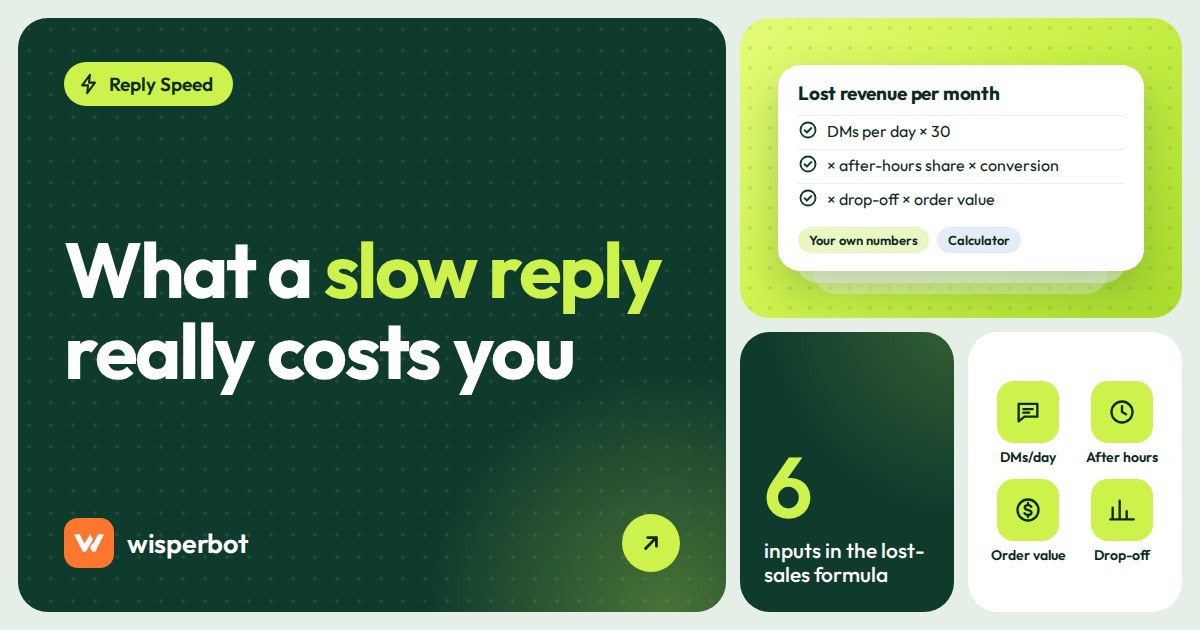
The cost of a slow customer response is the orders you would have won if you'd answered in time, minus the ones you win anyway. A simple way to estimate it: messages per day × 30 × share arriving when nobody answers × your normal conversion rate × the share of those buyers who give up before you reply × your average order value. For a Facebook clothing page getting 80 DMs a day, with our clearly labelled assumptions, that comes to about Tk 75,600 a month in lost sales. The point of this post is to help you put in your own numbers rather than borrow ours.
Key takeaways
- Lost revenue per month = DMs per day × 30 × after-hours share × conversion rate × drop-off when late × average order value.
- Every input in our examples is an assumption, not a statistic. Replace them with numbers from your own inbox.
- You can measure your own drop-off: compare the order rate of chats answered quickly with those answered the next morning.
- Look at lost gross profit, not just lost revenue, before deciding what a faster reply is worth.
- For some shops the maths says a bot pays for itself many times over. For others it doesn't, and our India example is one of those.
How do you calculate the cost of a slow reply?
Multiply your monthly messages by the share that wait too long, then by how many of those would normally buy, then by how many give up because of the wait, then by your average order value. That gives lost revenue. Multiply by your gross margin to get lost profit, the number to compare with any cost of replying faster.
Written out, with each input explained:
- DMs per day. New conversations, not individual messages. Count a normal week and divide by seven.
- Share arriving when nobody answers. For most small shops that's late night and early morning. Count how many conversations start outside your active hours.
- Conversion rate when answered fast. Of conversations you answer within a few minutes, what share become orders?
- Drop-off when the reply is late. Of the people who would have bought, what share have gone by the time you reply? This is the number most people guess. Below, we show how to measure it.
- Average order value (AOV). Total sales divided by number of orders.
- Gross margin. What you keep from each sale after the cost of the product and delivery.
Lost orders per month = DMs per day × 30 × after-hours share × conversion rate × drop-off
Lost revenue = lost orders × AOV
Lost gross profit = lost revenue × gross margin
We deliberately don't plug in industry averages. Figures like "X% of customers leave if you don't reply in Y minutes" get passed between blog posts without a traceable study behind them. Your own inbox is a better source than any of them.
Worked example: a Facebook clothing page in Dhaka
Example: a women's clothing page run from Mohammadpur. The owner answers messages from 10 am to 10 pm. Every number below is an assumption chosen to be plausible, not a measured figure.
- 80 new conversations a day.
- 35% arrive between 10 pm and 10 am, when nobody is answering.
- 10% of quickly answered conversations become orders.
- Half of the would-be night buyers have bought elsewhere or lost interest by 10 am.
- Average order value Tk 1,800. Gross margin 30%.
Night-time conversations: 80 × 30 × 0.35 = 840 a month. Normally 10% would order, so 84 would-be orders. Half are lost to the wait: 42 lost orders. At Tk 1,800 each that's Tk 75,600 in lost sales a month, or about Tk 22,680 in lost gross profit.
That's one "kurti set, M size, dam koto?" at 11:40 pm, repeated about ten times a week. None of those buyers complains. They just don't come back, and nothing in your Facebook insights tells you they existed.
The same model for an Instagram brand in Bengaluru and a WhatsApp shop in Dubai
The formula works in any currency. Here are two more examples with different volumes and order values. Again, every input is an assumption.
| Input or result | Dhaka clothing page (BDT) | Bengaluru skincare brand (INR) | Dubai abaya shop (AED) |
|---|---|---|---|
| New conversations per day | 80 | 150 | 40 |
| Share arriving when nobody answers | 35% | 30% | 40% |
| Conversion when answered fast | 10% | 8% | 12% |
| Drop-off when reply waits until morning | 50% | 40% | 40% |
| Average order value | Tk 1,800 | ₹900 | AED 250 |
| Gross margin | 30% | 40% | 35% |
| Night-time conversations per month | 840 | 1,350 | 480 |
| Lost orders per month | 42 | About 43 | About 23 |
| Lost revenue per month | Tk 75,600 | ₹38,880 | AED 5,760 |
| Lost gross profit per month | Tk 22,680 | ₹15,552 | AED 2,016 |
Notice the Bengaluru brand has about 60% more night-time messages than the Dhaka page but loses about the same number of orders, because fewer of its chats convert and fewer of its buyers give up overnight. Each of those lost orders is also worth far less. Volume alone doesn't tell you how much a slow reply costs.
What changes if you cut reply time?
Lost sales fall as reply time falls, but not in a straight line. Most of the loss sits in the overnight gap, so moving night replies from "next morning" to "within a few minutes" recovers far more than shaving a daytime reply from ten minutes to five. The table below shows this for the Dhaka example.
| Reply time for night-time messages | Assumed share of would-be buyers lost | Lost orders per month | Lost revenue per month |
|---|---|---|---|
| Under 1 minute | 0% (baseline) | 0 | Tk 0 |
| Around 15 minutes | 5% | 4.2 | Tk 7,560 |
| Around 1 hour | 15% | 12.6 | Tk 22,680 |
| Next morning (8 to 12 hours) | 50% | 42 | Tk 75,600 |
| Never answered | 100% | 84 | Tk 151,200 |
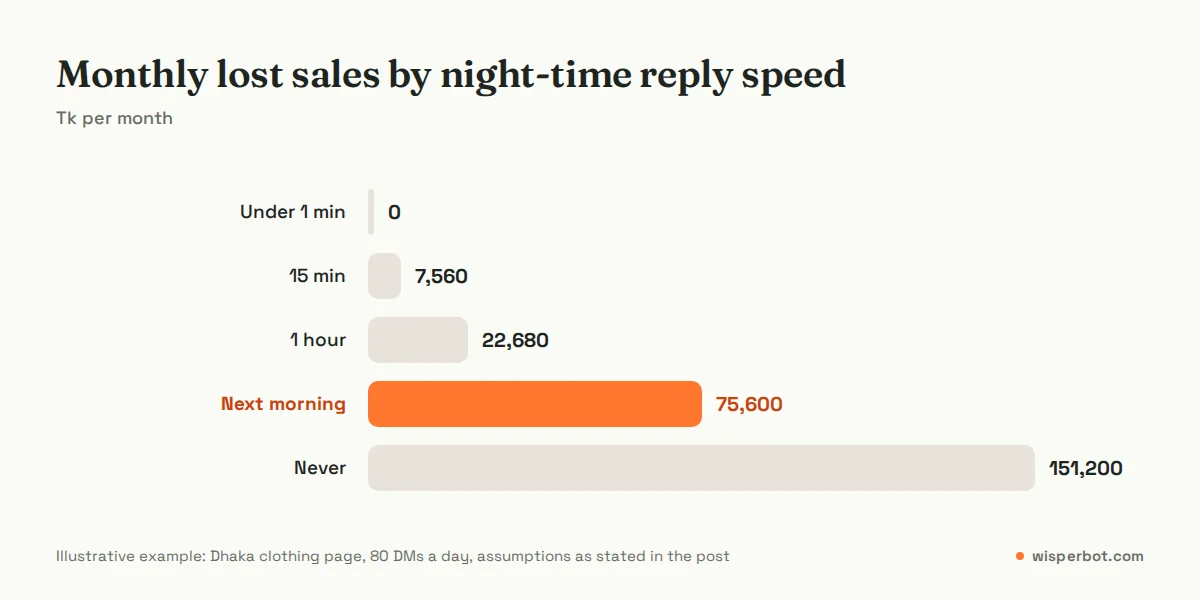
The drop-off percentages in that table are our placeholders. Research supports the direction, not the exact figures. Harvard Business Review's 2011 audit of 2,241 US companies found that firms contacting a lead within an hour were nearly seven times as likely to qualify it as firms that waited even an hour longer. That was web leads to US businesses, not DMs to an online shop, so treat it as a reason to measure, not a number to copy.
How do you find your own drop-off rate?
Compare two groups of conversations from the last month. First, chats you answered within five minutes: what share became orders? Second, chats that arrived at night and got their first reply next morning: what share became orders? Drop-off = 1 minus (slow-group order rate ÷ fast-group order rate).
Example: 11% of quick-reply chats ordered, and 4% of next-morning chats ordered. Drop-off = 1 − (4 ÷ 11) = about 64%. That's your number, from your buyers, and it beats any figure in this post.
You need roughly 50 conversations in each group before the result settles. Use labels or a simple spreadsheet column to mark "ordered" as you go. If you've never measured how quickly you reply, start with our reply speed test and the targets in how fast you should reply to customer messages.
Does replying faster pay for itself?
Compare the gross profit you'd recover with the full cost of replying faster, whether that's a night-shift person or software. An AI reply bot won't win back every lost order, so assume it recovers part of them. If the recovered profit is comfortably above the monthly cost, it pays; if it's close, cover fewer hours or improve answers first.
Here's that check using the plan prices of WisperBot, our reply-first inbox for WhatsApp, Instagram, Messenger and website chat (checked 8 October 2026), and three more assumptions: each answer the bot sends counts as one AI reply, and a typical conversation needs a few bot answers (our estimate: 2 to 4, so we use 3 here); the bot recovers half of the lost orders, and exchange rates of Tk 122.85, ₹96.81 and AED 3.6725 to the US dollar.
| Example | AI replies needed per month | Plan that covers it | Monthly cost in local currency | Gross profit recovered (half of lost) | Verdict |
|---|---|---|---|---|---|
| Dhaka clothing page | About 2,520 | Growth, $39 | About Tk 4,790 | Tk 11,340 | Pays, roughly 2.4 times over |
| Bengaluru skincare brand | About 4,050 | Scale, $129 | About ₹12,490 | ₹7,776 | Doesn't pay on these numbers |
| Dubai abaya shop | About 1,440 | Growth, $39 | About AED 143 | AED 1,008 | Pays, roughly 7 times over |
The Bengaluru case is worth staring at. High volume, low order value and a modest conversion rate mean it needs a bigger plan while each recovered order is worth less. On these assumptions the owner would do better to cover only the busiest night hours, say 10 pm to 1 am, or to push up the recovery rate by making sure the bot answers price and stock questions accurately. Or decide nights aren't worth automating yet. That's a legitimate answer.
Two costs aren't in the table. Meta's WhatsApp fees are separate from WisperBot plans and left out here, which flatters the Dubai WhatsApp shop most. Since 1 October 2026 Meta charges per message for service replies inside the 24-hour window, at the utility rate for that market, once a business number has used its 1,000 free service messages for the month. Past that, every bot answer on WhatsApp carries a Meta fee unless the chat started from an ad and sits in the free entry point window, which can stay open for up to 7 days. Check Meta's rate card for your country and subtract it. And setting up a bot properly takes a few hours of your time: price list, delivery charges, policies, testing. Our chatbot ROI guide adds staff time saved and ad spend to the picture.
What this calculator leaves out
The model is deliberately simple, which means it misses things in both directions.
- Repeat buyers. A first order won at midnight can turn into five more over a year. The model counts only the first.
- Paid conversations. If night messages come from Click-to-WhatsApp or Messenger ads, you paid for each one to start. A slow reply wastes that spend as well.
- Buyers who wait. Some loyal customers will happily wait until morning. That's what the drop-off rate is for; don't set it at 100%.
- Daytime slowness. We've focused on nights. A dead hour at lunch can cost money too.
- Seasonality. Eid, Diwali, 11.11 and Black Friday can multiply message volume. Run the numbers for a sale week separately.
Where WisperBot fits
WisperBot is built for the overnight gap this calculator usually exposes. A Smart Bot answers from your own price list and policies in seconds, on a schedule you set, and hands over to a person in the morning for anything that needs judgement. Plans run from Free ($0, 100 AI replies a month) through Starter ($15), Growth ($39) and Scale ($129), paid by card, with a 14-day trial on paid plans and 15% off yearly billing. Run your own numbers first, then check the pricing page for the plan that fits.
Frequently asked questions
How much revenue do slow replies cost a small online shop?
It varies hugely with message volume, order value and how many buyers give up while waiting. In our illustrative Dhaka example, 80 DMs a day with 35% arriving overnight works out to about Tk 75,600 in lost monthly sales. Use the formula in this post with your own inbox numbers rather than relying on anyone's averages.
Is lost revenue the right number to compare with software costs?
No. Compare lost gross profit, which is lost revenue multiplied by your margin after product and delivery costs. A Tk 1,800 order at 30% margin is worth Tk 540 to you, not Tk 1,800. Using revenue makes every tool look like it pays for itself, which is how small businesses end up with subscriptions they don't need.
What drop-off rate should I assume if I can't measure it?
If you truly can't measure it yet, run the calculator at three values, such as 20%, 40% and 60%, and see whether your decision changes. If it pays at 20%, you're on safe ground. If it only pays at 60%, measure first by comparing order rates for quick-reply and next-morning chats over a month.
Does an auto-reply that says "we'll get back to you" reduce drop-off?
A little, perhaps, because the buyer knows the page is active. But it doesn't give them the price or the size, so they can still buy from a page that does. Our view is that only a reply that actually answers the question should count as a reply when you measure drop-off.
Should I hire a night-shift agent instead of using a bot?
Run the same profit check with the agent's monthly pay in place of the plan price. A person handles judgement calls better; a bot covers every hour, including weekends, at a fixed cost. Many shops end up with both: a bot for first replies at night and a person for the morning follow-up.
Sources
- Harvard Business Review: The Short Life of Online Sales Leads (March 2011)
- WisperBot pricing (plan prices and AI reply allowances, checked 8 October 2026)
- Meta for Developers: WhatsApp Business Platform pricing
- Exchange-Rates.org: USD to BDT (122.85 on 7 October 2026)
- Exchange-Rates.org: USD to INR (96.81 on 8 October 2026)
- Central Bank of the UAE: exchange rates (dirham pegged at 3.6725 to the US dollar)
- Meta for Developers: Non-template (service) message pricing, charged per message from 1 October 2026
Last checked: 8 October 2026.