Restaurants and Cloud Kitchens: Handling Orders and Reservations in DMs
Let a bot answer menu, price, delivery area and hours questions, then have staff confirm direct orders and table bookings with a simple chat template.
In this article
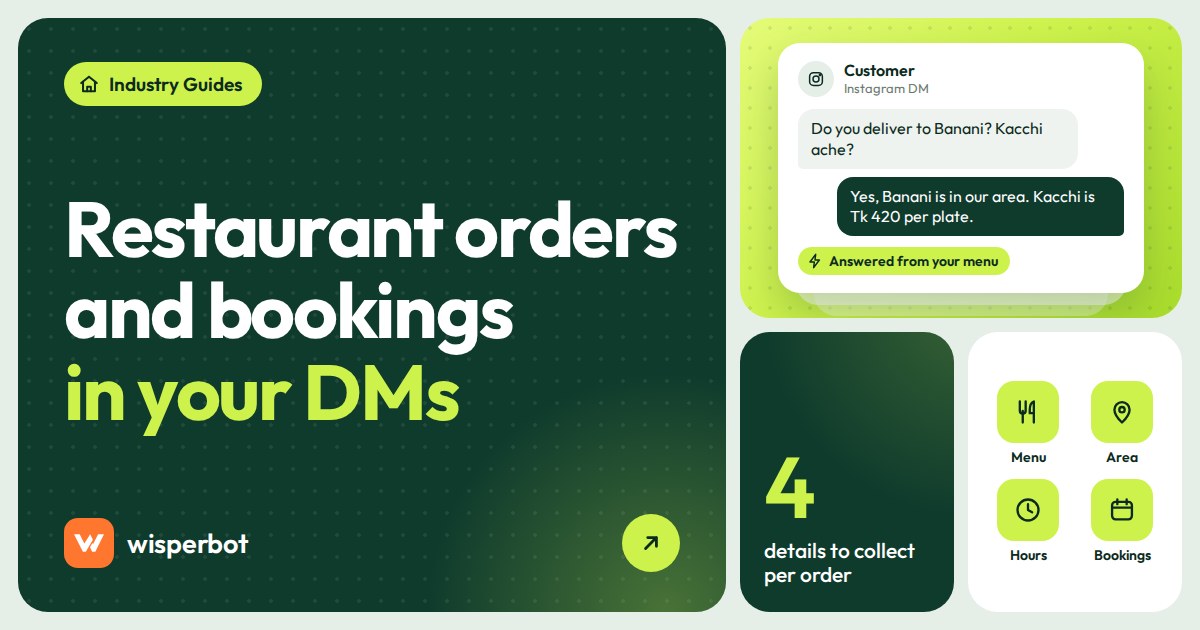
Restaurant and cloud kitchen DMs are mostly the same handful of questions: is this on the menu today, how much is it, do you deliver to my area, when do you close, and can I book a table for eight on Friday. An AI reply bot can answer the first four instantly from your menu sheet and business details. Direct orders and reservations still need a person to confirm, so the practical setup for restaurant WhatsApp ordering is a bot that answers and collects, and a human who confirms.
Key takeaways
- Menu, price, delivery area and opening hours questions can be answered in seconds from a menu sheet and a short business details page.
- For direct orders, have the bot collect items, address and phone in a fixed template, then hand the conversation to whoever confirms orders.
- Reservations need someone who can see the table plan. The bot should collect date, time, party size and name, never promise a table.
- Never let a bot guess about allergens. In the UK, allergen information for distance sales must be available before purchase and at delivery.
- Food orders usually fit inside Meta's 24-hour messaging window, so delivery updates in the same chat are straightforward.
What do restaurant customers actually ask in DMs?
Restaurant DMs mostly ask about the menu, prices, delivery areas, opening hours, today's specials and table bookings. Fewer are actual orders or complaints about late or wrong food. The first group is repetitive and answerable from written information. Orders, bookings and complaints need a person who can see the kitchen and the diary.
Here is how those questions break down, and what the bot needs to answer each one.
| Question type | Example DM | Who answers | What the bot needs |
|---|---|---|---|
| Menu and price | "Beef tehari half plate koto?" | Bot | Menu sheet, one row per portion size |
| Delivery area | "Do you deliver to Bashundhara R/A?" | Bot | List of areas you cover and the delivery charge for each |
| Hours | "Are you open after Jummah?" | Bot | Opening hours by day, including Friday and holiday changes |
| Today's specials, stock | "Kacchi ache ajke?" | Bot if updated daily, otherwise person | A daily specials row someone edits each morning |
| Direct order | "2 chicken biryani, 1 borhani, House 12 Road 5" | Bot collects, person confirms | Order template and delivery charge list |
| Reservation | "Table for 8 on Friday 8pm?" | Bot collects, person confirms | Party size limits and booking policy |
| Allergy or diet | "Is the korma nut free?" | Person | Nothing. Hand over. |
| Complaint | "Food came cold, 1 hour late" | Person | Nothing. Hand over with a label. |
Illustrative example messages.
Notice how many of these depend on something changing daily. A menu sheet that is correct on Monday and wrong by Thursday is worse than no bot, because the bot will confidently quote Monday's kacchi.
Should you take orders in DMs or send customers to a delivery app?
Do both, deliberately. Delivery apps bring customers who have never heard of you, handle payment and riders, and take a commission. Direct DM orders keep the margin and the customer relationship, but you handle confirmation, payment and delivery yourself. A sensible split is apps for discovery, DMs for regulars and large orders.
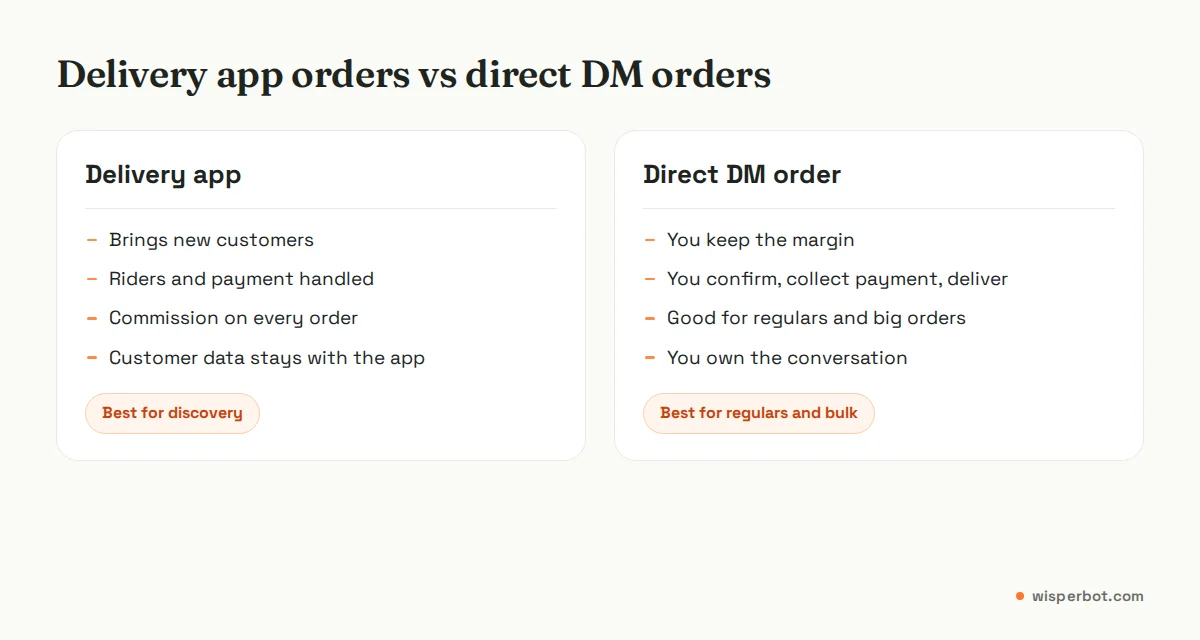
Our opinion: do not try to move every app customer into WhatsApp. It annoys people and app terms may restrict it. Instead, make the DM route the obvious choice for things apps handle badly: office lunch orders for 20, a family iftar platter, a birthday cake with a name on it, or a regular who orders the same thing every Thursday.
Commission rates vary by app, city and contract, so we have not quoted a figure here. Look at your own last month's statement and work out the commission per order. That number tells you how much effort a direct order is worth.
How do you handle a direct order without built-in order capture?
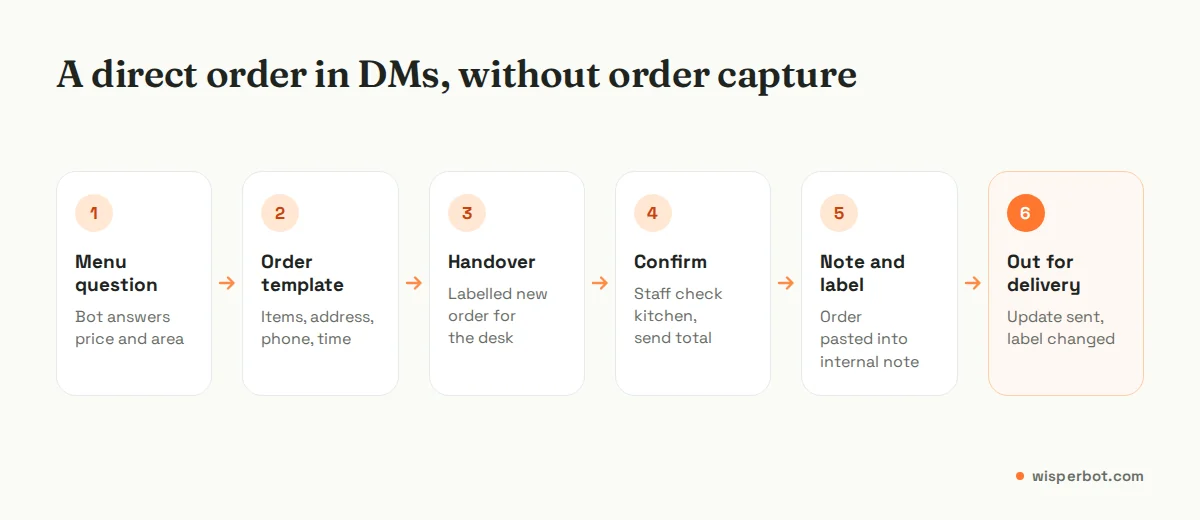
Use a fixed order template in chat. The bot answers menu and price questions, then asks the customer to send items, quantities, address, phone and preferred time in one message. A person checks the kitchen, confirms the total including delivery charge, and labels the conversation so nothing gets lost between kitchen and rider.
We should be clear: WisperBot does not have a cart, order capture or courier integration. The order lives in the conversation, labels and internal notes, and in whatever your kitchen already uses (a POS, a notebook, a WhatsApp group with the riders). For a kitchen doing 30 direct orders a day that works well. For 300 a day, you need an ordering system, and the inbox becomes where customers ask about it.
The order template
Give the bot this wording in your business details so it asks the same way every time:
"Please send your order in one message:
1. Items and quantity
2. Full address with area and landmark
3. Phone number
4. Delivery time (now or later today)
Our team will confirm the total with delivery charge."
The landmark line matters more than it looks. "Near Shyamoli Square, opposite the pharmacy" saves your rider a phone call at 9:15 pm.
Steps from DM to delivered
- The bot answers menu, price and area questions, then sends the order template.
- The customer replies with the filled template. The bot hands over to the order desk with the label "new order".
- Staff check stock with the kitchen, reply with the total including delivery charge and expected time, and change the label to "confirmed".
- Staff paste the order into an internal note in a fixed format, so anyone who opens the conversation sees it.
- When the rider leaves, staff send "Your food is on the way" and change the label to "out for delivery".
- At close, filter by "new order" and "confirmed". Anything still sitting there is a problem.
Food orders have one advantage over other businesses: they happen fast. On WhatsApp, a customer message opens a 24-hour customer service window during which you can reply with normal messages instead of approved templates (since 1 October 2026 Meta charges for those WhatsApp replies too, per delivered message, at the utility rate for your market, after the first 1,000 per business number each month), and Messenger has a similar 24-hour standard messaging window. An order placed at 8 pm and delivered at 9 pm sits comfortably inside it. Our explainer on the 24-hour messaging window covers the edge cases, such as a cake ordered on Monday for Saturday.
Delivery areas, hours and "are you open?"
These are the easiest wins and the most common source of wrong answers. Write them out once, in plain sentences, in your bot's business details.
- Areas by name, not radius. Customers do not know if they are within 5 km. They know they live in Mohammadpur. List every area you cover and the charge for each, and list the nearby areas you do not cover so the bot can say no clearly.
- Last order time, not closing time. If the kitchen closes at 11 pm but the last delivery order is 10:15 pm, the bot needs the second number.
- Friday, holidays and Ramadan. Hours that change on Fridays, during Ramadan or on Eid are where bots go wrong, because someone forgot to update them. Put a reminder in your calendar a week before.
For late-night kitchens, a scheduled bot is the obvious move. If your last order is at midnight, questions at 11:30 pm are still worth answering, and questions at 1 am deserve a polite "We're closed, we open at 12 pm tomorrow" rather than silence. A schedule can have more than one time window a day, so you can also give the bot the dinner rush, when staff are plating rather than typing, and different hours on Friday. Our guide to after-hours AI replies shows how to set the windows.
How should a bot handle reservation requests?
A bot should collect the reservation details (date, time, party size, name, phone and any occasion) and hand over to whoever holds the table plan. It should never say "your table is booked" unless a person has confirmed. Large groups, birthdays and set menus need a human anyway, because they come with questions about deposits and decoration.
A good collecting reply looks like this: "Thanks. For a table for 8 on Friday at 8 pm, may I have a name and phone number? Our manager will confirm availability shortly." Then the conversation goes to the manager with a "reservation" label. Salons have the same problem with appointment slots, and our guide to handling salon and spa bookings from Instagram DMs uses the same collect-then-confirm pattern.
"Shortly" has to mean something. If nobody checks reservation requests until the next afternoon, change the wording to say when you will confirm. A promise you cannot keep is worse than an honest "we'll confirm by 2 pm tomorrow".
Why should a bot never guess about allergens?
Because a wrong answer can hurt someone. A bot reading your menu does not know the korma sauce is made with cashew paste unless you wrote it down, and even then cross-contamination in a busy kitchen is a judgement call. Set the bot to hand every allergy and diet question to a person.
The rules back this up. UK government guidance for food businesses says that for distance selling (online and phone orders, which includes DMs), allergen information must be provided at two stages: before the customer buys and when the food is delivered. UK law requires 14 allergens to be declared. If you trade elsewhere, check your local food authority, but the principle is a sound one wherever you cook: write allergen information down, and let a person answer specific questions.
Where WisperBot fits
WisperBot, a reply-first inbox for WhatsApp, Instagram, Messenger and website chat, gives a restaurant one place to see all DMs, and a Smart Bot that answers menu, price, area and hours questions from a CSV or Google Sheet in seconds. Staff use labels, assignment and internal notes to move orders and reservations along, from a desktop at the counter or the agent app on a manager's phone.
It is not an ordering system or a reservation book. There is no cart, no order capture and no courier integration. If you need those, keep your POS or ordering tool and use WisperBot for the conversations around it.
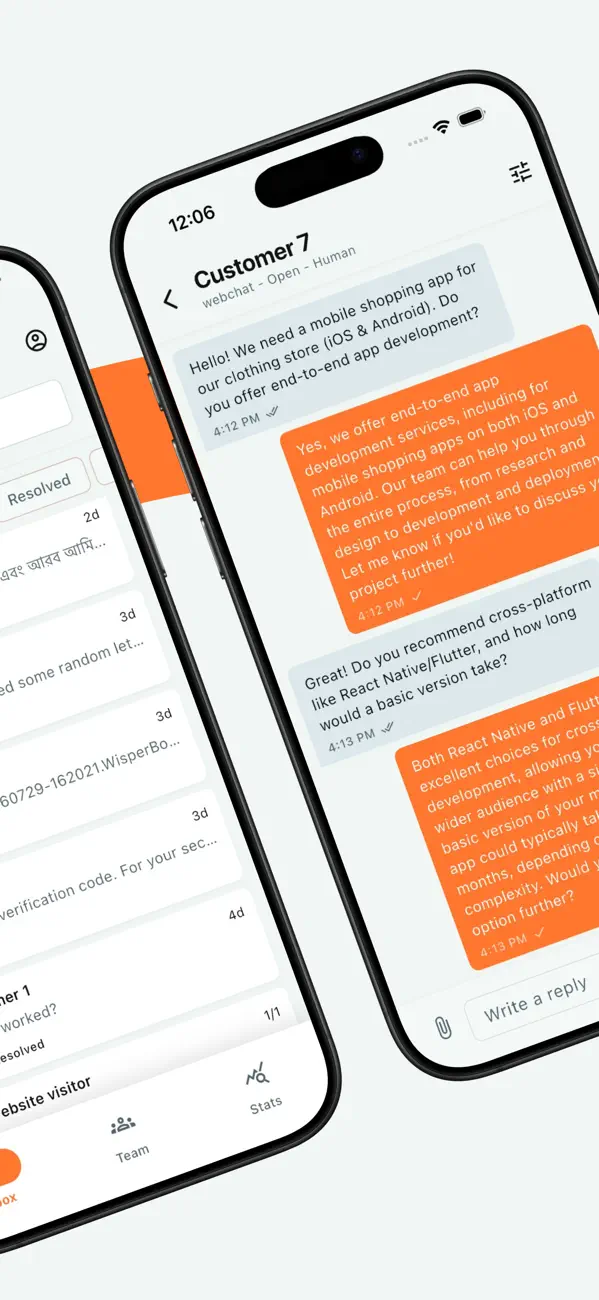
Running the inbox alone from a phone? Our one-owner phone workflow applies to a small kitchen, and our 40 saved replies for online sellers include wording for late delivery and wrong item messages, which you can store as Quick Replies in WisperBot.
Frequently asked questions
Can a chatbot take restaurant orders on WhatsApp?
Some ordering tools can, with a cart and payment. WisperBot cannot capture orders. Its Smart Bot answers menu and price questions and asks the customer to send the order in a fixed template, then hands over to staff who confirm the total and timing. That works well for kitchens taking dozens, not hundreds, of direct orders a day.
Is it OK to take direct orders when I am also on a delivery app?
Usually, yes, but read your app contract first, because some agreements restrict how you contact app customers. Direct orders work best for regulars, large office or family orders and custom items like named cakes. Do not pester app customers to switch, and keep prices consistent so nobody feels tricked.
How should a restaurant reply to messages after closing time?
Reply with your opening time and a way to order then, rather than leaving the message unread. "We're closed now, we open at 12 pm tomorrow, and you can send your order any time after 11:30 am" keeps the customer. A scheduled AI bot can send this, and answer menu questions, overnight.
What should a restaurant bot never answer?
Allergy and dietary questions, complaints about food quality or late delivery, refund requests and anything about large event bookings or deposits. These need a person who can check the kitchen or make a decision. The bot should acknowledge the message, say a team member will reply, and hand over with a clear label.
How do I stop a bot quoting yesterday's menu?
Keep the menu in a Google Sheet rather than a PDF, and make one person responsible for editing the specials row before opening. Mark sold-out items in the sheet instead of deleting them, so the bot can say "finished for today" rather than pretending the dish does not exist.
Sources
- GOV.UK / Food Standards Agency: Allergen guidance for food businesses (distance selling, 14 allergens), updated 17 July 2026, checked October 2026
- Meta for Developers: WhatsApp Business Platform pricing (24-hour customer service window), checked October 2026
- Meta for Developers: WhatsApp non-template (service) message pricing, checked 8 October 2026
- Meta for Developers: Messenger Platform policy overview (24-hour standard messaging window), checked October 2026
Last checked: 8 October 2026.