F-Commerce in Bangladesh: How Facebook Selling Works in 2026
What f-commerce means, how many Pages sell on Facebook in Bangladesh, how orders, couriers and COD work, which rules apply, and where sellers lose money.
In this article
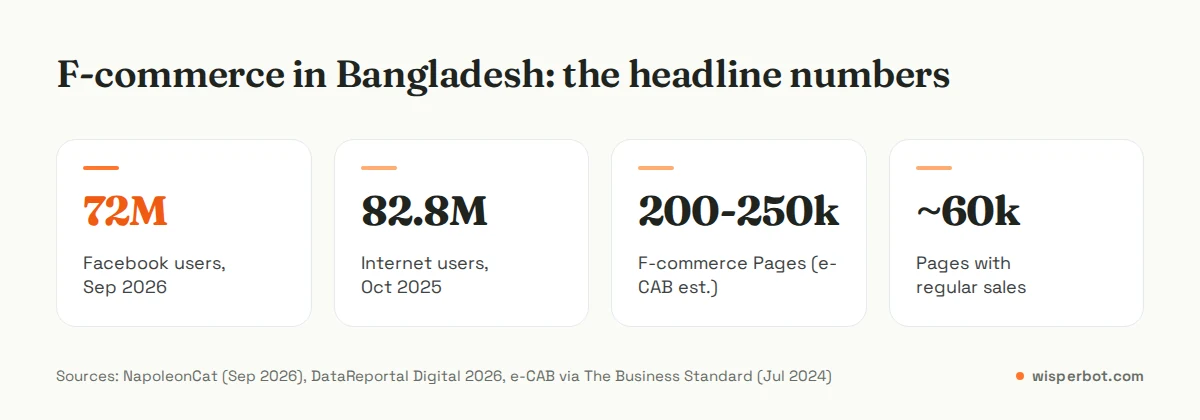
It's 10:15 pm in Mohammadpur and a home baker has 34 unread Messenger chats, a Pathao rider booked for 9 am, and three "cake koto?" messages she hasn't answered since dinner. That is f-commerce in Bangladesh in one picture: selling through a Facebook Page, with the order, the haggling and often the payment promise all happening in chat. Nobody has an exact count of how many Pages do this, but e-CAB has estimated 200,000 to 250,000 f-commerce Pages, with about 60,000 making regular sales. The sellers who last are the ones who treat the inbox, the courier and the rules as seriously as the product photos.
Key takeaways
- F-commerce means selling through Facebook (Pages, groups, Messenger and, increasingly, Instagram and WhatsApp), usually with orders taken in chat and paid by cash on delivery.
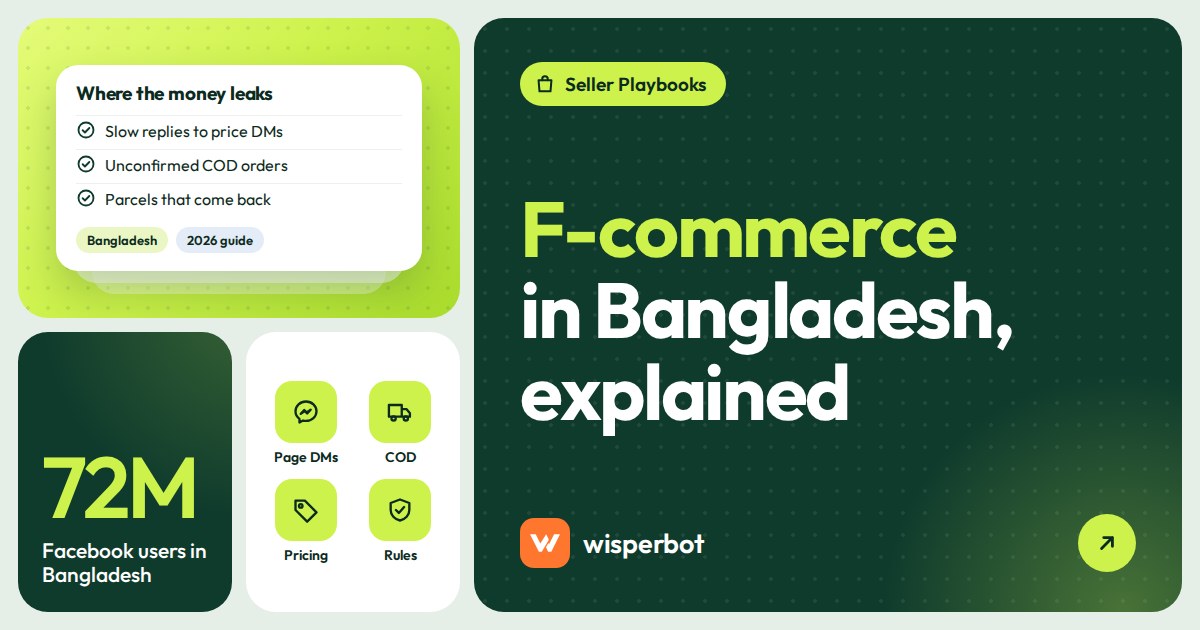
- Bangladesh had about 72 million Facebook users in September 2026 (NapoleonCat, from Meta's ad tools). Estimates of selling Pages range from 50,000 to over 500,000 depending on who counts and how.
- The Digital Commerce Operation Guidelines 2021 set delivery deadlines (5 days same city, 10 days elsewhere, as summarised by law firms) and expect sellers to show their registration on the Page.
- Most avoidable losses come from slow replies, unconfirmed COD orders and parcels that come back.
- Registration, tax and licensing questions belong with the authority: RJSC for DBID, your city corporation for a trade licence, NBR for eTIN.
What does f-commerce mean?
F-commerce means buying and selling through Facebook. In Bangladesh it usually describes a business that runs from a Facebook Page or group: products are posted or boosted, buyers ask questions in Messenger or the comments, the seller confirms the order in chat, a courier delivers it, and the buyer pays cash on delivery or by bKash or Nagad.
There's no storefront and often no website. The Page is the shop window, the inbox is the till, and the courier is the delivery van. That's why the model took off: you can start with a phone, a few photos and a Tk 500 boost.
The term is loose. Plenty of sellers we speak to now take half their orders on WhatsApp, and fashion and beauty Pages lean on Instagram too. We still call it f-commerce because Facebook is where most of these businesses find their buyers.
How big is f-commerce in Bangladesh?
Nobody publishes an official count. Facebook reached about 71.96 million people in Bangladesh in September 2026, according to NapoleonCat's figures from Meta's ad tools. e-CAB estimated in 2024 that 200,000 to 250,000 Pages are run by f-commerce entrepreneurs, with about 60,000 generating regular sales. Other estimates differ widely.
Treat every f-commerce number with care, including the ones above. Here are the main figures, who gave them and when.
| Figure | Estimate | Source and date | How to read it |
|---|---|---|---|
| Facebook users in Bangladesh | 71.96 million (39.7% of the population) | NapoleonCat, September 2026 | Based on Meta's ad audience tools, not a census |
| Internet users | 82.8 million (47% of the population) | DataReportal, Digital 2026 Bangladesh (data to October 2025) | Different method, so not directly comparable with the line above |
| Business Pages on Facebook | More than 500,000 | e-CAB, quoted by The Business Standard, July 2024 | Includes shops that also sell elsewhere |
| Pages run by f-commerce entrepreneurs | 200,000 to 250,000, about 60,000 with regular sales | e-CAB, quoted by The Business Standard, July 2024 | The most useful figure for active sellers |
| F-commerce share of daily e-commerce sales | About 80% of Tk 45 to 50 crore a day | Pathao's CEO, from parcel data, July 2024 | One courier's view of its own deliveries |
| Facebook Pages selling retail or wholesale | Nearly 50,000 | A BTRC official, quoted September 2022 | Much lower count, older and narrower |
The spread tells you something. A Page that posts once a month and a Page shipping 200 parcels a day both count as "f-commerce", so the totals depend on where you draw the line. What every source agrees on is the audience: tens of millions of Bangladeshis are on Facebook, and 18 to 24 year olds are the largest group at 39.1% (NapoleonCat, September 2026).
How does an f-commerce business in Bangladesh actually run?
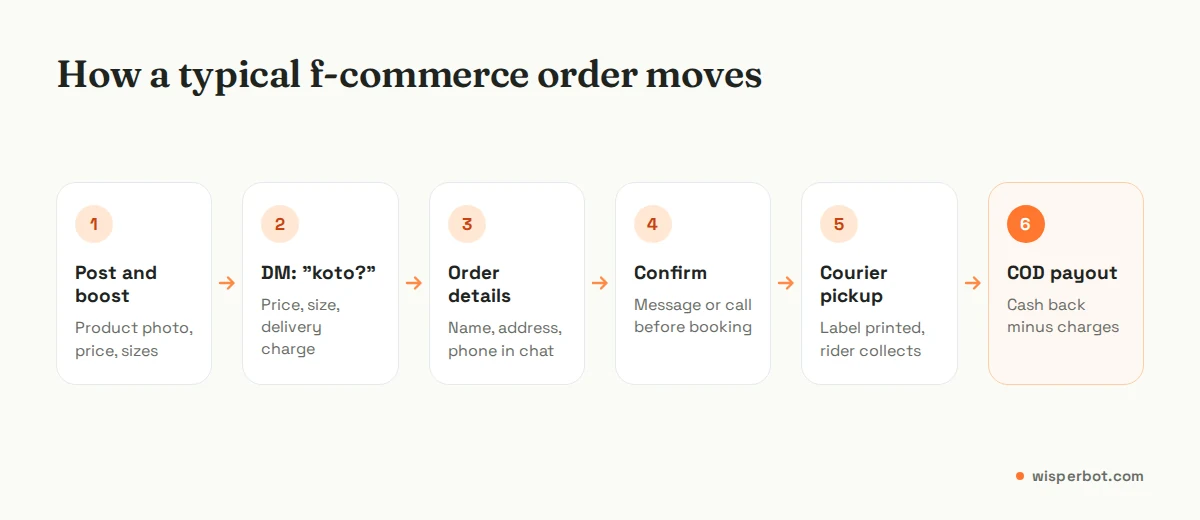
A typical f-commerce business in Bangladesh posts products on its Facebook Page, boosts the best ones, answers price and size questions in Messenger, collects name, address and phone number in chat, confirms the order, books a courier, and gets the cash-on-delivery money back from the courier a few days later, minus delivery and COD charges.
The daily rhythm looks like this for most of the Pages we talk to:
- Morning: pack yesterday's confirmed orders, print courier labels, hand over to the pickup rider.
- Afternoon: shoot and post new stock, set a boost on the post that's getting saves.
- Evening to past midnight: the inbox. Price questions, size questions, "Sylhet e delivery charge koto?", order details, the odd complaint.
- Every few days: courier payout lands in bKash, Nagad or the bank; reconcile it against your order sheet and chase returns.
Courier pricing shapes your margins. Paperfly's published rates, as listed on 12 October 2026, are Tk 70 for the first kilo within the same city, Tk 110 for suburbs such as Savar and Gazipur, and Tk 130 for the rest of the country, plus Tk 20 per extra kilo, with a 1% COD charge outside the same city and no extra return fee. Steadfast's pricing page lists a 1% COD and risk charge. Other couriers, such as Pathao and RedX, publish their own rates, so compare before you commit.
What rules apply to a Facebook business in Bangladesh?
The main rulebook is the Ministry of Commerce's Digital Commerce Operation Guidelines 2021, issued on 4 July 2021. Since 2022 the government has also asked online and social-media sellers to get a Digital Business Identification (DBID). Requirements change, so check current rules with the Ministry of Commerce, RJSC and NBR before relying on any summary, including ours.
This isn't legal or tax advice. Here's what published summaries say the rules cover, so you know what to ask about:
- Showing who you are. A law firm summary (Mahbub & Company, January 2022) says digital commerce businesses should hold whichever applies of a trade licence, VAT registration, TIN, or a unique business ID or PRA, and display it on their social media Page or website.
- Delivery deadlines. Hand the product to the courier within 48 hours of full payment; deliver within 5 days if buyer and seller are in the same city, 10 days if not.
- Advance payment. Full advance only for goods ready to ship; a refund within 10 days, by the same method, if delivery fails.
- Product information. Price, delivery charges, return conditions and real images of the item (The Daily Star, July 2021).
- DBID. The Financial Express reported in March 2026 that "all e-commerce and social media-based businesses must obtain a DBID to operate legally", that registration is allowed without a trade licence if the business has an online presence, and that RJSC had certified 2,136 digital businesses out of 13,541 applications.
Our honest view: the paperwork is worth doing once you're past the hobby stage, because courier settlement, bKash merchant accounts and bank payouts all get easier with documents in hand. But ask the authority, not a Facebook group, what applies to you.
Where do f-commerce sellers lose money?
Most f-commerce sellers lose money in three places: price questions that wait hours for an answer, cash-on-delivery orders that were never confirmed, and parcels that come back after two courier legs have been paid. Each one is fixable with habits rather than software, though tools help once volume grows.
| Leak | What it looks like | Cheap fix |
|---|---|---|
| Slow replies | "Price?" at 11:40 pm, answered at 10 am, buyer already ordered elsewhere | A fixed price list, quick replies, and cover for the late evening |
| Unconfirmed COD orders | Wrong address, switched-off phone, "ami order dei nai" | Confirm every order by message or call before booking the courier |
| Returns | Size wrong, colour "looked different", buyer changed mind at the door | Measurements in the post, real photos, a clear exchange rule sent before dispatch |
| Unclear delivery charges | Buyer refuses the parcel over a Tk 60 difference | State inside and outside Dhaka charges in every price reply |
| Platform risk | Facebook restricted, no way to reach buyers | Keep buyers' numbers (with permission) and a second channel such as WhatsApp |
Platform risk isn't theoretical. When Facebook access was restricted in July 2024, The Business Standard reported courier companies losing roughly Tk 4 to 5 crore a day as deliveries dropped. Sellers who had buyers on WhatsApp could still reach them.
The reply problem is the one we see most. Buyers send "koto?" to three Pages and order from whoever answers first. If we could fix one thing for every Page in Dhaka it would be the gap between 10 pm and 10 am, not the photos. We wrote up the night-time version in why Facebook sellers in Bangladesh lose orders at night, and the confirmation routine in COD order confirmation on WhatsApp.
What's changing in f-commerce in 2026?
Three changes matter for Facebook sellers in 2026: more conversations moving to WhatsApp and Instagram alongside Messenger, steadier pressure to register through DBID, and buyers expecting answers at any hour. Meta also began charging for WhatsApp service replies beyond a free 1,000 a month on 1 October 2026, which affects busier sellers using the WhatsApp Business Platform.
On the WhatsApp point: Meta gives each business phone number 1,000 free service messages (free-form replies inside the 24-hour window) a month, and since 1 October 2026 it charges for each one after that on the WhatsApp Business Platform, at the utility rate for the market. A Page under 1,000 such replies a month pays nothing for them. Chats started from click-to-WhatsApp ads still open a free entry point window once you reply within 24 hours: up to 7 days on Meta's developer pricing page (updated 30 September 2026), though some older Meta pages still say 72 hours. Messenger and Instagram replies still carry no per-message fee from Meta. If you use the plain WhatsApp Business app on your phone, none of this applies to you yet; see our guide to the WhatsApp Business API in Bangladesh before you switch.
The other change is quieter. Buyers who grew up with instant replies from big marketplaces now expect the same from a two-person Page. That doesn't mean you need staff at 1 am. It means "dam koto?" needs an answer at 1 am, and the complaint can wait for the morning.
Where WisperBot fits
WisperBot, a reply-first inbox for WhatsApp, Instagram, Messenger and website chat, puts your Page messages and WhatsApp chats in one inbox and lets a Smart Bot answer price, size and delivery questions from your own price list, in Bangla, English or Roman Bangla, then hand over to a person. You can run it only at night or all day. It doesn't take orders, connect to couriers or accept bKash or Nagad, and plans are paid by card in US dollars, so it suits Pages whose bottleneck is replies rather than logistics. See the inbox and plans. If you're just starting, our checklist for selling on Facebook in Bangladesh comes first.
Frequently asked questions
Is f-commerce legal in Bangladesh?
Yes, selling through Facebook is legal, but it falls under the Digital Commerce Operation Guidelines 2021, and published reports say social-media sellers are expected to get a DBID. Whether you also need a trade licence, eTIN or VAT registration depends on your business, so check with RJSC, your city corporation and NBR.
How many f-commerce businesses are there in Bangladesh?
There's no official count. e-CAB estimated 200,000 to 250,000 Pages run by f-commerce entrepreneurs in 2024, with about 60,000 making regular sales. Other estimates range from about 50,000 to more than 500,000 business Pages, depending on how "selling" is defined.
Do I need a trade licence to sell on Facebook in Bangladesh?
Not always, according to news reports on DBID, which say registration is allowed without a trade licence if the business has an online presence. Courier settlements, bKash merchant accounts and banks may still ask for one. Requirements change, so confirm with RJSC and your city corporation before deciding.
What is the best way to take payment for f-commerce orders?
Most Pages use cash on delivery, with bKash or Nagad for advances or repeat buyers. bKash offers a Personal Retail Account aimed at micro and small f-commerce sellers, and its document list (NID, mobile number, proof of profession) doesn't include a trade licence. Confirm every COD order before booking the courier to cut returns.
How fast should a Facebook Page reply to customers?
As fast as you can for price and size questions, ideally within minutes, because buyers message several Pages at once. Meta's Messenger policy allows businesses up to 24 hours for standard replies, but by then most buyers have ordered elsewhere. Cover late evenings, when many Pages get their busiest inbox.
Sources
- NapoleonCat: Facebook users in Bangladesh, September 2026
- DataReportal: Digital 2026 Bangladesh (published November 2025)
- The Business Standard: Facebook restriction keeps F-commerce entrepreneurs at bay (July 2024, e-CAB and Pathao estimates)
- The Business Standard: Bangladesh e-commerce sales to more than double by 2026 (September 2022)
- The Daily Star: Overview of the Digital Commerce Operation Guidelines 2021
- Mahbub & Company: Ministry of Commerce issues detailed guidelines on e-commerce business (January 2022)
- The Financial Express: Digital business applications pile up (March 2026, RJSC DBID figures)
- bKash: Personal Retail Account
- Paperfly: Delivery charges
- Steadfast Courier: Pricing
- Meta for Developers: Messenger Platform policy overview (24-hour standard messaging)
- Meta for Developers: WhatsApp pricing (1,000 free service messages per number per month, free entry point window)
Last checked: 12 October 2026.