Make Your AI Chatbot Sound Like Your Business
Give your chatbot a clear business voice with accurate sources, practical instructions, and honest limits. Pair useful answers with your own brand tag.
In this article
A chatbot can carry your name and still sound like it belongs somewhere else. It may greet customers with the right colours, then answer a simple delivery question with a paragraph of vague sales language.
Branding has two parts here. The visible identity tells customers whose service they have reached. The conversation tells them how that business behaves.
WisperBot lets you edit the footer company name on every tier, including Free, so the tag can read “Powered by Your Brand”. Making the answers feel equally yours takes clear sources, a suitable tone, and instructions that describe what the bot should do.
Separate identity, knowledge, and behaviour
These three areas often get mixed into one long prompt. A business writes its story, refund policy, preferred greeting, and sales goals in the same block, then struggles to understand why an answer went wrong.
Keep the roles clear. Identity covers the business name and what it does. Knowledge supplies the facts the bot needs. Behaviour defines how to use those facts and when to ask for help.
Tone sits inside behaviour. “Friendly” can guide the phrasing, but it should not change the return window or create a discount. A warmer answer still needs the same factual boundary.
WisperBot's Smart Bot setup provides separate business details, knowledge sources, tone, and answer controls. Use that structure to make the configuration easier to maintain.
| Layer | Good input | Input to avoid |
|---|---|---|
| Identity | What the business offers and whom it serves | Unsupported claims of market leadership |
| Knowledge | Current policies and product information | Conflicting versions of the same policy |
| Tone | Plain, warm, brief language | A stack of vague personality adjectives |
| Behaviour | Ask for location when delivery depends on it | Always agree with every customer request |
| Escalation | Offer a person for unsupported cases | Invent a confident answer to avoid handoff |
Describe the conversation you want
“Be helpful” is a reasonable aim, but it does not tell the bot what to do when a customer writes “delivery?”
Give an instruction linked to the actual question. If delivery depends on location, ask for the location. If the business only quotes after reviewing requirements, explain that process instead of producing an estimate from nowhere.
Keep each instruction short enough for another teammate to understand. That teammate should be able to tell whether a reply followed the rule.
Avoid instructions that fight each other. “Always answer in one sentence” may conflict with “include every condition of the refund policy”. Decide which matters for the job and allow the answer enough room to be useful.
Edit for the customer's next step
Consider an illustrative question: “Can I return a sale item?” A weak answer begins with a broad statement about customer satisfaction. A useful answer identifies the relevant policy and explains what the customer can do next.
If the policy says sale items are excluded except when faulty, the reply should preserve that distinction. It can be phrased warmly without removing the exception or suggesting that every return will be accepted.
The same editing principle applies to service businesses. “Our team would be delighted to assist” says less than “Tell us which service you need, and the team can confirm availability.”
Read the reply aloud. If it sounds like a brochure in a conversation where someone wants a direct answer, shorten the introduction and move the useful information forward.
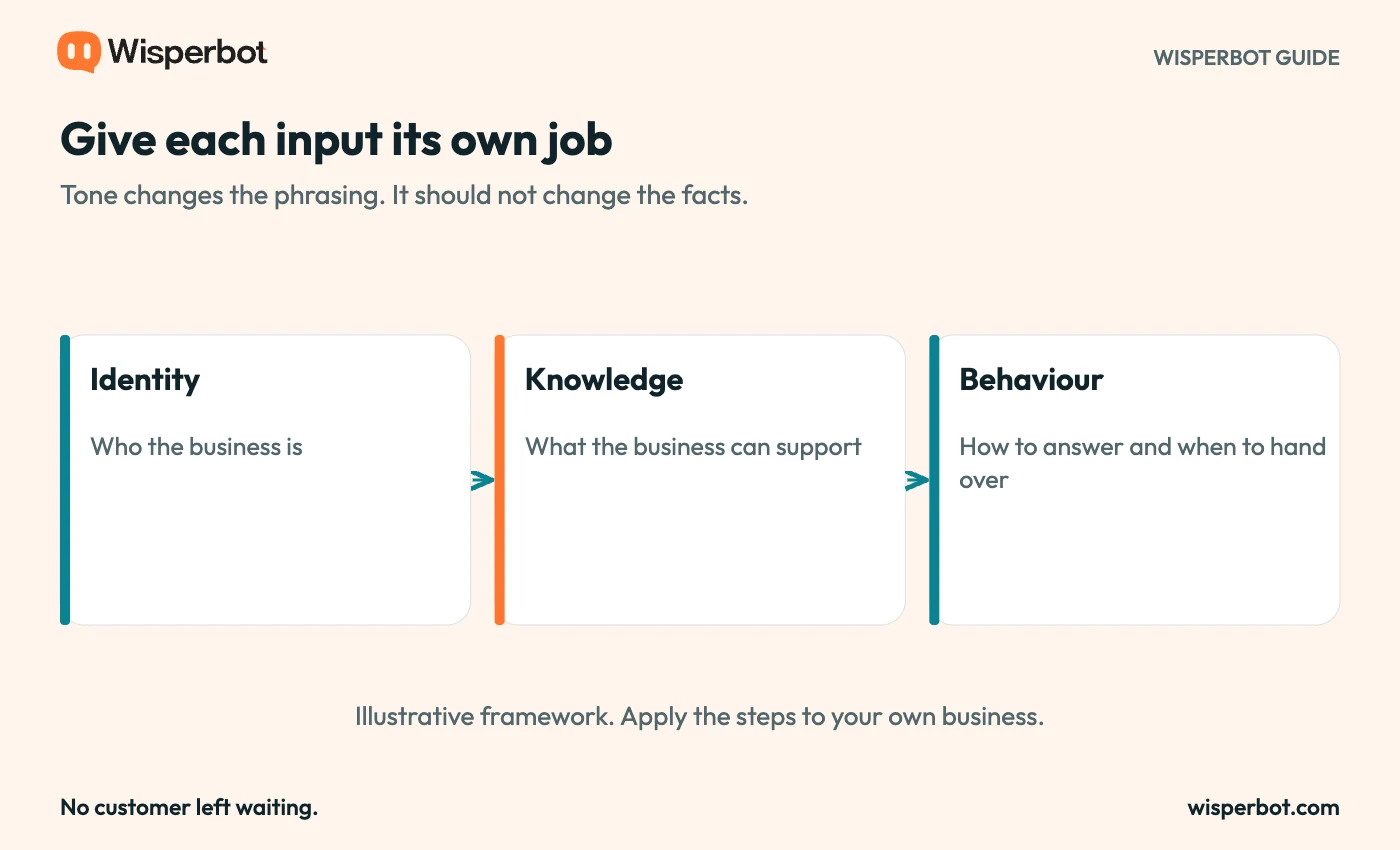
The three inputs have different jobs. Tone changes phrasing; it should not change business facts.
Keep the welcome message modest
The opening message should help the visitor begin. Name the kind of help available and offer a clear way to ask.
For an illustrative shop, “Ask about delivery, returns, or product details” is a useful start. For a consultancy, the message might invite questions about services and explain that staff confirm tailored advice.
Do not promise that the bot can answer anything. That creates an expectation the knowledge and permissions may not support.
Also avoid making the bot impersonate a named employee. A business can use its own brand in the footer while making clear that the first reply comes from an AI assistant. Honest identity is part of a dependable brand voice.
Give uncertainty a voice of its own
A bot's fallback is often where the brand becomes most visible. Does it repeat a generic apology, guess, or explain a useful next step?
Write a fallback that fits the information gap. If the request lacks a location, ask for it. If the policy does not cover the case, offer a person. If the question is outside the business's scope, redirect politely.
Avoid claiming that every answer is verified or that the AI never makes mistakes. Instead, configure the appropriate answer scope, test it, and maintain the information behind the replies.
The handoff guide explains how to carry that voice into the transition to staff. The customer should understand what happens next without needing to start again.
Build a small voice review sheet
Choose a few common questions and write what a good answer must preserve: the fact, the tone, and the next step. Add one question that should be escalated.
Review the bot's answers against those criteria. Do not score only whether the wording resembles a favourite sentence. Two replies can use different words and still be accurate, clear, and appropriate.
When a reply feels wrong, identify the layer. Is the source incomplete? Is the instruction too broad? Is the tone overly formal? Fixing the right layer is more effective than adding another paragraph to the prompt.
Repeat the review after changes to the business or its policies. A consistent voice is maintained through those ordinary updates, not just chosen on launch day.
Questions about chatbot brand voice
Does changing the footer change how the AI answers?
No. The footer company name changes a visible tag. Knowledge, tone, and answer settings control the conversation and should be configured separately.
Can the bot sound like us without pretending to be human?
Yes. Use your vocabulary, concise explanations, and business rules while identifying the assistant honestly. Brand consistency does not require hiding AI use.
What is the best first instruction?
Choose a rule tied to a common customer need, such as asking for a missing location before explaining delivery. Specific, testable instructions are easier to maintain than broad personality claims.
Set your brand tag in WisperBot website chat, then make the first useful answer deserve that name. For the configuration sequence, follow the setup walkthrough.