Keep Your Brand Consistent From AI Reply to Human Help
Plan a clear handoff from branded AI chat to your team. Set ownership, availability, and context so customers understand what happens after asking for a person.
In this article
The customer asks a question. The bot gives a useful first answer. Then the request becomes more specific and a person needs to join.
That transition is part of the brand experience. If the customer has to repeat the whole story or cannot tell whether anyone will reply, a polished opening screen only gets you so far.
WisperBot lets every tier, including Free, use an editable footer company name in the chatbot's “Powered by” tag. Your business can own that visible introduction. A dependable handoff makes the rest of the conversation live up to it.
Give AI and people different jobs
A bot can explain current business information and help a customer clarify what they need. A person can investigate a specific problem, approve an exception, or make a decision that the bot is not authorised to make.
Define that boundary before launch. A return policy question is not the same as approval of a disputed return. A list of service hours is not confirmation of an appointment.
The customer should be able to ask for a person directly. Do not require them to exhaust a list of bot answers first. Someone who knows they need human help should receive a clear next step.
WisperBot supports AI conversations with human takeover. The business still needs to decide who handles those conversations and when they are available.
Make the transition visible
The handoff message should explain what has happened. Is the request waiting for the team? Has someone joined? Is the business closed?
Avoid using the same sentence for every state. “An agent is joining now” creates the wrong expectation if nobody is available. “The team will review this during opening hours” is more useful when it is accurate.
The language should remain recognisably yours, but the identity should stay honest. A branded AI assistant does not need to pretend that its first answer came from a teammate.
When a human joins, make the change understandable. The customer should know whom they are speaking with and should not receive conflicting replies from AI and staff.
| Conversation state | What the customer needs to know | Business decision |
|---|---|---|
| AI answering | Help available and its limits | Approved knowledge and answer scope |
| Human requested | The request has been recognised | Where the conversation is routed |
| Waiting for staff | A realistic expectation | Coverage and follow-up ownership |
| Staff joined | A person is now helping | Clear responsibility for the reply |
| Follow-up required | What will happen next | A named owner and completion process |
Carry context into the human reply
A teammate should be able to see the customer's question and what the bot already said. Without that context, the first human message can feel like a restart.
Prepare staff to read the conversation before asking another question. If the customer has already supplied the relevant detail, use it. If the bot misunderstood something, acknowledge the correction plainly.
Do not treat a machine-generated summary as a substitute for checking the source conversation when the decision matters. A concise summary can be useful, but staff need the underlying context for disputes or unusual cases.
Keep internal notes separate from customer-facing replies. A handoff should make the service more coordinated without exposing staff discussion or another customer's information.
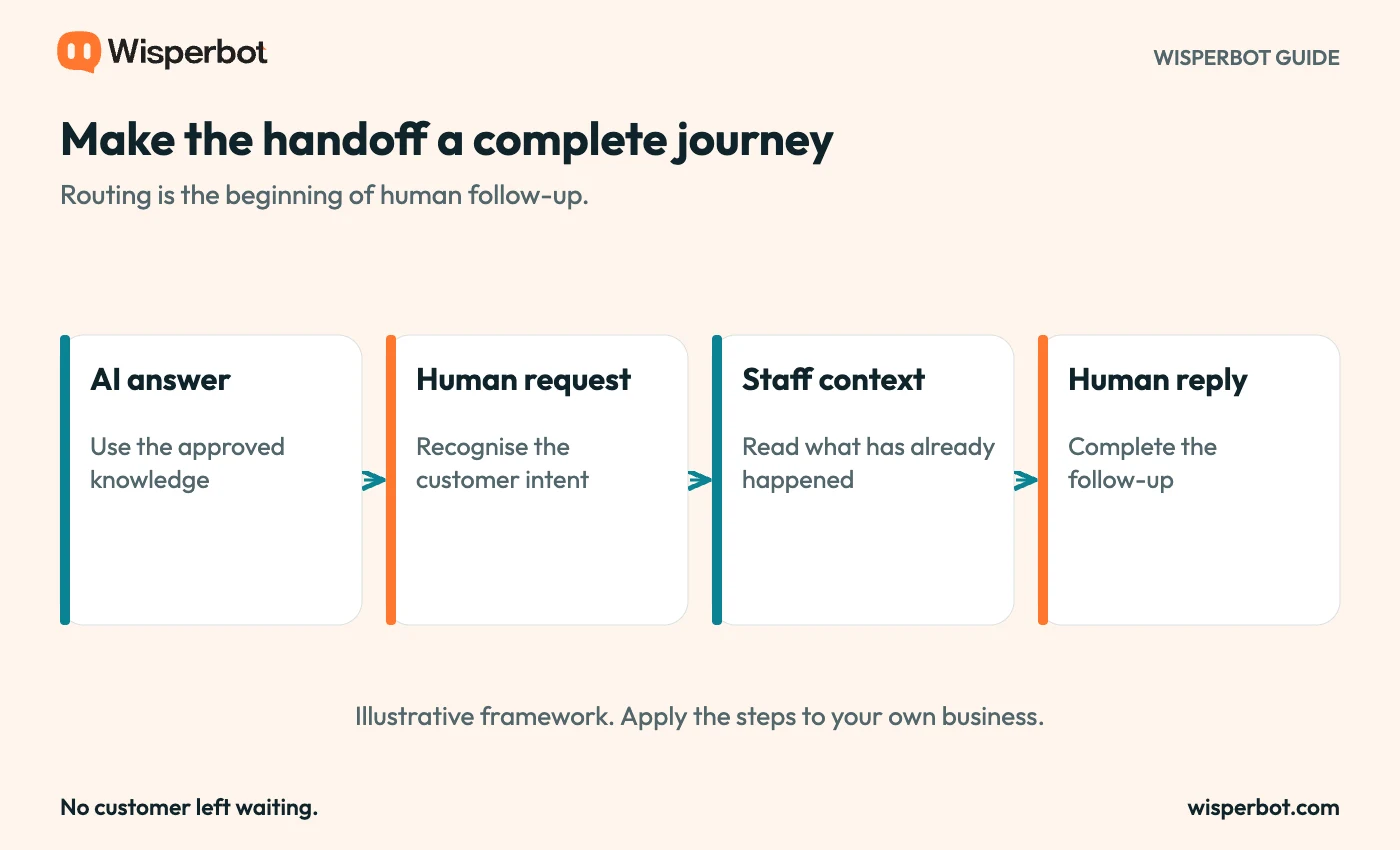
The sequence describes a recommended service process. Actual staff availability must match the expectation given to visitors.
Plan for the hours nobody is at the desk
After-hours AI can help with routine information, but it does not create overnight human coverage.
Write an availability message based on the real operation. If the team checks enquiries on the next working day, say that rather than offering an unmeasured response-time guarantee.
Decide how urgent requests should be handled within your approved process. A general chatbot should not improvise a promise because a visitor sounds upset or asks repeatedly.
Review the morning queue as part of the service. The handoff is not complete when the bot announces it. It is complete when the responsible person responds or closes the loop in another agreed way.
Use your name without hiding the limits
In WisperBot, Footer company name changes the company name in the standard tag on every plan. It does not remove the “Powered by” prefix or turn every software surface into your brand.
That scope is enough to make a useful point: the conversation can carry your business name from the free pilot onward. The name should be accompanied by accurate expectations about the help available.
For example, an illustrative service assistant might say it can explain services and pass an enquiry to the team. It should not imply that a specialist has reviewed the case before anyone has done so.
Clear identity protects the relationship. Customers can accept that the first reply came from AI when the answer is useful and the route to people is straightforward.
Test handoff as a complete journey
Ask for a person in a new conversation and after several messages. Try it during staffed hours and when the team is away. The customer should receive an appropriate response in each case.
On the staff side, confirm that someone owns the conversation. A shared inbox can still leave a request untouched if everyone assumes someone else will answer.
Then send the human reply and inspect the visitor side. Check the identity, message order, and whether the customer can continue without opening another channel.
Record failures by stage. A missed notification, unclear ownership, and misleading waiting message are different problems. Fixing the wording alone will not solve a routing failure.
Measure whether the transition works
Count handoff requests and completed staff follow-ups using a defined time window. Review cases where the customer repeated information or left before receiving a response.
Do not mark every escalation as an AI failure. A correct handoff can be the safest and most useful outcome. Equally, do not mark a routed conversation as completed if nobody has replied.
Use the measurement article to define the review, and the setup walkthrough to check the configuration.
Questions about branded human handoff
Can customers know the bot is AI and still see our brand?
Yes. Business identity and AI disclosure answer different questions. Your brand tells customers whose service it is; clear assistant identity tells them how the first reply is being provided.
Does changing the footer create human coverage?
No. Staff availability and ownership must be planned separately. An editable name is a branding control, not a response-time guarantee.
Is a handoff always a bad result?
No. Requests involving exceptions, private investigation, or a human decision may belong with staff. The important test is whether the transition is clear and completed.
Build a WisperBot website chatbot that introduces your business and gives customers a dependable route to the people behind it.