How We Run Customer Messaging for Our Own eSIM Business
Telzen is our own group's travel eSIM business. Here is how its customer messaging runs on WisperBot: what the bot answers, and what always goes to a person.
In this article
Telzen, the travel eSIM business in our own group, runs its customer messaging on WisperBot. It is not an independent customer and this is not a testimonial: it's where we use our own product every day, so read this AI customer service case study as a description of how we set things up. Below is what Telzen's customers ask, which questions the Smart Bot answers on its own, which ones always go to a person, and how a weekly review keeps the answers right.
Key takeaways
- Telzen is our own group's business, so treat this as a worked example of how we set things up, not independent proof.
- eSIM questions fall into a few repeatable groups: coverage and plans, phone compatibility, installation and activation, data usage, top-ups, and refunds.
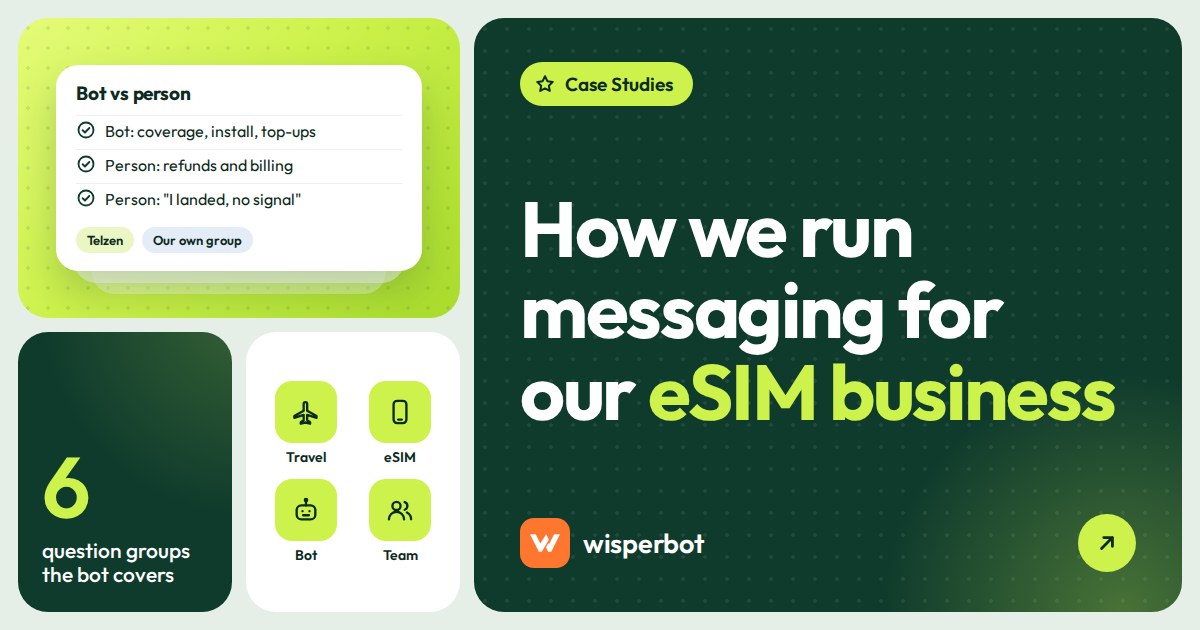
- The bot handles the documented, step-by-step questions. Refunds, billing disputes and "I've landed and nothing works" go to a person.
- The bot runs around the clock, because travellers message from their own time zone, not ours.
- A 20-minute Monday review of unanswered questions and handovers drives almost every improvement.
What does an eSIM business get asked?
Mostly the same handful of questions, at all hours. Before buying, people ask whether a plan covers their destination and whether their phone supports eSIM. After buying, they ask how to install it, why it says "No service", how much data is left and how to add more. A smaller share ask for refunds or report billing problems.
For readers who don't sell eSIMs: an eSIM is a SIM profile downloaded to the phone instead of a plastic card. The GSMA, the mobile industry body, describes it as a specification that "enables remote SIM provisioning of any mobile device". Telzen sells data plans for travellers that install this way, through its app.
What makes eSIM support distinctive is timing. A customer asking "does it work in Bangkok?" a week before the trip can wait an hour. A customer standing at the arrivals hall at 2 am local time with no data, no Wi-Fi and a taxi to find cannot. The same inbox has to treat those two very differently.
The six kinds of question, and who answers them
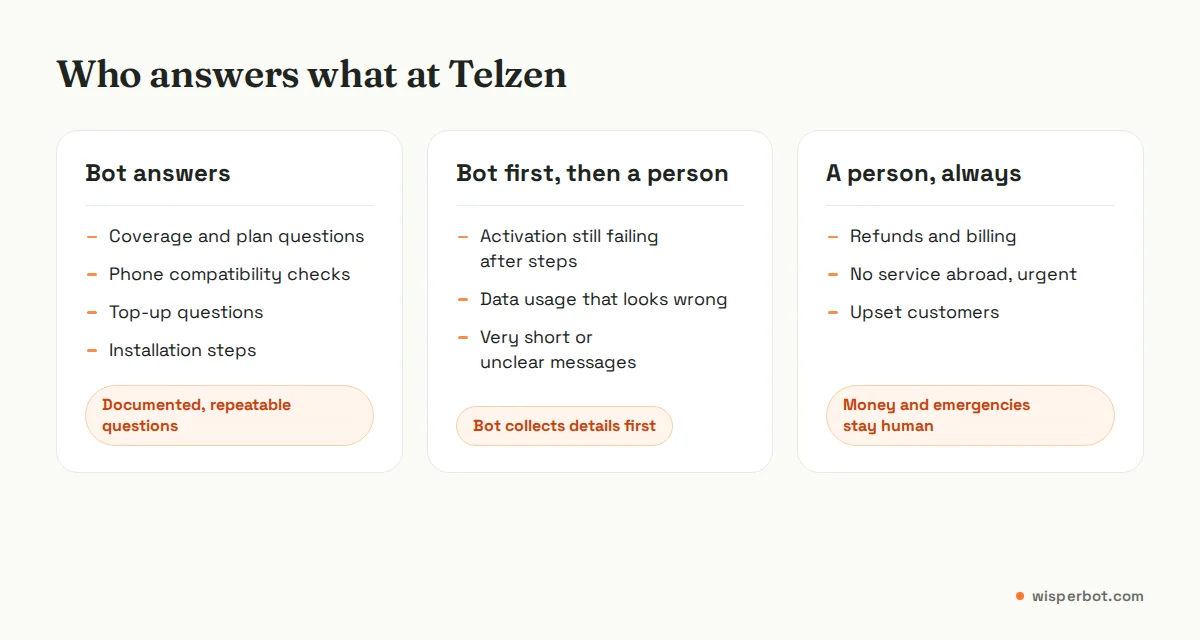
Here's how we split the work. The bot answers from Telzen's own information: plan details, coverage, installation steps and written policies. Nothing outside that.
| Question type | Typical message | Who answers | Why |
|---|---|---|---|
| Coverage and plans | "Do you have a plan for Thailand and Malaysia on one eSIM?" | Bot | Answered from the plan and coverage data |
| Phone compatibility | "Will this work on my Samsung A54?" | Bot, asks for the model if unclear | Documented device rules plus the carrier-lock check |
| Installation and activation | "QR scan korsi but showing No Service" | Bot first, person if the steps don't fix it | Most cases are a setting; some need account checks |
| Data usage | "How much data do I have left?" | Bot explains where to check; person if the numbers look wrong | Account-specific disputes need a human |
| Top-ups | "Can I add 5GB to my current plan?" | Bot | Answered from the plan data |
| Refunds and billing | "I didn't use it, can I get my money back?" | Person, always | Depends on the order and the terms; money decisions stay with people |
How does the bot handle compatibility and activation questions?
It works through the checks a trained agent would, in order, using only Telzen's written steps. Is the phone model supported? Is it locked to a carrier? Is the travel line chosen for mobile data? If that doesn't solve it, the bot hands over to a person with the answers already collected, so nobody asks twice.
The carrier-lock check is the one that catches people. Apple's own guidance for using an eSIM while travelling says the iPhone "cannot be locked to a carrier", and tells you to look in Settings, General, About, where Carrier Lock should read "No SIM Restrictions". It also lists iPhone XS, XS Max, XR or later as the general requirement. Putting those exact menu names in the bot's knowledge turns a vague "check your phone settings" into an instruction someone can follow in an airport queue.
The other frequent fix is choosing which line to use for mobile data. Apple's article walks through Settings, then Cellular, then Cellular Data, then picking the travel line. It also warns that keeping the home line active can still bring roaming charges from the home provider. That warning is worth saying before the customer lands, not after.
Does the bot reply in Roman Bangla?
Yes. The Smart Bot replies in the customer's language, including mixed scripts. "eSIM ta kivabe install korbo? iPhone 13" gets the installation steps back in the same style. Very short messages, such as "not working" or a lone screenshot, still often go to a person: there's too little to go on, and we'd rather hand over than guess.
Mixed-language messages are normal for any business with South Asian customers: English for the technical words ("QR", "data roaming", "No Service"), Bangla for everything around them. We wrote more about setting this up in our guide to making an AI chatbot understand Roman Bangla.
What always goes to a person?
Three things, every time. Refund and billing requests, because they depend on the specific order and Telzen's terms. Anything that sounds urgent abroad, such as a customer with no data at an airport. And anything where the customer is upset or the bot has already tried the standard steps without success. These are switched from AI to Human and assigned.
The handover itself matters as much as the decision to hand over. When a conversation switches to a person, the bot has usually already collected the phone model, the destination and what the customer tried. The agent adds a label (refund, activation, urgent) and an internal note if another teammate needs context. Our AI-to-human handoff playbook describes the same pattern for any business.
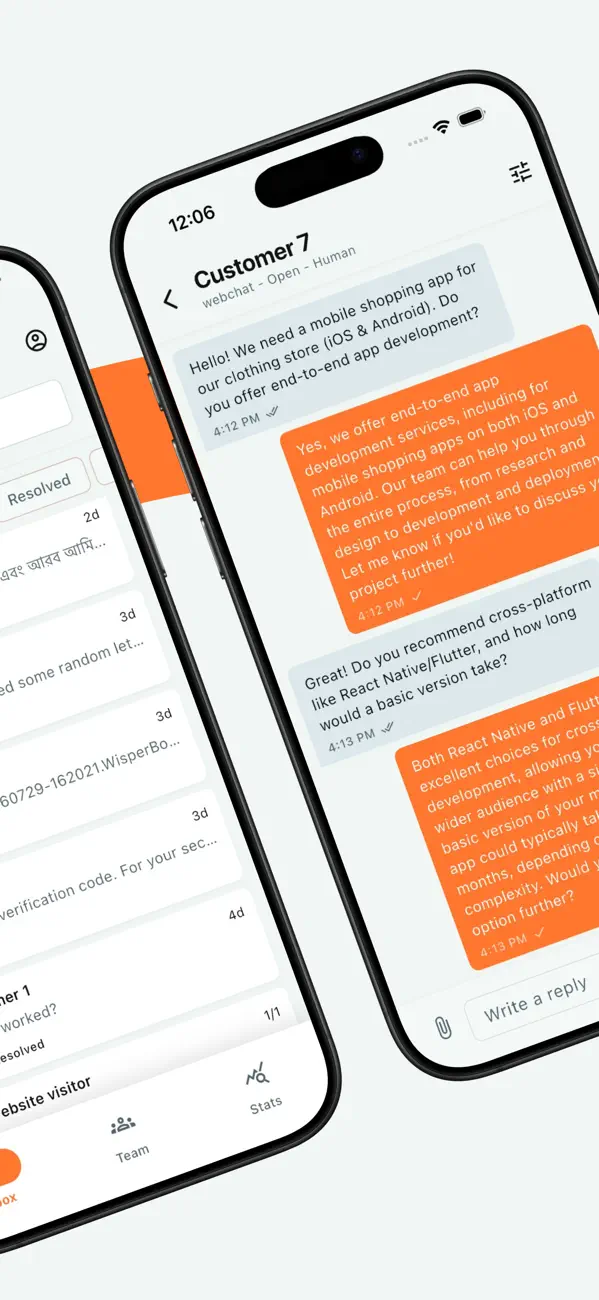
Urgent cases are picked up on the WisperBot agent app, so whoever is on call can reply from their phone, including with a voice note when typing steps would take longer than saying them. On WhatsApp there's one more constraint: a normal reply is only possible within 24 hours of the customer's last message. After that, Meta requires an approved template, so we don't let handed-over conversations sit overnight.
How it's set up
Nothing here is special to Telzen. It's the standard Smart Bot setup, filled in carefully:
- Smart Bot and business details: what Telzen sells, who it's for, support hours for human replies.
- Knowledge: installation steps per phone type, the carrier-lock check, how to choose the data line, what "No Service" usually means, and the written refund process (which tells the bot to hand over, not decide).
- How it answers: Strict. It answers only from Telzen's information and asks or hands over when unsure. For a business where a wrong compatibility answer can strand someone abroad, we wouldn't use anything looser.
- Prices and live data: the plan list, so coverage and top-up questions are answered from current data rather than old messages.
- Where it answers: AI answering set to Always on, not Scheduled, because a traveller in Dubai or London is messaging on their clock.
How much the bot handles
We don't have a measured figure we're ready to publish. Our own rough estimate, still being measured, is that the bot fully answers about 8 in 10 incoming questions, with the rest going to a person by design. Treat that as an owner's estimate for our own business, not a benchmark you should expect.
We'd add a caution. eSIM support suits a bot unusually well: the questions are repetitive, the answers are documented, and most of them are steps rather than judgement calls. A business selling custom furniture or tailoring will see a much smaller share answered by the bot, and that's fine.
What the weekly review changes
Every Monday someone starts with the Unanswered questions panel in the Smart Bot's Knowledge step, which lists what customers asked that the knowledge couldn't answer, most asked first. Then they go through the conversations the bot handed over or answered badly, tag each with a reason and fix the top gaps, following the routine in our 20-minute weekly bot review. The changes it produces are small and specific:
- Splitting installation steps by phone brand, because one generic set of steps confused people whose menus are named differently.
- Adding the names customers use for things ("roaming on korsi?", "line select") alongside the official menu names.
- Writing down that refund questions are always handed over, after early replies tried to explain the policy in more detail than a bot should.
Almost none of the fixes involve changing the bot's settings. They are changes to Telzen's own written information.
Where WisperBot fits
Everything above uses standard WisperBot features: WisperBot, a reply-first inbox for WhatsApp, Instagram, Messenger and website chat, with a Smart Bot set to Strict, AI answering Always on, the AI/Human switch, labels, assignment and internal notes, the mobile agent app for urgent cases, and the Monday digest email to start the weekly review. There's no special build for our own business. If your questions look like Telzen's (repeatable, documented, sometimes urgent), the Smart Bot is set up the same way.
Frequently asked questions
Is Telzen an independent WisperBot customer?
No. Telzen is the travel eSIM business in our own group, so it runs on WisperBot because we built WisperBot. We share how it's set up as a worked example, not as a testimonial. Judge the process on its merits, and test it against your own inbox during a trial rather than taking our numbers as proof.
Can an AI chatbot fix eSIM activation problems?
It can fix the common ones, as long as it answers from written steps: checking the phone supports eSIM, checking it isn't locked to a carrier, and choosing the right line for mobile data. When those steps don't work, the problem usually needs an account check, so the conversation should go to a person with the details already collected.
Which eSIM support questions should a bot never answer?
Refunds and billing disputes, because they depend on the specific order and the provider's terms. Urgent cases where a traveller has no service abroad should also go straight to a person. A bot can collect the phone model, destination and what has been tried, which makes the human reply faster.
Why run an eSIM support bot 24/7 instead of on a schedule?
Because eSIM customers are travelling, so their messages arrive on their local time across many time zones. A schedule built around one city's working day leaves someone landing at 3 am without help. Always-on answering, with people covering urgent handovers from a phone, matches how travellers actually use the service.
How do you check the bot's eSIM answers are correct?
By keeping it on strict answering, so it only uses Telzen's written information, and by reviewing the Unanswered questions panel and handed-over conversations every Monday. Any wrong or weak answer is traced back to the information it came from, which is then corrected, and the original customer message is used to retest.
Sources
- Apple Support: Use eSIM while traveling internationally with your iPhone
- GSMA: What is eSIM for Consumer and IoT?
- Meta for Developers: WhatsApp Business Platform pricing and the 24-hour customer service window
- Telzen website (our group's eSIM business)
Last checked: 8 October 2026.